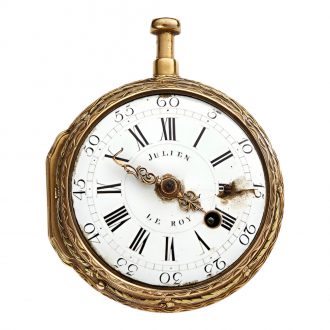
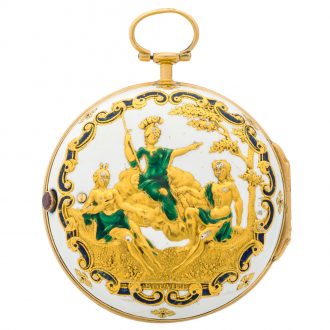
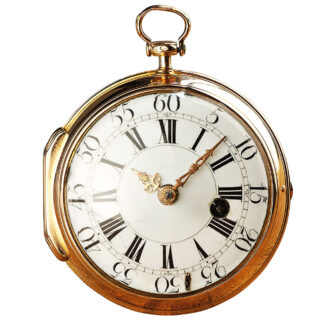
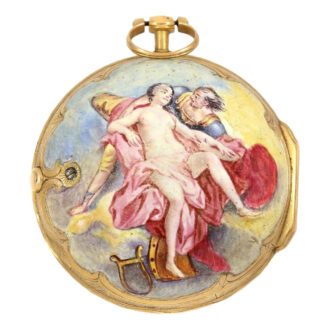
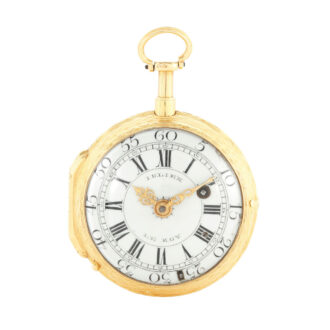
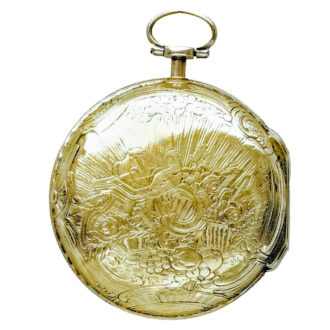
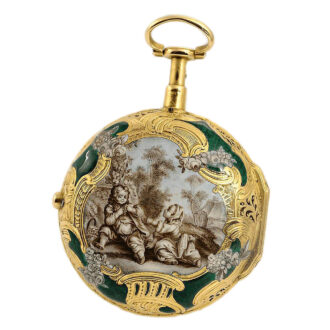
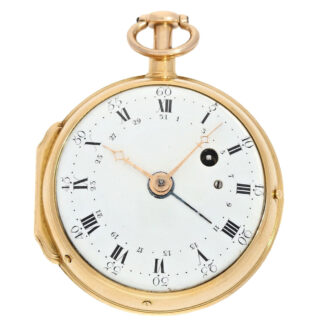
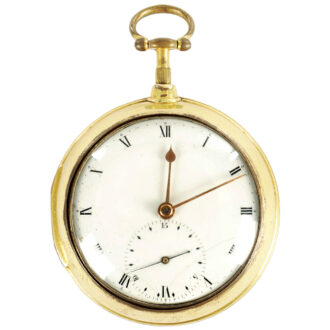
French gold quarter repeating à toc and à tact watch Circa 1740
- Kenmerk
- AD1441
- Diameter
- 45 mm
- Estimate
- € 6.000 - 10.000
- Price sold
- € 6.000
Gold and enamel repeating verge à tact watch by Julien Le Roy
–
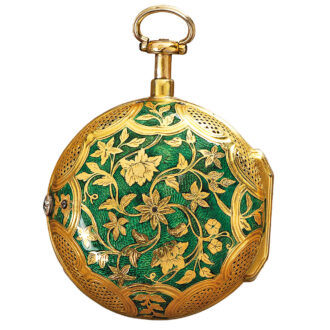
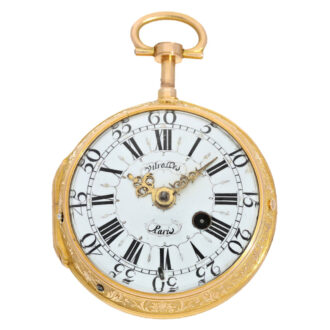
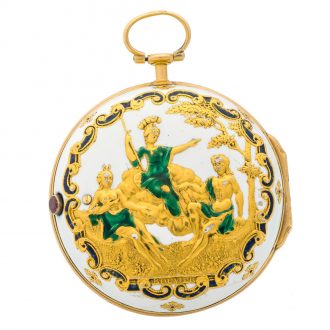
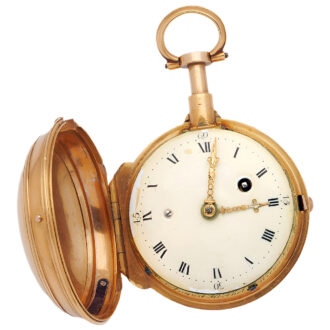
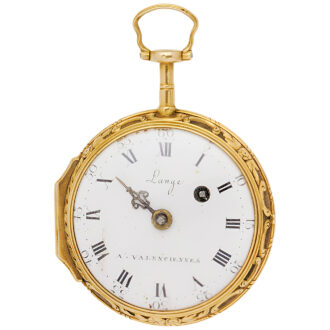
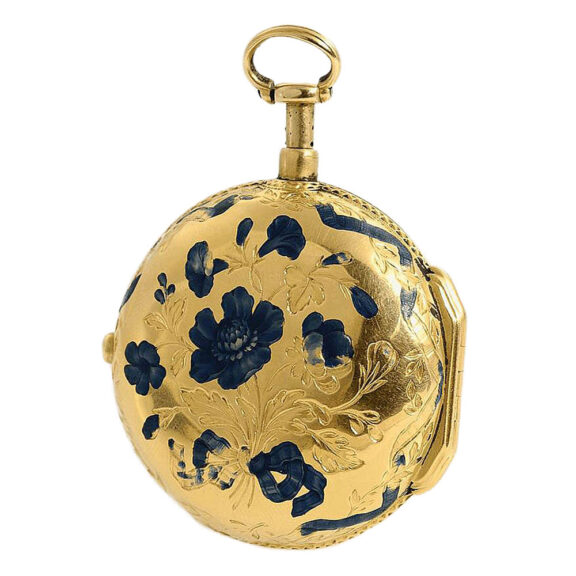
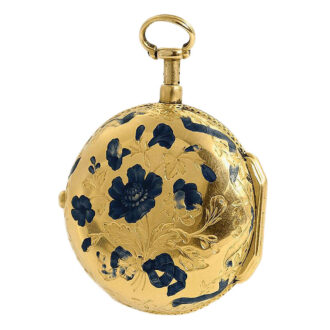
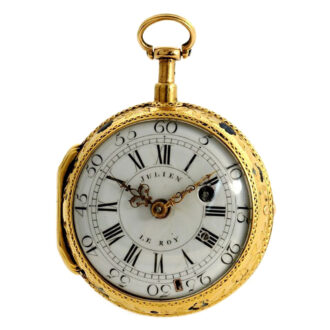
A very fine and rare French 18K gold and enamel open faced quarter repeating à toc and à tact verge pocket watch, circa 1740.
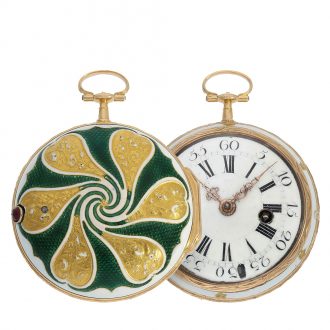
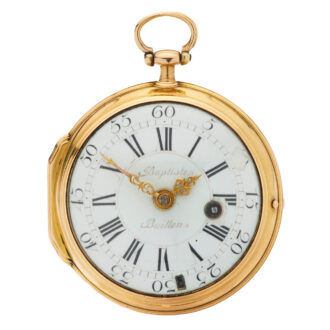
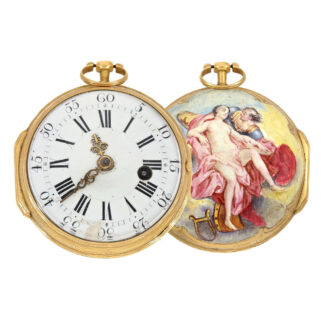
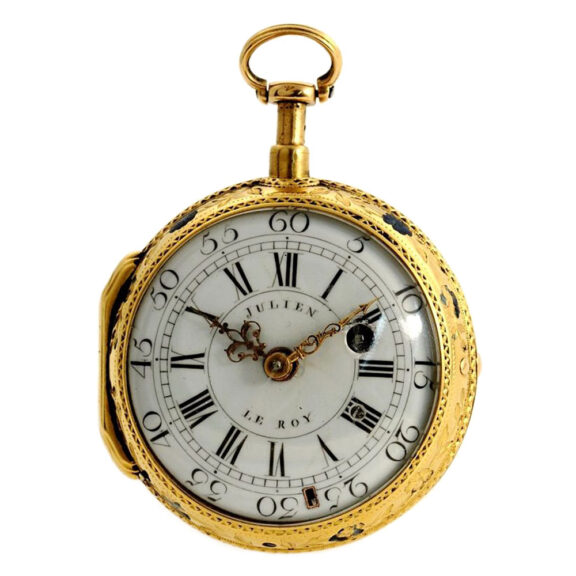
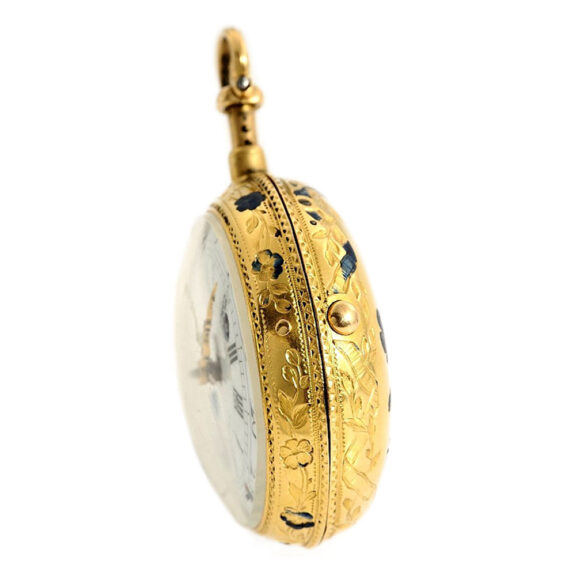
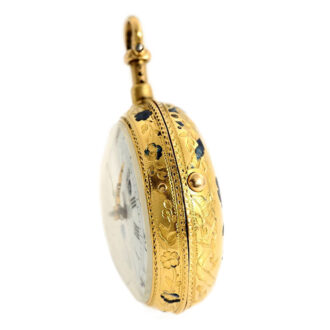
Engraved case back with a blue enamelled floral decor, the band pierced, the front bezel also pierced, engraved and decorated with blue enamel flowers, a large lateral hinge. Signed white enamel dial with Roman hours, Arabic minutes and Louis XVI hands. Signed fire gilt full plate movement, solid pillars, chain and fusee, two hammers, three-arm steel balance, engraved band pierced balance bridge.
The rim of the movement signed Inventé par Jul. Le Roy en 1740.
–
Diameter: 45 mm
–
Weight: 95 g
–
Signed: Julien Le Roy
–
Julien Le Roy is one of the clockmakers who contributed most to the progress and the reputation of French watch- and clockmaking. Born in Tours on August 6, 1686, and died in 1759 in Paris. He came to Paris in 1699. In 1713 he achieved his master’s degree and in the following years, he became a jury member of the Paris Guild of Watchmakers. Later, Le Roy became director of the Société des Arts de Genève and, in 1739, Court Watchmaker (French Horloger Ordinaire du Roi) under Louis XV, he had his private quarters in the Louvre. He improved almost all branches of clockmaking and many important inventions in the realm of time measurement are owed to him. In 1717, Julien Le Roy presented an equation clock to the Royal Academy of Sciences which showed the true time, the place of the sun and its decline. His most important discoveries concerned watch mechanisms. The adjustable ‘potence’ for the verge escape wheel considerably improved the escapement’s functioning and the steel end-piece (coqueret) which allowed oil to be retained in the balance pivots in order to diminish frictional force, was quickly adopted by other watchmakers. He was the inventor of dumb repeating watches too, in 1740, he created a new arrangement that allowed the area allotted to the repeating work to be enlarged. This invention, called ‘à bâte levée’, was also adopted by his fellow clockmakers. In 1755 he invented a small anchor escapement used as a regulator for the repeating train. He contributed to the Encyclopédie by writing several articles on clockmaking together with his son Jean-Baptiste, the Academician. Le Roy ran his workshop in the Rue de Harlay in Paris until his death. Examples of his timepieces can be found in various important museums around the world, such as the Louvre and the Victoria and Albert Museum.
–
Montre à toc. A ‘dumb’ repeater watch in which a hammer strikes the inside of the case to produce a muffled sound. Invented by Julian Le Roy in 1740.
–
Montre à tact. A type of watch made after 1795 by Abraham Louis Breguet to give time by touch. In the late eighteenth century it was considered impolite to consult one’s watch in company, a question of etiquette which the à tact watch helped to solve (the French tact, meaning touch, has given the English tact and tactful). Knobs representing the hours are positioned around the case with a large hand that could be turned until it met resistance. Its position in relation to the knobs gave the time. This kind of tactile watch is now mainly used by the blind and visually impaired.
Signed: Julien Le Roy
Share this page: