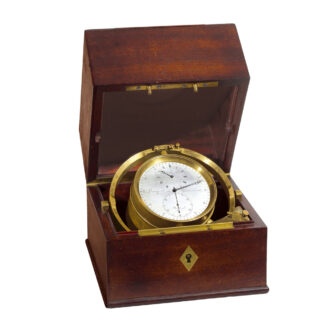
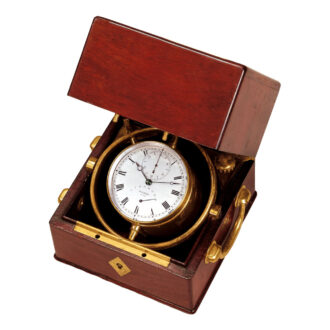
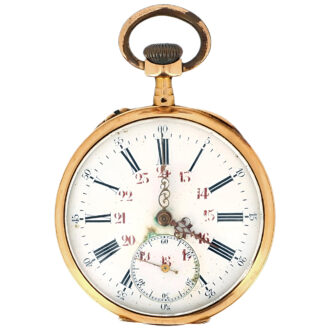
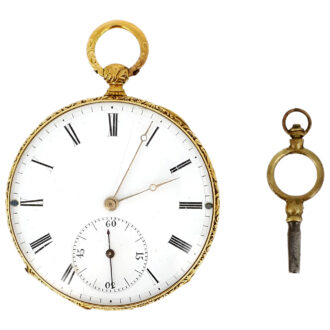
French brass watch with 36 hour power reserve Circa 1845
- Kenmerk
- HC2212
- Diameter
- -
- Estimate
- € 5.000 - 15.000
- Price sold
- € 6.200
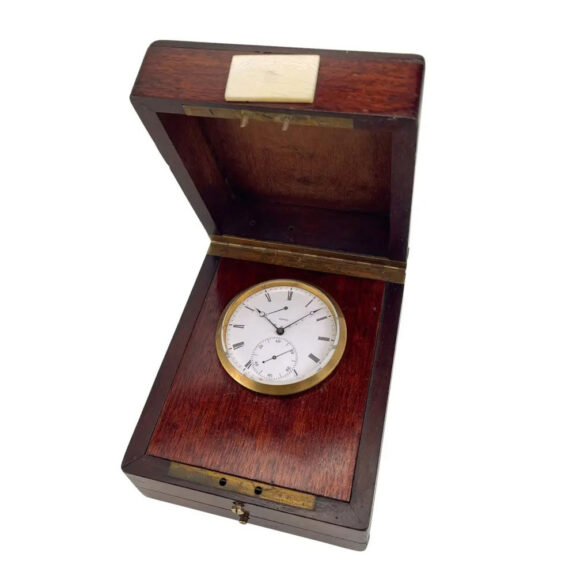
Important chronometer in mahogany box
–
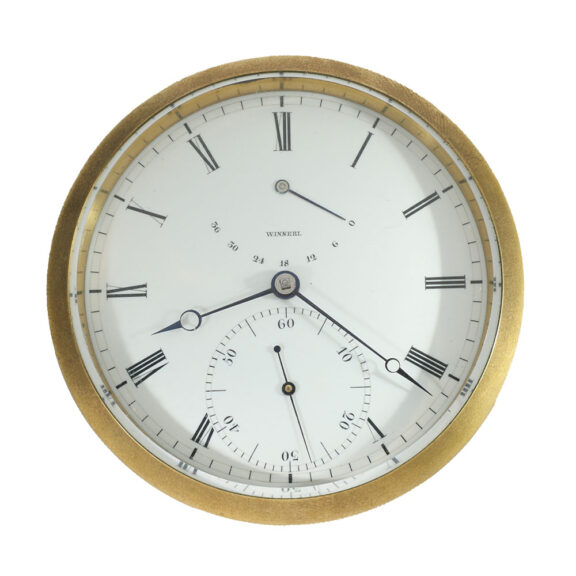
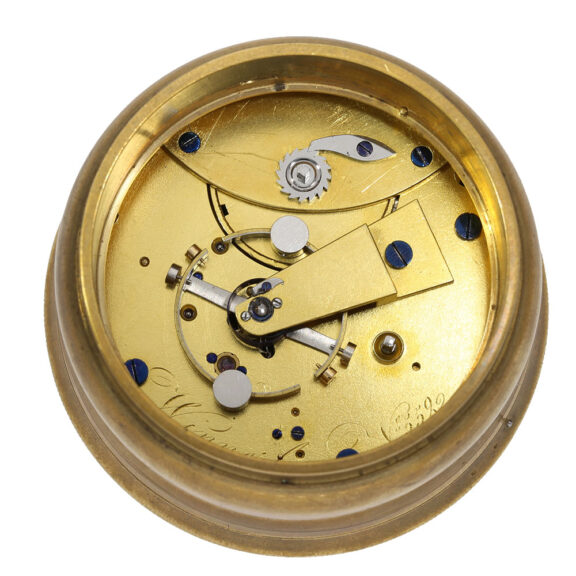
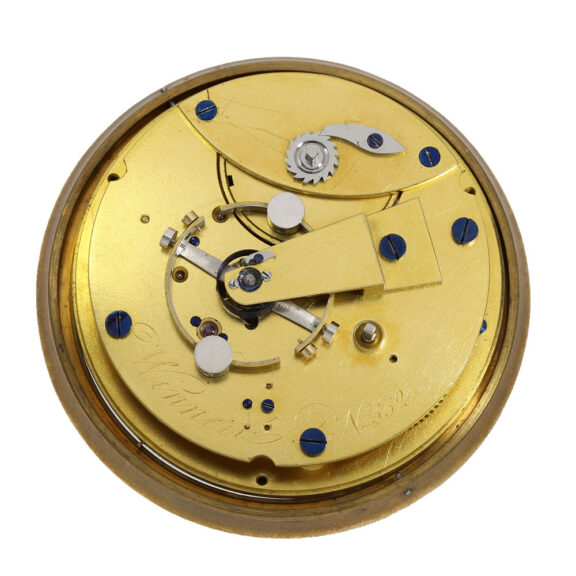
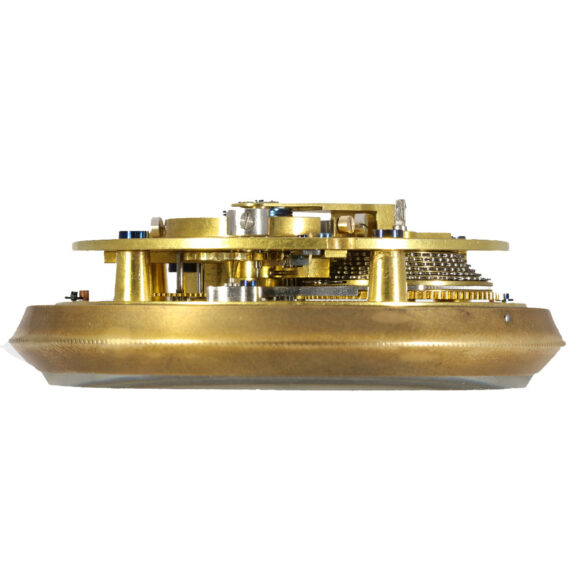
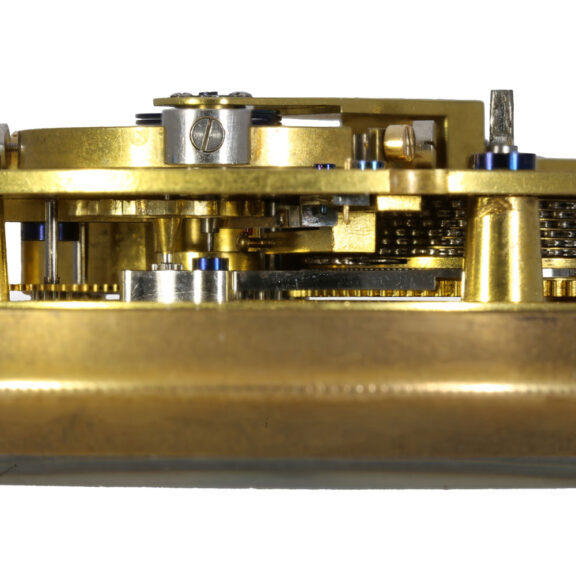
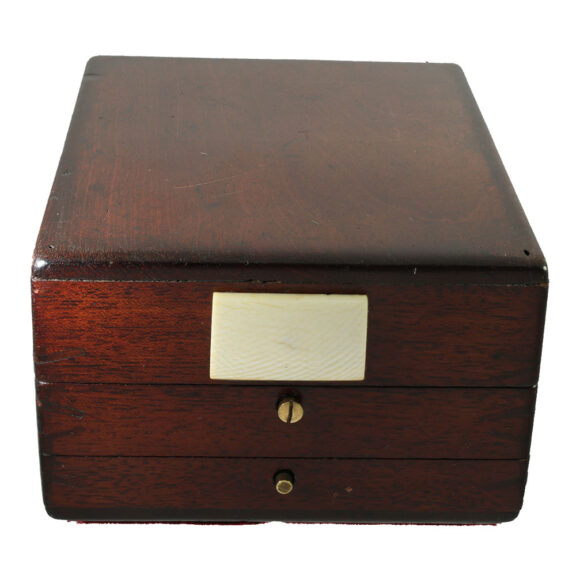
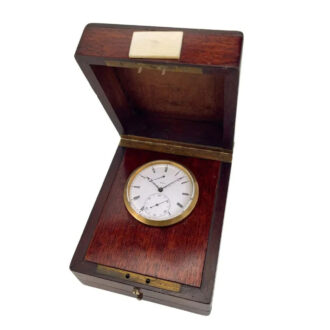
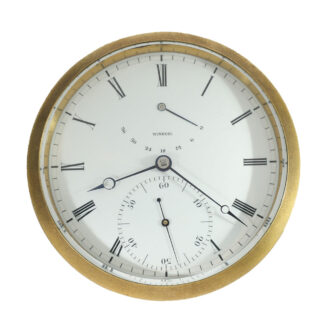
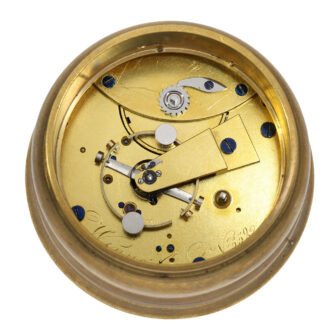
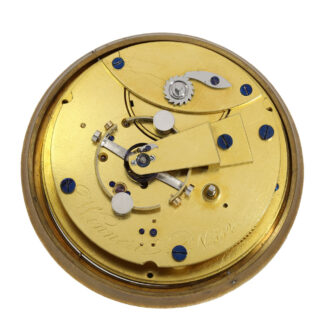
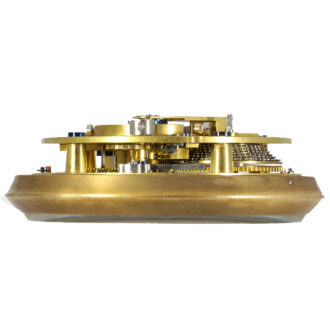
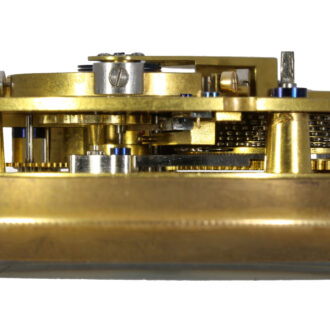
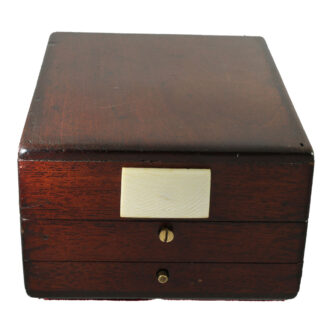
An important deck chronometer with 36 hour power reserve in mahogany box, made by Joseph Thaddeus Winnerl in Paris, France, circa 1845. This watch has a brass case which is mounted in a mahogany box and its original enamel dial features an outer minute and hour track with Roman hour numerals, a subsidiary seconds dial at 6 o’clock, a 36 hour power reserve indicator at twelve o’clock and hands made of blued steel. The numbered very fine Winnerl chronometer movement is equipped spring detent chronometer with a helical hairspring.
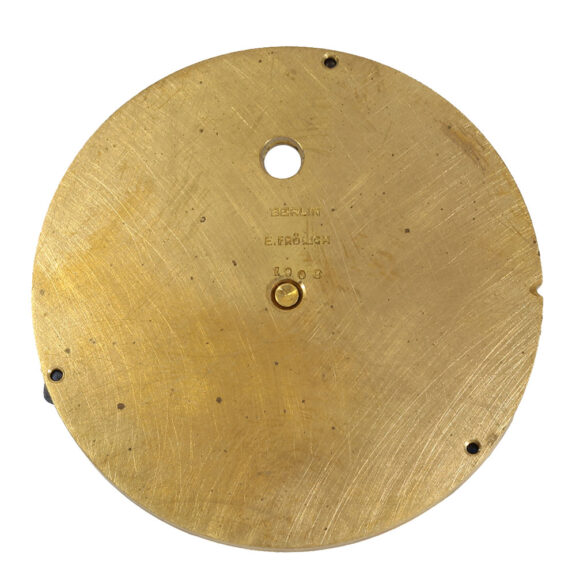
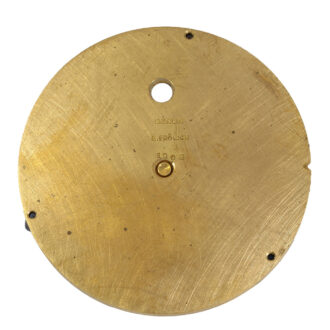
The underside of the numbered dial plate, dial and movement are signed.
–
Dimensions: 120 x 100 x 60 mm
–
Signed: Winnerl
–
The signature on the underside of the dial plate suggests that the extremely rare French chronometer presented here was restored and modernised, probably, in 1908 by E. Fröhlich in Berlin. However, the movement and dial are in their original condition.
–
Winnerl
Joseph Thaddeus Winnerl (1799-1886) was born in Mureg Styria in Austria on January 25, 1799. He completed his apprenticeship with Georg Schmidt Fidel in Graz in 1816. From 1823, Winnerl worked in Breslau, then at Kessels in Altona, at Urban Jürgensen in Copenhagen and from 1829 in Paris, where he worked for Breguet, among others.
Winnerl closed his famous Paris business and dissolved his workshop before his demise in 1886 and the physical atelier ceased to exist upon his retirement. By this time, he had achieved immense success, serving as an elected City Councilor of Paris and producing roughly 550 masterwork marine chronometers, pocket chronometers and astronomical clocks.
Shortly after closing his Paris workshop, Winnerl left the bustling city and relocated to Andrésy, a quiet, small commune northwest of Paris along the Seine. He did not stop working entirely. In 1873, the French government officially appointed him as the Expert Clockmaker to the French Navy. He maintained this prestigious, high level consulting and testing office until the day he died, continuing to present advanced scientific timing inventions to the Academy of Sciences.
He lived out his final years in Andrésy in peaceful retirement until his passing on January 25, 1886.
Today he is considered one of the most important French chronometer makers.
–
Fröhlich
Fröhlich was not a consumer pocket watchmaker around 1900, but the name is tied directly to high precision horology, chronometers and specialised parts from that exact era.
Historical records show an Emil Fröhlich operating in Berlin around 1900 – 1908, who was designated as a “Chronometermacher” (chronometer maker). Rather than making standard pocket watches for the public, he specialised in high precision scientific instruments and marine timekeeping.
- He is famous in horological history for modifying and housing movements by elite watchmakers. For example, he built later specialised brass casings and bayonet-closure bowls for prized observation chronometers originally crafted by masters like Joseph Thaddäus Winnerl.
- An antique piece bearing his name from this period is typically a high grade marine chronometer, an observation clock, or a precision scientific casing rather than a commercial pocket watch.
Signed: Winnerl (dial and movement)
Share this page: