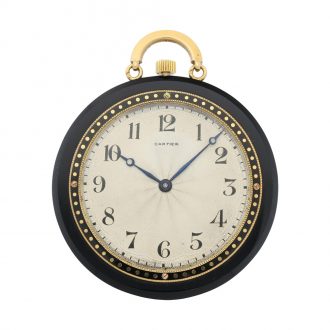
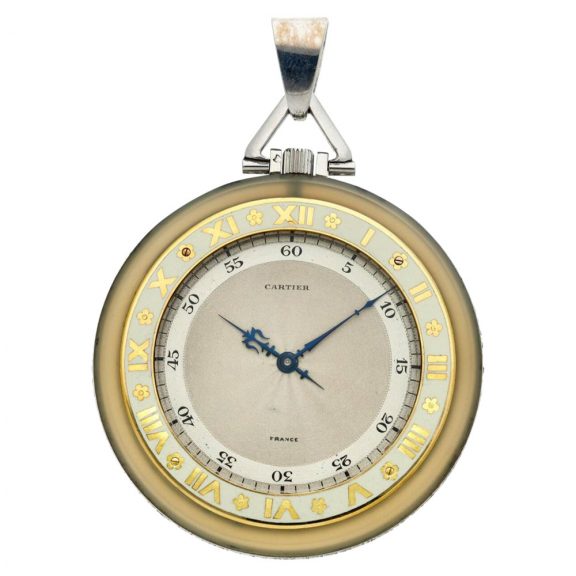
Fine French chalcedony, enamel and diamond set watch Circa 1920
- Kenmerk
- AS2253
- Diameter
- 50 mm
- Estimate
- € 3.500 - 7.000
- Price sold
- € 5.650
Open faced, keyless pocket watch by Cartier
–
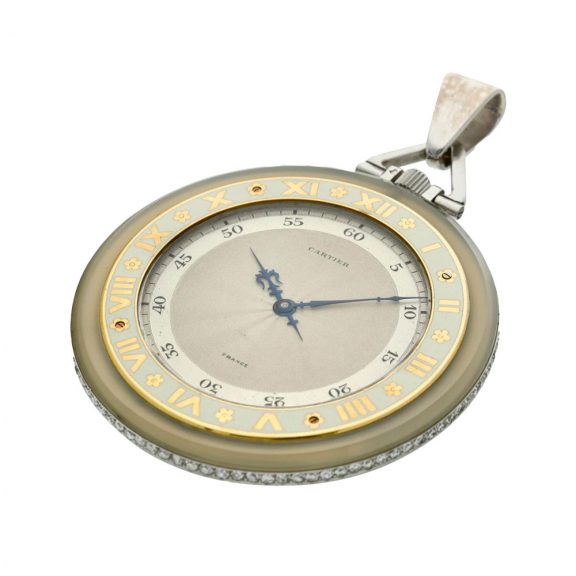
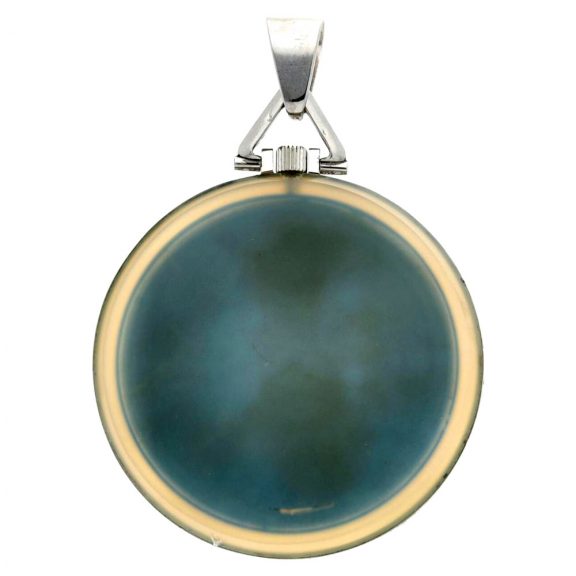
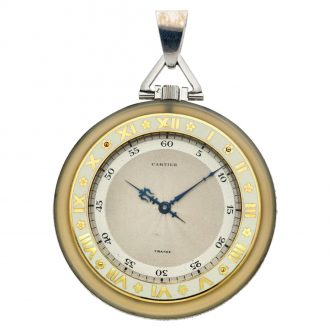
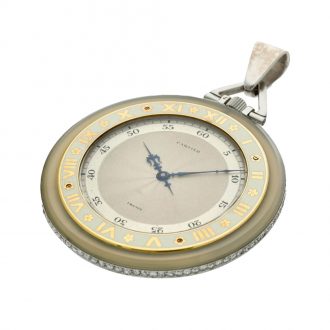
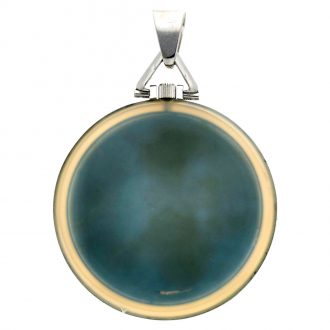
A French chalcedony, enamel, and diamond set open faced keyless watch, circa 1920. The manual winding nickel lever movement features 19 jewels. It has a silvered dial with gold applied Roman numerals on a silvered chapter ring, an inner minute track marked with Arabic five minute numerals, and elegantly blued steel hands. The case, crafted from chalcedony and enamel, has a diamond set band and a snap-on case back. Both the case and dial are signed Cartier, while the movement bears the signature of the European Watch & Clock Co.
–
Diameter: 50 mm
–
Signed: Cartier France
–
The case is in excellent condition overall. The chalcedony is striking, free from any visible nicks or cracks. The enamel chapter ring remains intact, with no visible hairlines, though surface scratches are present across the gold Roman numerals and outer track. The bow exhibits some surface wear but retains clearly visible Cartier numbers and gold marks. All diamonds are secure and intact. The dial is in excellent overall condition, and the movement is functioning properly.
–
Chalcedony is a cryptocrystalline variety of silica, consisting of fine intergrowths of quartz and moganite. Both are silica minerals, but they differ structurally: quartz has a trigonal crystal system, while moganite is monoclinic. The standard chemical composition of chalcedony, derived from quartz, is SiO2 (silicon dioxide).
–
Chalcedony is characterized by its waxy lustre and can be semitransparent or translucent. It occurs in a wide range of colours, most commonly white to grey, greyish blue, or shades of brown that vary from pale to nearly black. Commercially sold chalcedony often has its colour enhanced through dyeing or heating processes.
–
The name “chalcedony” originates from the Latin term chalcedonius (also spelt calchedonius), likely linked to the ancient town of Chalcedon in modern day Turkey. The term appears in Pliny the Elder’s Naturalis Historia as a descriptor for a translucent type of jasper. Additionally, a reference to a gem called khalkedón is found in the Book of Revelation (21:19). However, since this is a hapax legomenon—appearing only once in the Bible—it is unclear if the gem mentioned corresponds to what we now recognise as chalcedony. The term “plasma” is occasionally used to describe green translucent varieties of chalcedony.
Signed: Cartier France
Share this page: