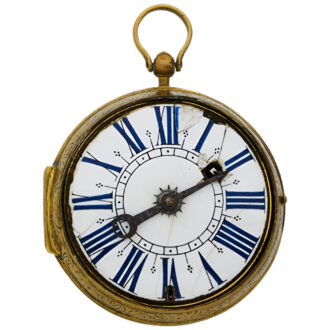
French exceptionally repeating “oignon” watch Circa 1685
- Kenmerk
- AD3166
- Diameter
- 78 mm
- Estimate
- € 35.000 - 60.000
- Price sold
- € 51.650
Open faced verge pocket watch by Nicolas Gribelin
–
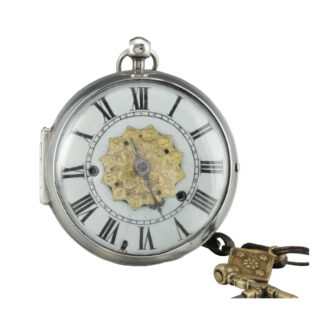
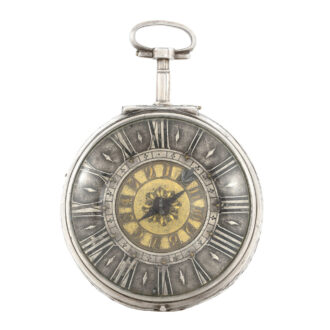
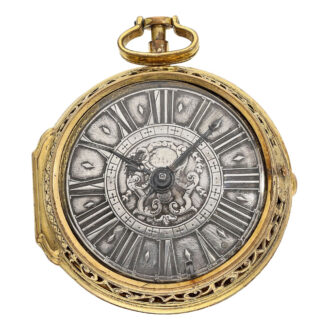
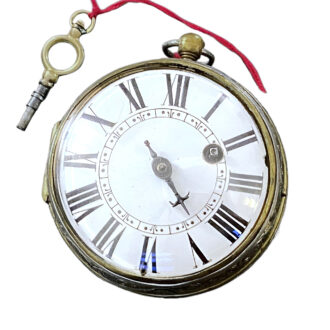
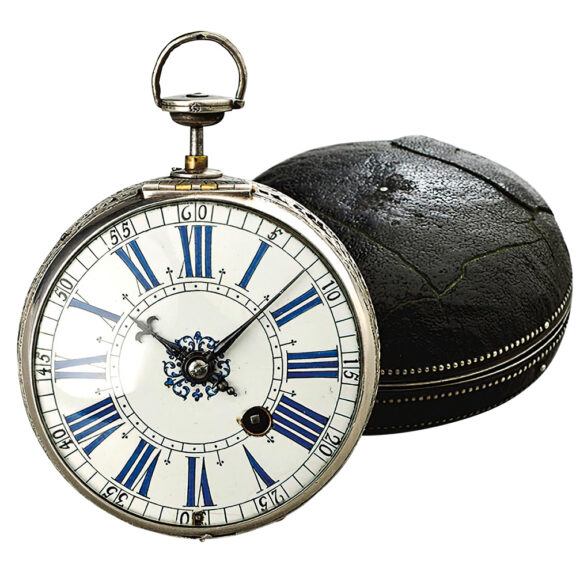
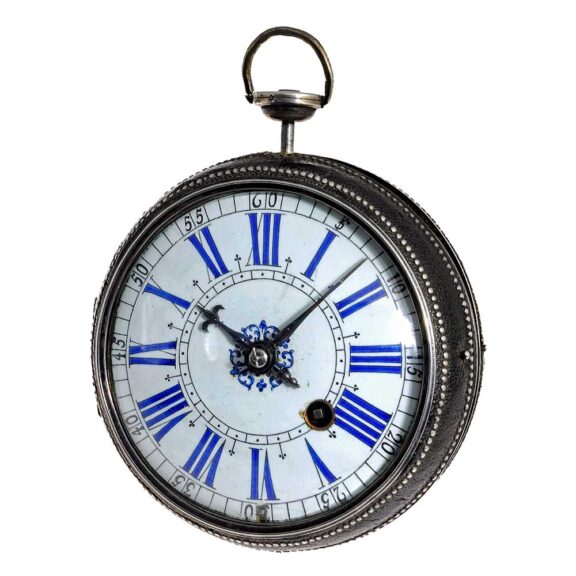
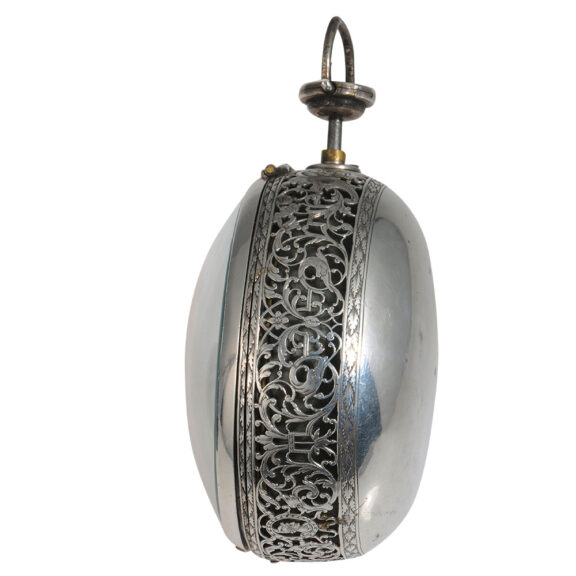
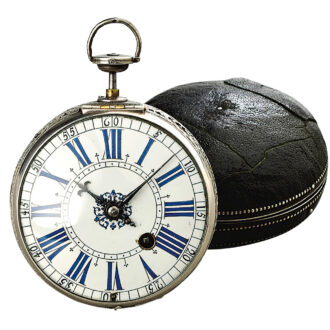
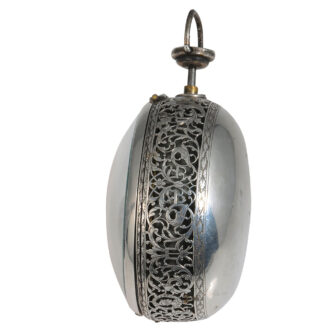
A French exceptionally rare quarter-repeating Louis XIV oignon verge pocket watch in its original leather covered transport case with applied silver stud decoration – perhaps the largest oignon in existence, circa 1685.
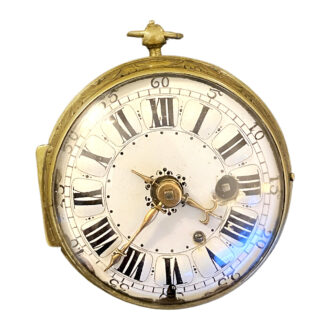
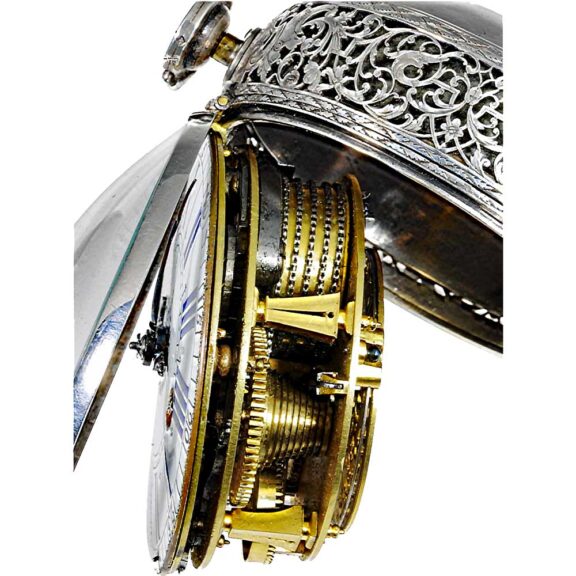
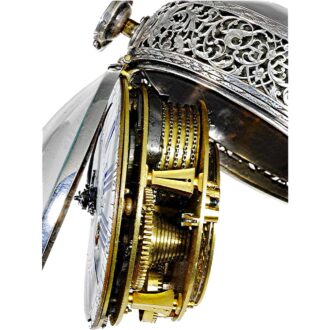
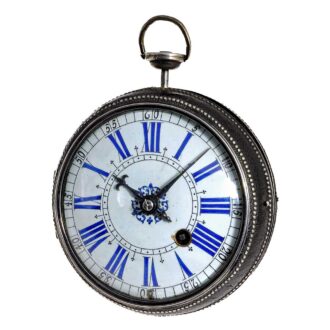
Silver case, pierced band, rear bell; white enamel dial, blued Roman hours, black Arabic minutes, decorative hands; full plate movement, chain/fusee, 1 hammer, verge escapement, ratchet wheel set up, three arm steel balance.
The silver case is open worked around the edge and ornamented with engraved scrolls, heads of birds, mascarons and two oval medallions with two male profile portraits. The back is polished and holds the bell for the repeater. The Roman hours are blue on white enamel and time is indicated with blued “Poker & Beetle” hands. The magnificent fire gilt full plate movement features Egyptian pillars and an impressively large Louis XIV style balance bridge with exquisite engraving and foliage scrolls, fantastic birds and mascarons; the ornamentation matches the motif on the outside of the case. The repeater mechanism sits in a finely engraved barrel.
–
Diameter: 78 mm
–
Weight: 585 g
–
Signed: Nicolas Gribelin à Paris
–
This unusually large “oignon” is a wonderful example of the skill and craftsmanship of Nicolas Gribelin, who is regarded as one of the best makers of the late 17th century. The engraving on the case and the balance bridge is probably based on the designs for watchmakers published by Pierre Bourdon and reproduced in E. Geli’s “L’Horlogerie Ancienne”. The engraving and the open work ornamentation on the edge of the case are particularly fine and detailed, as are the gently curved silver locking brackets – the work is more delicately executed than in watches half the size of this one.
–
Nicolas Gribelin was born in Blois in 1637 as son of clockmaker Abraham Gribelin. By the end of the XVII century he was one of the most famous French clockmakers of the time. In 1674 he was appointed Horloger de Monsieur le Dauphin, who was the son of Louis XIV; Gribelin was received at the Faubourg St. Germain as Master in 1675. Gribelin often worked together with Andre Charles Boulle for the cases of his clocks. When the Dauphin’s clocks were inventoried in 1689, four of then were by Nicholas Gribelin. Gribelin died in 1719; today many museums hold examples of his work.
Signed: Gribelin à Paris
Share this page: