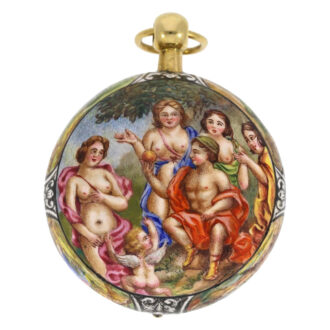
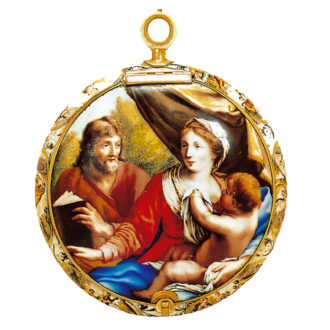
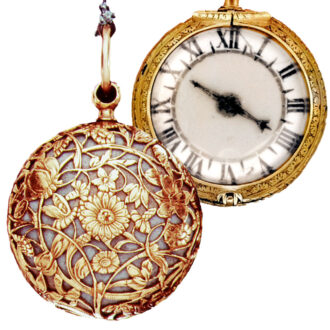
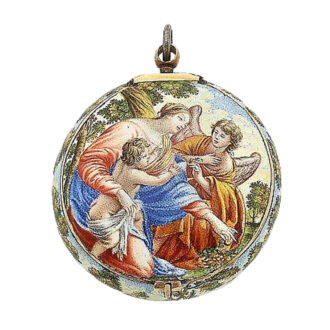
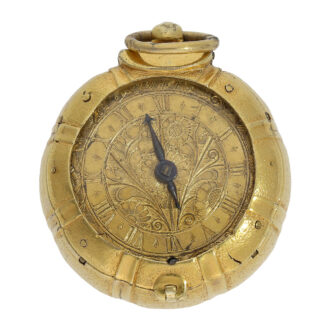
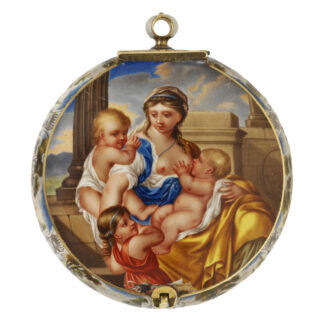
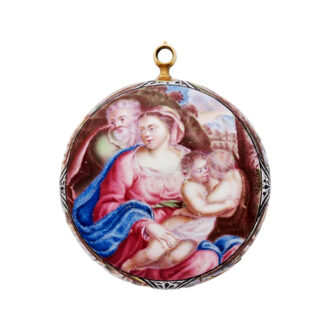
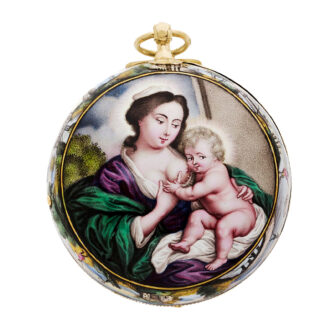
French gold and painted-on enamel verge watch Circa 1640
- Kenmerk
- AM0200
- Diameter
- 57 mm
- Estimate
- € 30.000 - 60.000
- Price sold
- -
Gold enamel pocket watch by Grégoire Gamot
–
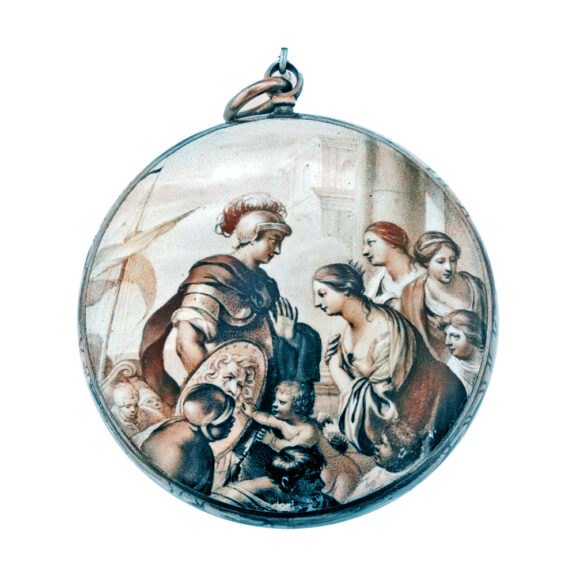
An extremely fine and equally rare French gold and enamel, single-handed pocket watch, circa 1640. This exquisite piece boasts a gold case adorned with finely painted enamel scenes, both on the exterior and interior. The deeply curved band adds a touch of elegance to the overall design. The enamel dial features a chapter ring with Roman radial hours and half-hour dots and a beautifully painted-on enamel scene at the centre. The gilt-brass full plate movement and verge escapement are testaments to the exceptional craftsmanship of the maker, as evidenced by the signature on the movement: G. Gamot à Paris.
–
Diameter: 57 mm
–
Signed: G. Gamot à Paris
–
Grégoire Gamot was a well-known master watchmaker from 1628 to 1673 in Paris.
He was probably born around 1605 and married 1628 Marie Marques (Margue-Marge-Maricque-Marques), daughter of the watchmaker Etienne Marques. From this marriage, at least four children were born. On October 8, 1628, the son Daniël was baptized, godmother was Marie Rodez, wife of the clockmaker Daniel Dugué. On July 13, 1632, at the baptism of Grégoire’s son, Etienne Marques was the godfather. On June 14, 1633, the son Jacques was baptized. On May 25, 1640, “Madame Gamot Horlogère” (watchmaker) died. Marie Gamot-Marques was also a watchmaker due to her father’s and husband’s professions. Daughter Marie married the watchmaker Claude Arthus on November 24, 1652; witnesses are Grégoire and Jeann Gonthier, Grégoire’s new wife.
–
Grégoire married Jeanne Gontier about a year after Marie Gamot-Marques died. At least four children were born from this marriage. On June 9, 1642, the son Maximilian was baptized. On November 2, 1645, the baptism of the son Gilles followed . Then there are Antoine, Louis and Françoise, whose baptism date is unknown. Grégoire was with Jeanne and both watchmakers Gilles Gamot and Louis Gamot on July 27, 1670, at the wedding of master goldsmith Pierre II le Bastier (v.1641-?), with daughter Françoise Gamot. Antoine Gamota’s will is known and dated April 15, 1673; he was married twice.
–
Grégoire worked from 1628 to 1673 in several places in the city; he was based at Rue de la Calandre, Parish of Saint-Germain le Vieil (1634). Afterwards, in the Rue de la Barillerie, Parish of Saint-Barthélemy (1638). This street is perpendicular to Rue de la Calandre. It crosses the island from Pont au Change (Quai de l’Horloge) to Pont Saint-Michel (Quai des Orfèvres). It is the heart of Paris, the district of master watchmakers, goldsmiths, metalworkers, etc. On February 20, 1646he signed, together with five other colleagues representing the community of masters, the new statutes of the Watchmakers’ Association of the City of Paris and asked Louis XIV to confirm and renew the privileges, distinctions and commissions of this art and craft. The colleagues are Pierre Belon, David Margotin, Nicolas Bernard, Claude Raillard and Guillaume Beauvais. Grégoire Gamot was Nicolas Bourret ‘s tutor for 6 years from September 1, 1634 the son of Nicolas Bourret, assistant to the Presidency of Mantes, for £180.
–
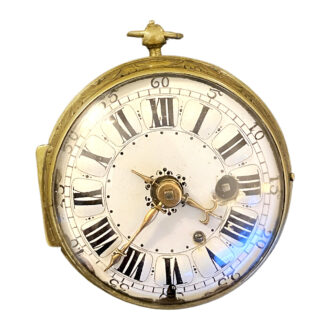
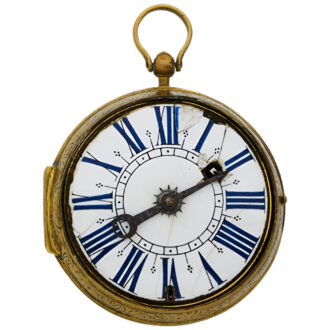
Only a few watches by Grégoire have survived, but there are some very fine enamelled watch cases by the Parisian enamel painters Henri Toutin (1614-ap.1683) and Jean (II) Toutin (1619-ap.1660), among others. Most clocks can be found in museums such as the Historisches Museum Basel, The Walters Art Museum, the Metropolitan Museum of Art, Musée du Louvre (Département des Objets d’art). A few others appeared at public auctions.
–
According to the death certificate, Grégoire Gamot died on August 7, 1673; Gilles Gamot and Louis Gamot were involved in the funeral.
Signed: G. Gamot à Paris
Share this page: