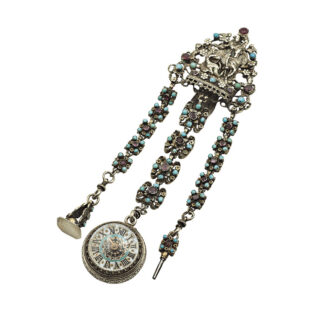
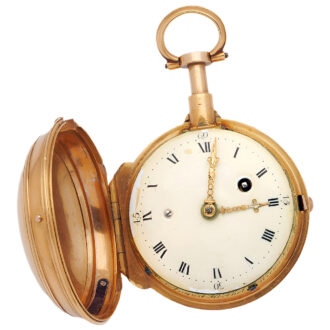
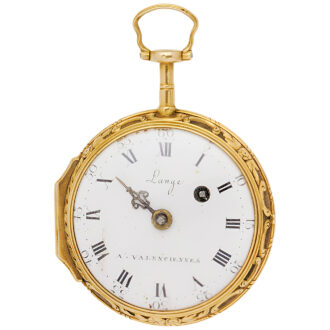
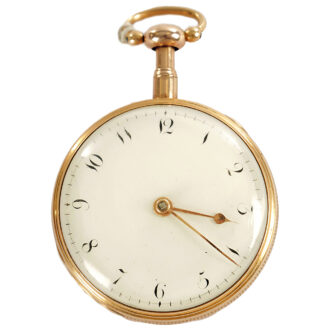
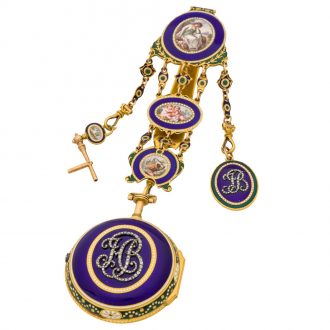
Austrian silver gilt, rock crystal watch with chatelaine Circa 1780
- Kenmerk
- FF0005
- Diameter
- 40 mm
- Estimate
- € 2.000 - 4.000
- Price sold
- € 2.400
Renaissance style silver gilt and rock crystal watch
–
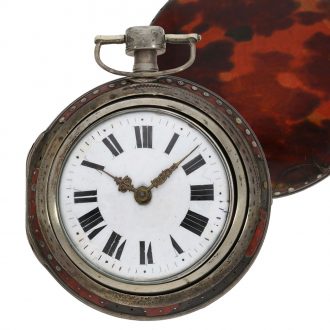
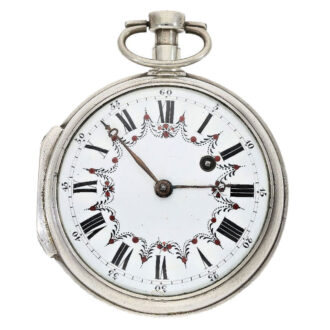
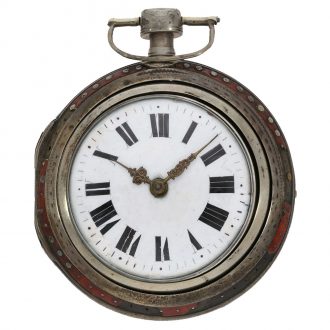
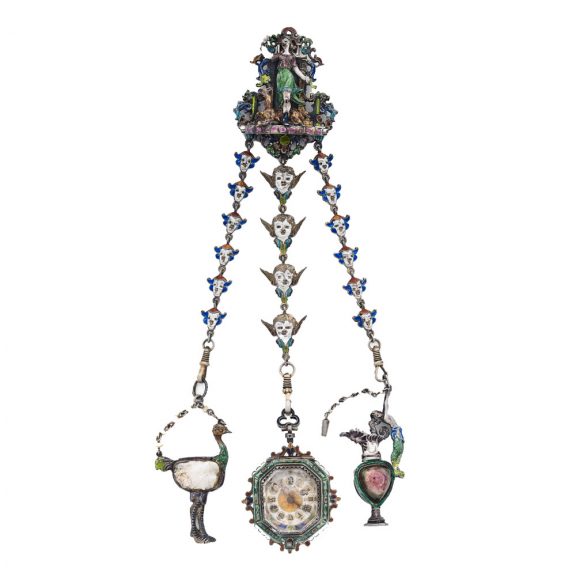
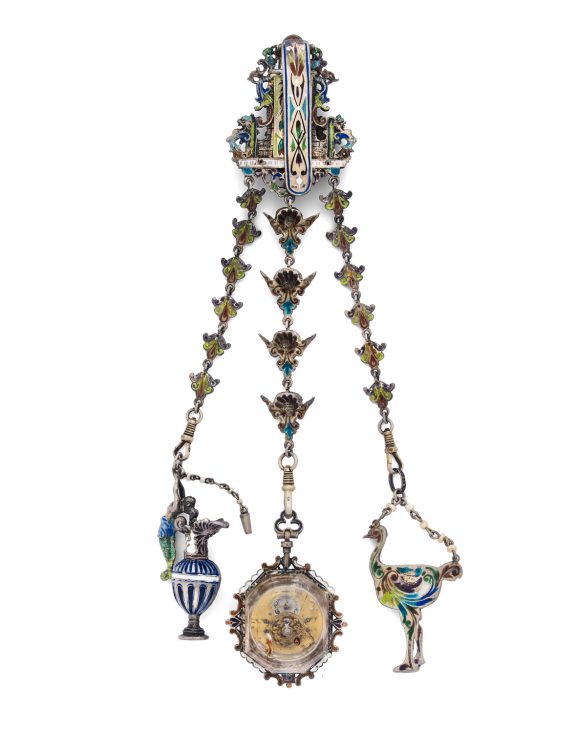
An Austrian Renaissance style silver gilt and rock crystal open faced watch with a silver gilt, enamel, pearl set and hardstone chatelaine, circa 1780. Full plate gilt movement with key winding and verge escapement, chased and pierced balance cock, older Viennese work from the late 18th century, likely inserted into this case at the original owner’s request.
Champlevé enamel dial with Roman numerals in stylized pastilles, stylized hands, and an opening for the winding square. Octagonal rock crystal and silver gilt case with stylized decoration around the rim featuring polychrome champlevé enamel, signed with the master’s marks on the bail.
–
Chatelaine mounted with a fully modelled enamelled figure representing Diana the Huntress straddling a doe, all in Neo-Renaissance decor. The hook has champlevé enamel above two chains with Cupid’s heads suspending two pendants: one shaped like an ostrich with chains decorated with baroque pearls, and the other shaped like an ewer as a perfume bottle. Both are decorated with hardstones on the back, and the ostrich is stamped with the master’s mark.
–
Diameter 40 mm
–
Chatelaine: 22 cm
–
Weight: 156 g
–
Signed: Hermann Böhm
–
Hermann Böhm (1866 – 1922)
Hermann Böhm (or Boehm) was a skilled goldsmith and enameller working in Vienna in the late 19th century. He is widely regarded as one of the greatest enamellers in Europe at the time, and his work contributed greatly to the reputation that Viennese enamel enjoys today.
Böhm worked primarily in the neo-Renaissance, or Renaissance Revival, style, and was inspired by the Limoges enamellers of the Middle Ages and early Renaissance. He received a prize at the Vienna Exhibition of 1873.
The neo-Renaissance style in Vienna was a significant artistic and architectural period in the 19th century, in which Viennese architects drew on the forms and motifs of the Italian Renaissance to infuse their buildings with a classical grandeur.
The style was part of a broader movement in Europe in which many cities, driven by urban reform and industrialization, turned to historical aesthetics, particularly the Renaissance and Baroque, to assert their modernity and prestige.
Signed: Hermann Böhm
Share this page: