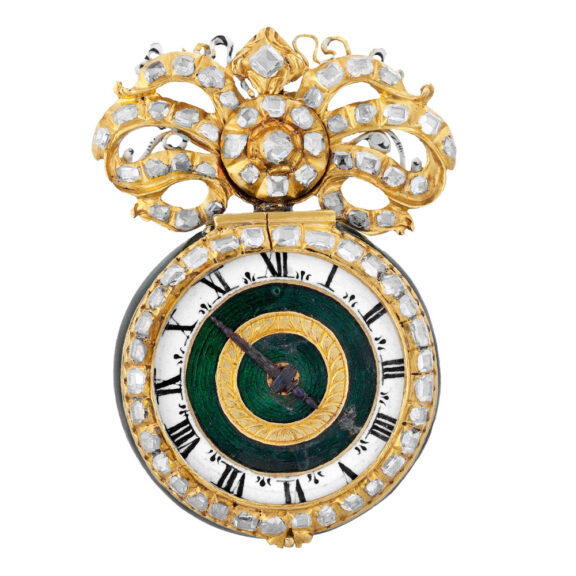
Swiss gold, enamel and diamond set ladies’ watch Circa 1640
- Kenmerk
- TA2398
- Diameter
- 33 mm
- Estimate
- € 30.000 - 60.000
- Price sold
- € 36.600
Gold decorative single handed pocket watch
–
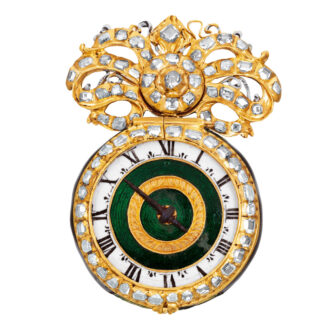
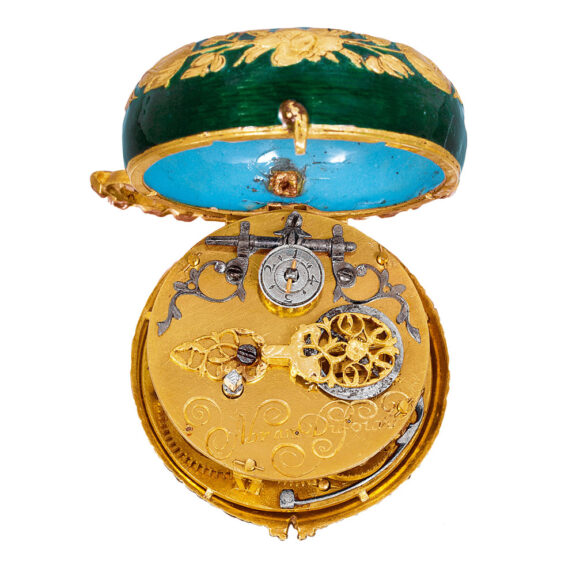
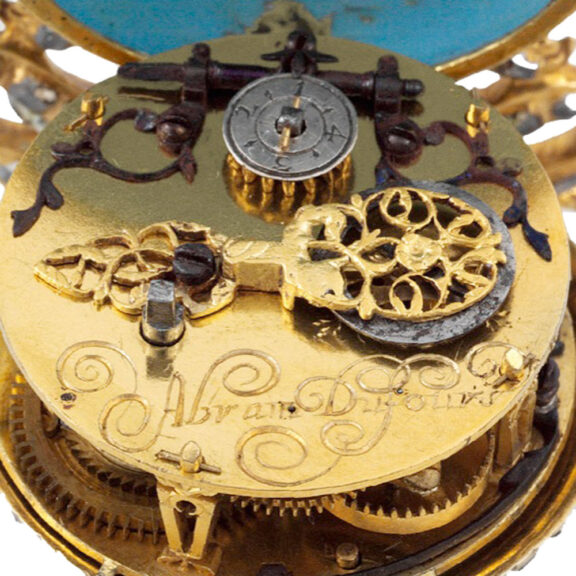
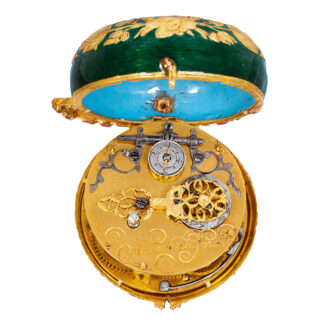
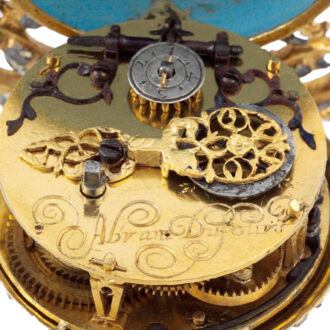
An exceptionally fine and equally rare Swiss 20 carat gold, enamel and diamond set one handed pre balance spring ladies’ pendant watch made by Abram Dufours in Geneva, circa 1640. Gilt brass full plate movement fitted with an early type divided Egyptian pillars, fusee with a gut line, a short four wheel train, steel two arm balance without spring, small foliate pierced cock secured by a screw, worm and wheel regulator with blued steel foliate brackets and silver regulation dial.
–
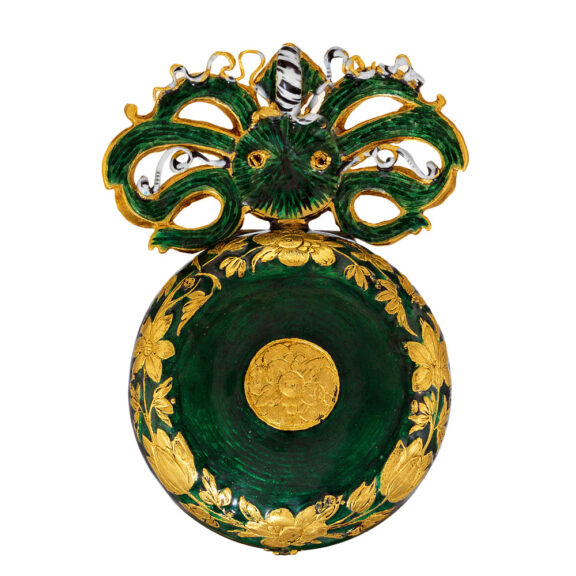
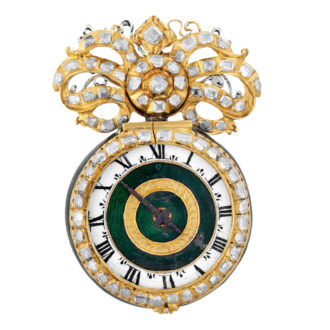
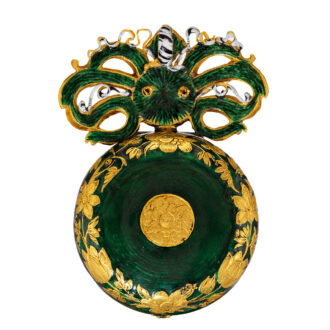
The case features a curved band, deep green basse taille enamel on the reverse with an outer border of chased and engraved gold flowers and leaves in relief, a central chased and engraved floral rosette, and light blue enamel on the inside back. A cut hinged bezel on the front set with 32 irregular cut diamonds in rub over settings and a ribbon form pendant set with 42 irregular cut diamonds in rub over settings, the reverse enamelled to match the case, with a black and white loop, and additional small ronde bosse enamel ribbons. Gold dial, a white enamel annular chapter ring with Roman hour numerals and alternating half hour markers, the center with concentric basse taille enamel rings matching the case, intersected by a chased and engraved gold ring with stiff leaf decoration, and a single steel hand.
–
The movement is signed.
–
Diameter: 33 mm
–
Signed: Abram Dufours
–
This exceptionally rare and beautiful watch is the only known early example of a piece with an integrated diamond set jewel made in Geneva.
–
The ribbon cresting is a classic design from the 17th century that can be found in surviving jewellery in museum collections throughout the world. An almost exactly similar emerald set pendant with ribbons and the central rosette is in the collection of the Victoria & Albert Museum in London.
–
A noticeable feature of dials made in the 17th century is that numerals on dials made in the first half of the 17th century were smaller, as time progressed, the numerals increased in size. This combined with the type of movement and the shape of the case means that the present watch can be dated to circa 1640.
–
Geneva has, since the earliest times been not only a watchmaking center but famous for enamelling. Designs for jewelled and enamelled pieces would have been inspired by the fashions of the European courts.
–
Abram (or Abraham) Dufours apprenticed to Antoine Arlaud in 1629 and became master horloger by 1636. He worked with Jean Dunant in 1649, and Jonas Robert and Bernard Dominice in 1652.
–
Basse taille is an enamelling technique in which the artist creates a low relief pattern in metal, usually silver or gold, by engraving or chasing. The entire pattern is created in such a way that its highest point is lower than the surrounding metal. A translucent enamel is then applied to the metal, allowing light to reflect from the relief and creating an artistic effect. It was used in the late Middle Ages, and then again in the 17th century.
–
Ronde bosse, en ronde bosse (in the round) or encrusted enamel is an enamelling technique developed in France in the late 14th century that produces small three dimensional figures, or reliefs, largely or entirely covered in enamel. The new method involved the partial concealment of the underlying gold, or sometimes silver, from which the figure was formed. It differs from older techniques which all produced only enamel on a flat or curved surface, and mostly, like champlevé, normally used non precious metals, such as copper, which were gilded to look like gold. In the technique of enamel en ronde bosse, small figures are created in gold or silver and their surfaces are lightly roughened to provide a key for the enamel, which is applied as a paste and fired. In some places, the framework may only be wire.
Signed: Abram Dufours
Share this page: