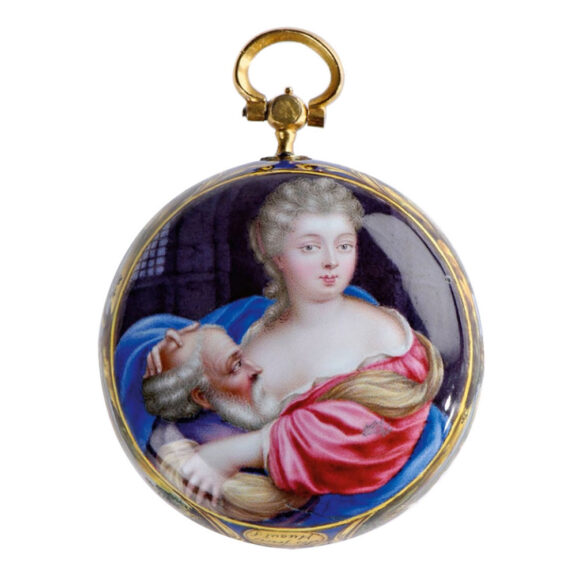
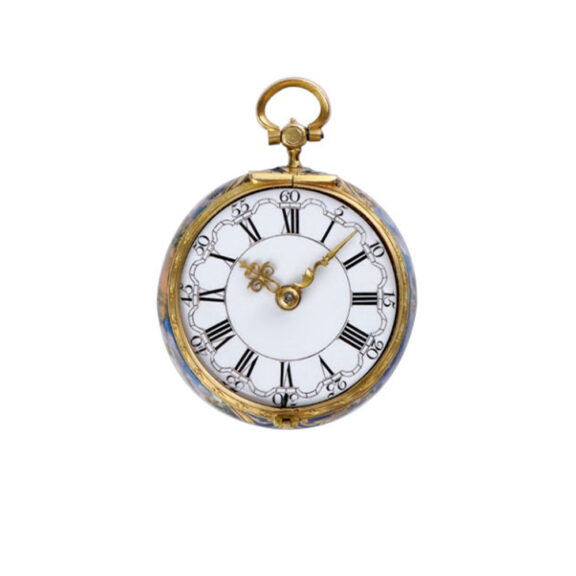
Important French gold and enamel verge pocket watch Circa 1700
- Kenmerk
- PD0044
- Diameter
- 46 mm
- Estimate
- € 12.000 - 22.500
- Price sold
- €
Gold and enamel pair-cased watch
–
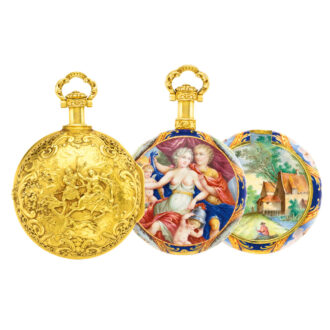
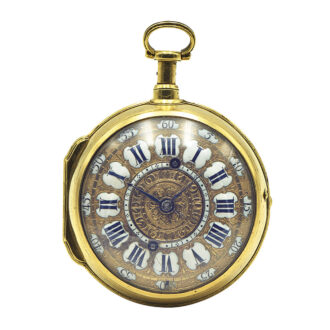
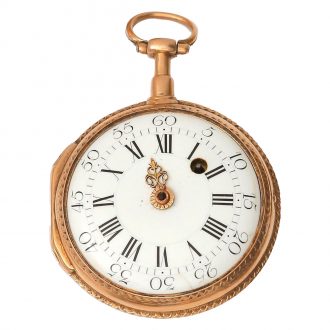
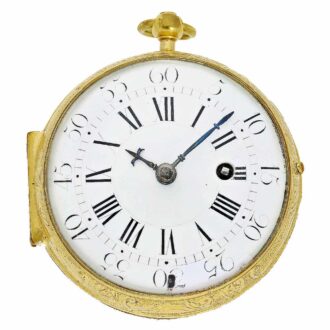
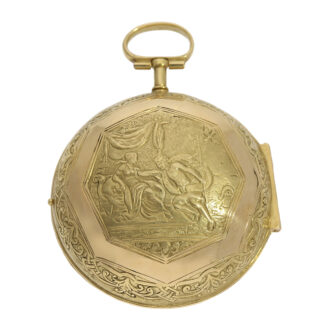
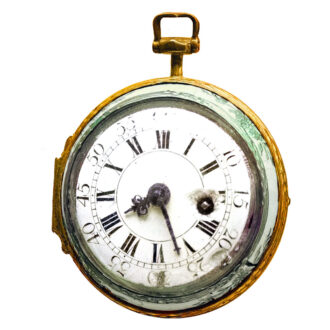
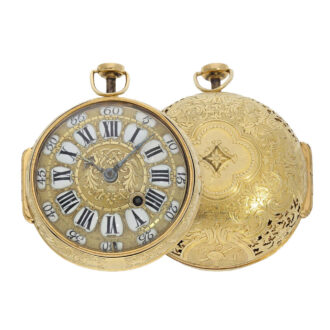
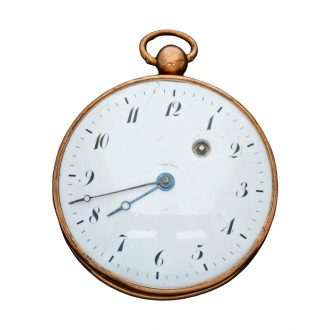
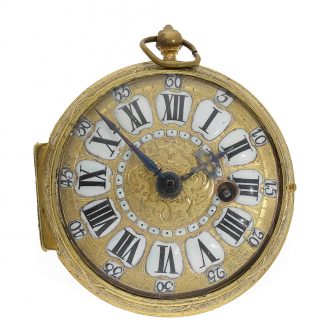
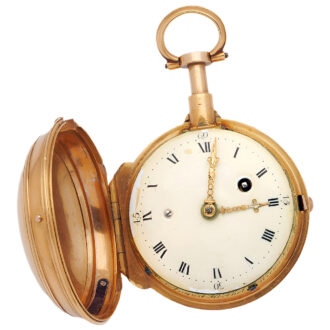
An important French gold and enamel pair cased verge pocket watch, circa 1700. A gold outer case, the band chased with a floral and foliate pattern, glazed back, large lateral hinge, the inner case gold and enamel, the back with a polychrome enamel scene after the painting Roman Charity or Cimon and Pero by Peter Paul Rubens, the band with landscape vignettes separated by acanthus scrolls, a cartouche with the signature Les Frères Huaut f(ecit), the interior with a classical landscape and figures, lavishly engraved bezel. White enamel with radial Roman hours and Arabic five-minute numerals, Louis XV gold hands. Fire gilt full plate movement, key-winding, polished screws, chain and fusee, turned pillars, three arm brass balance, blued balance spring, very finely engraved pierced balance cock, ratchet wheel with filigree polished steel click, silver regulator disc. Movement signed.
–
Diameter: 46 mm
–
Weight: 95 g
–
Signed: Le Frères Huaut f(ecit)
–
Roman Charity refers to the ancient story of a Roman woman who secretly breastfed her father who was sentenced to die of starvation in prison. It is an oil on canvas painting by Peter Paul Rubens executed around 1612, now in the Hermitage Museum in Saint Petersburg. Rubens also returned to the subject in the painting Cimon and Pero executed in 1630, now in the Rijksmuseum in Amsterdam.
–
Peter Paul Rubens was born in Siegen on June 28, 1577, and he died in Antwerp on May 30, 1640. He was a Flemish baroque painter, draughtsman, tapestry designer and diplomat, who worked in Antwerp. He was also called Pieter Paul, Pieter Pauwel or Petrus Paulus.
–
Les Frères Huaut (or Huaud). The cases painted on enamel by ‘Les deux Frères Huaut’ were among the finest examples of their kind from the Geneva School and were not only highly valued when originally made, but remained as art treasures in the centuries that followed. Pierre I was the founder of the Huaud dynasty. He was born in 1612 in Geneva as the son of a French goldsmith Jean Huaud. He settled in Geneva in 1630 and three of his 11 children became famous enamellists like their father: Pierre II (1647-1698), Jean-Pierre (1655-1723) and Ami (1657-1724). The brothers were most likely trained by their father and worked with him. Pierre II started his own business around 1680. Jean-Pierre and Ami became partners in 1682 and were appointed painters to the Prussian court in 1686 when they moved to Berlin and started working for Elector Frederick William of Brandenburg (1620-1688). Among their most well-known works are Diana and Actaeon, The Judgement of Paris, The Holy Family, St. John the Baptist, The Nativity and The Adoration of the Shepherds.
Signed: Le Frères Huaut f(ecit)
Share this page: