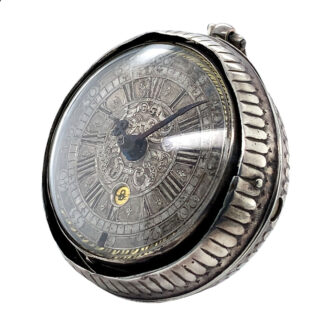
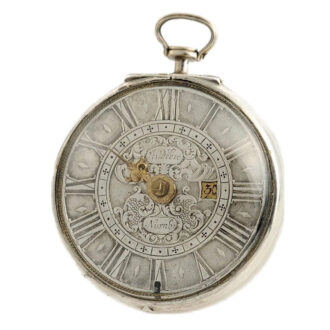
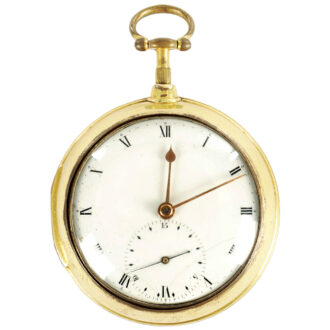
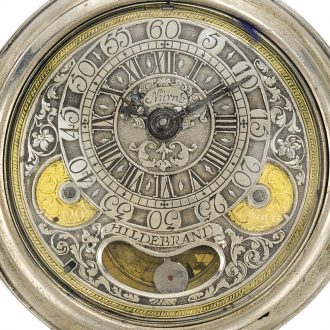
German pair cased verge watch with mock pendulum Circa 1705
- Kenmerk
- AS1632
- Diameter
- 56 mm
- Estimate
- € 4.000 - 7.500
- Price sold
- € 4.100
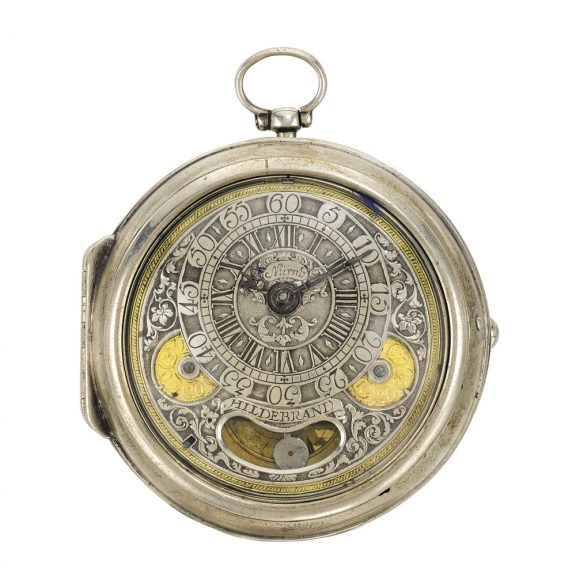
Silver verge with enamel portrait by Johann Christian Hildebrand(t)
–
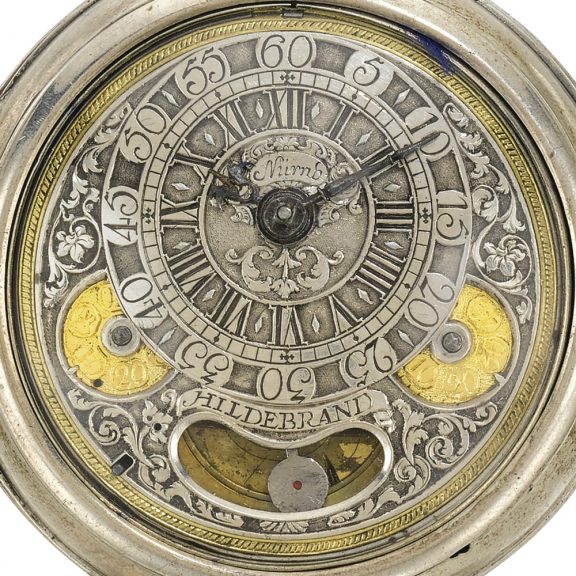
A German silver pair cased verge watch with a mock pendulum and a hidden enamel portrait of a lady, circa 1705. This watch features a gilded full plate movement with a backplate adorned with a polychrome enamel painted portrait of a lady wearing blue ribbons in her hair, all surrounded by a decoratively engraved border. It also includes a verge escapement, fusee and chain, scroll top Egyptian pillars and is signed by Hildebrand. The silver champlevé dial has Roman numerals, an outer Arabic minute ring, blued steel beetle and poker hands, a central banner engraved with Nürnb and surrounded by scrolls, and a glazed aperture to reveal the mock pendulum with a banner above signed Hildebrand. Additionally, it has gilded subsidiary dials/squares marked for regulation. It has two cases: a silver inner case with a split bezel for glass retention, the back featuring a winding aperture, a stirrup pendant, and bow, and a case maker’s mark IP beneath a crown. Additionally, there is a plain silver outer case.
–
The dial is elegantly designed with an off-set chapter ring, below which an aperture exposes the balance, with an arm affixed with a disc to imitate the movement of a pendulum. The positioning of the balance on the movement’s top plate allows for the addition of the enamel portrait plaque to the backplate.
–
Diameter: 56 mm
–
Signed: Hildebrand, Nürnb
–
The woman depicted in the portrait, with ribbons in her hair, is speculated to be the Duchesse de Fontanges (1660-1681), the mistress of Louis XIV. Legend has it that the Duchesse, renowned for her beauty, tied a ribbon in her hair after losing her hat while riding, leading to the trend of court ladies wearing their hair up and tied with a fontange.
–
German watchmaker Johann Christian Hildebrandt was a small watchmaker in Nuremberg who obtained the master’s title in 1705.
–
Slight scuffs and scratches are visible on the dial. The inner and outer cases both exhibit small indentations, especially around the band. The movement is running. The enamel portrait has been restored, and there are signs of chipping around the winding aperture.
Signed: Hildebrand, Nürnb
Share this page: