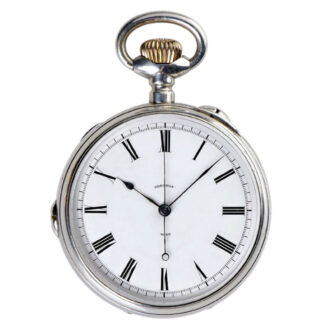
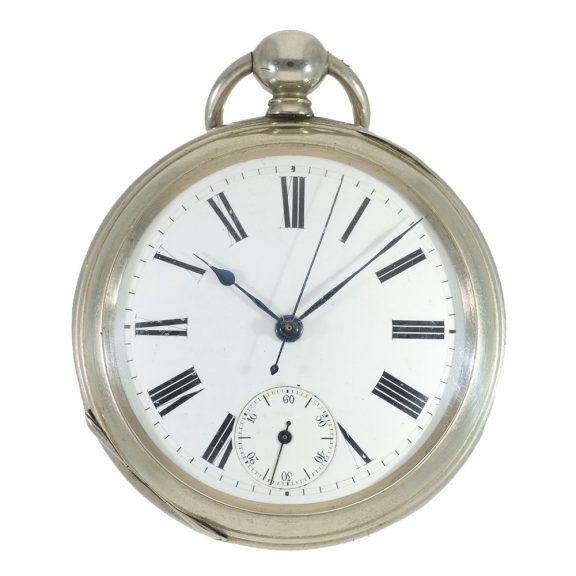
German silver dead beat seconds lever watch Circa 1870
- Kenmerk
- HC2045
- Diameter
- 57 mm
- Estimate
- € 1.750 - 3.500
- Price sold
- € 1.850
An early and unusual “seconde morte” watch
–
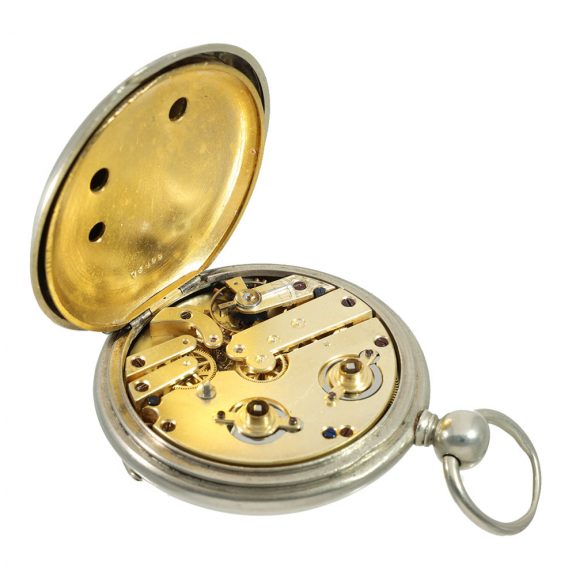
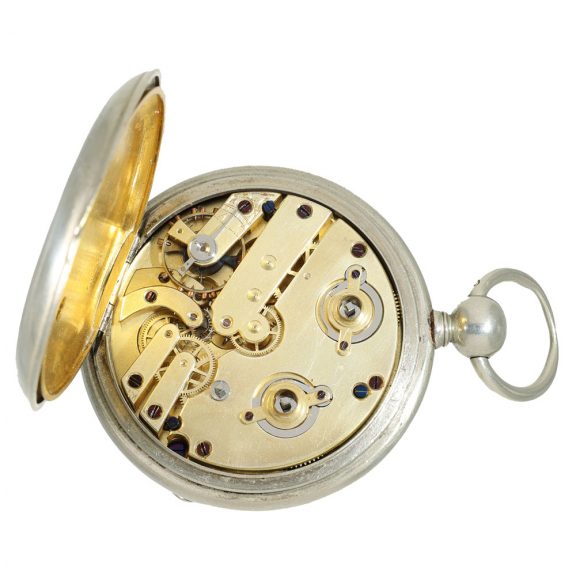
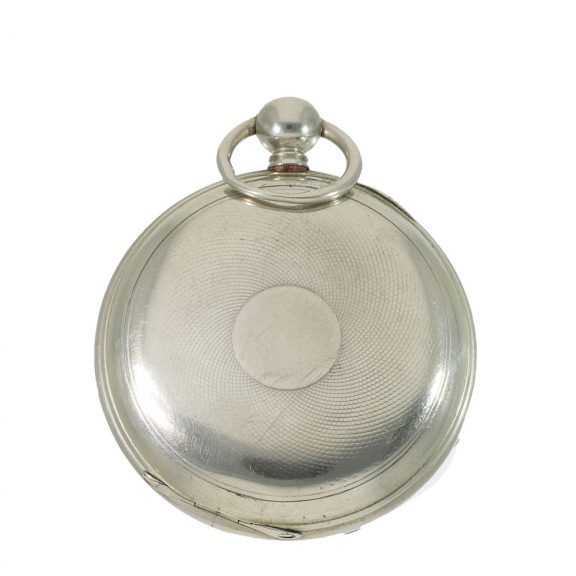
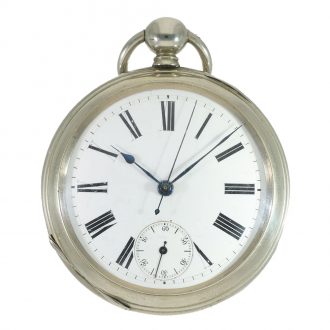
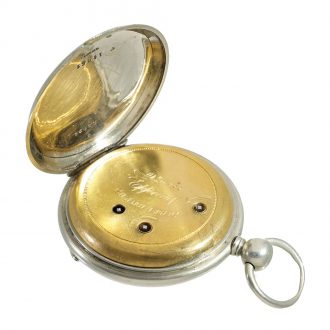
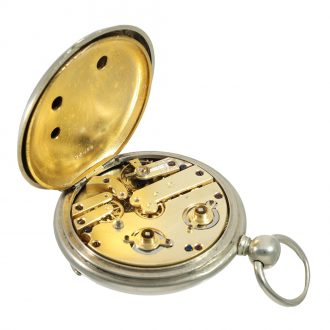
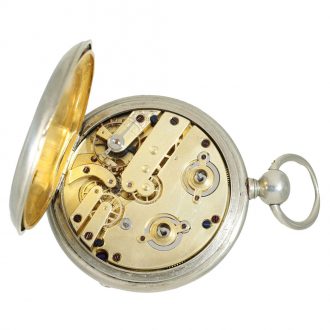
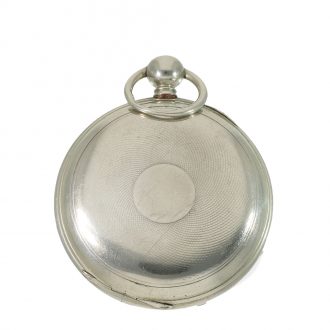
An unusual and early “Seconde Morte” (dead beat seconds) watch, made by A. Eppner & Co. in Silberberg, Germany, circa 1870. The numbered case of this watch was crafted from silver and features engine turned decoration on the back lid. The enamel dial features an outer seconds, minutes and hours track with Roman hour numerals, center seconds, a subsidiary seconds dial at 6 o’clock with a counter clockwise running seconds hand and blued steel hands. The numbered movement is equipped with a very fine precision lever escapement with two barrels and independent seconds
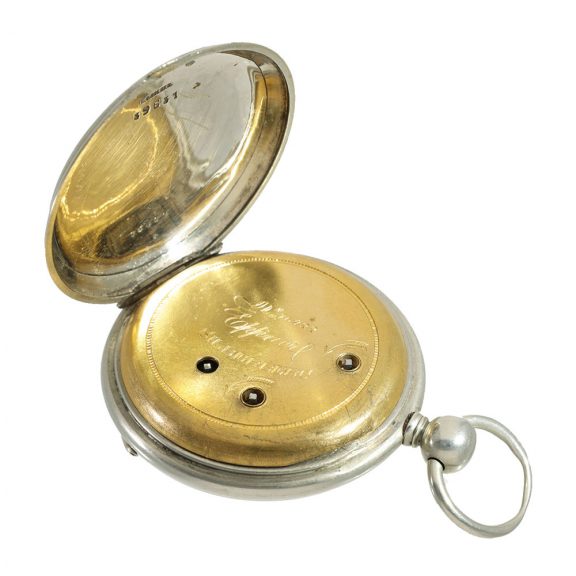
The case and movement have matching numbers and the cuvette is signed.
–
Diameter: 57 mm
–
Weight: 140 g
–
Signed: Gebrüder Eppner, Silberberg
–
Only a few Eppner watches with an additional complication are known to exist, making the item presented here a very rare one. Furthermore, the small counter clockwise running second hand is unusual for “Seconde Morte” watches.
–
Eppner
The history of Gebrüder Eppner is tied to a family of German watchmakers who bridged the gap between traditional Swiss craftsmanship and the industrialization of the German watch industry.
The family’s expertise began with the eldest brother, Carl Wilhelm Eppner (born 1804), who trained in Merseburg and later moved to La Chaux-de-Fonds, Switzerland, in 1821. He became a master horologist, specializing in precision parts like ruby cylinders and anchor escapements. Between 1828 and 1830, he trained his younger brothers, Eduard (1812–1887) and Albert, in Switzerland, establishing a strong foundation in high-end Swiss techniques.
Following success at the 1844 German Industrial Exhibition, Albert Eppner founded the Berlin branch, Gebrüder Eppner, in 1845. The workshop was located at Charlottenstraße 49 in Berlin. The firm became renowned for “first quality” pocket watches and marine chronometers. Their prestige was so high that Emperor Wilhelm I and Wilhelm II commissioned watches from them as official presentation gifts for dignitaries and military heroes.
While the Berlin branch focused on retail and high precision finishing, Eduard Eppner aimed to industrialize production. With Prussian government grants, he established factories in Silesia. Notably in Lähn (1852) and Silberberg (1869). Production expanded to include tower clocks, pendulum clocks and church clocks.
By the mid 1860’, the Eppner brothers were considered leaders in the German market for anchor escapement pocket watches.
After the deaths of Albert and Eduard in 1887, the company’s competitiveness began to wane as customers increasingly favored rivals like A. Lange & Söhne in Glashütte. The firm continued to operate in various forms, with the Silesian branch remaining active until 1945.
Today, Eppner pocket watches are highly prized by collectors for their “unmistakable calibers” and historical association with the Prussian court.
Signed: Gebrüder Eppner, Silberberg
Share this page: