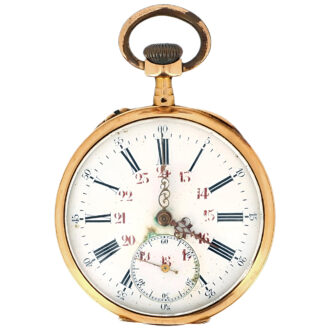
Heavy English precision watch with minute tourbillon Circa 1927
- Kenmerk
- AD8567
- Diameter
- 58 mm
- Estimate
- € 50.000 - 90.0000
- Price sold
- € 55.800
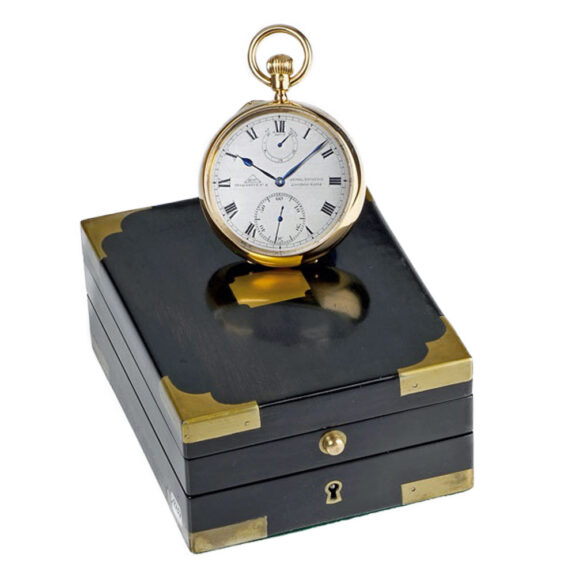
Gold open faced pocket watch by Dent
–
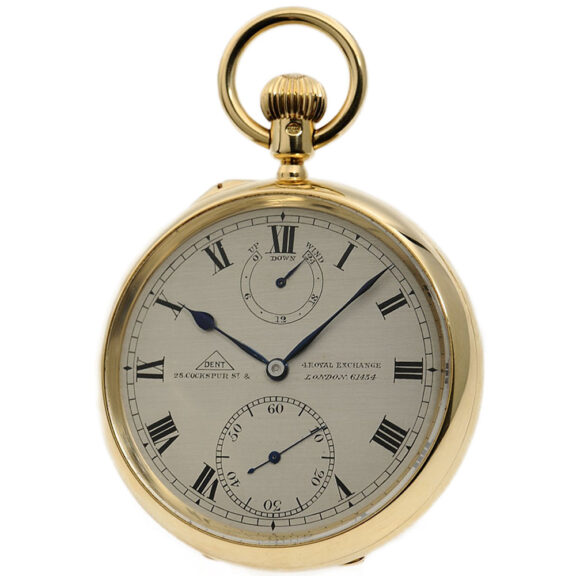
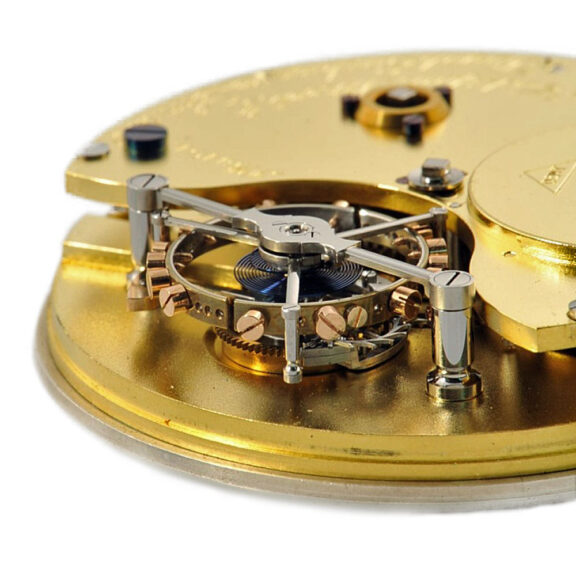
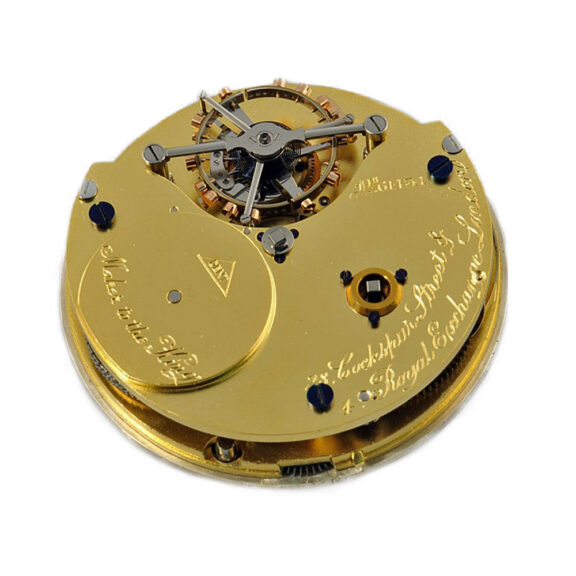
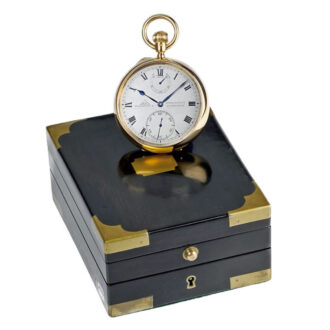
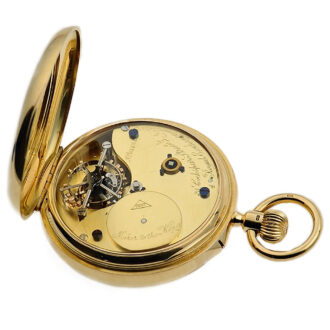
A very fine, heavy English precision pocket watch with minute tourbillon, 24-hour power reserve indicator, Kew A Certificat, and exotic wooden brassbound transport case, circa 1927.
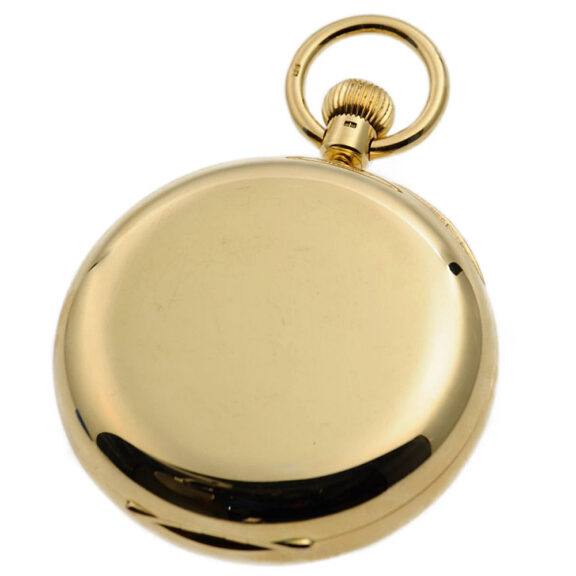
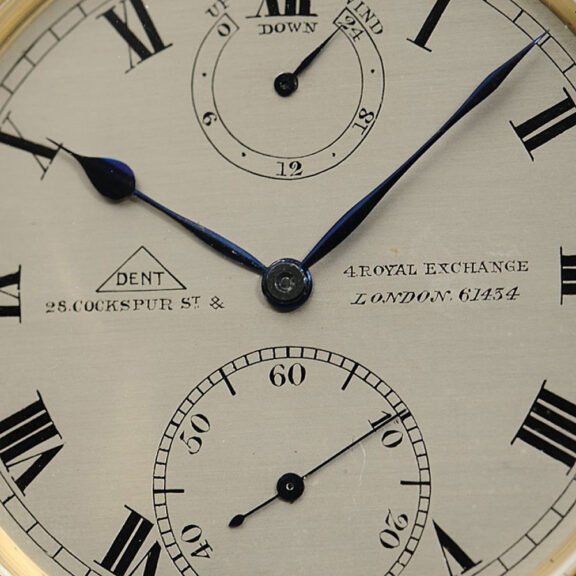
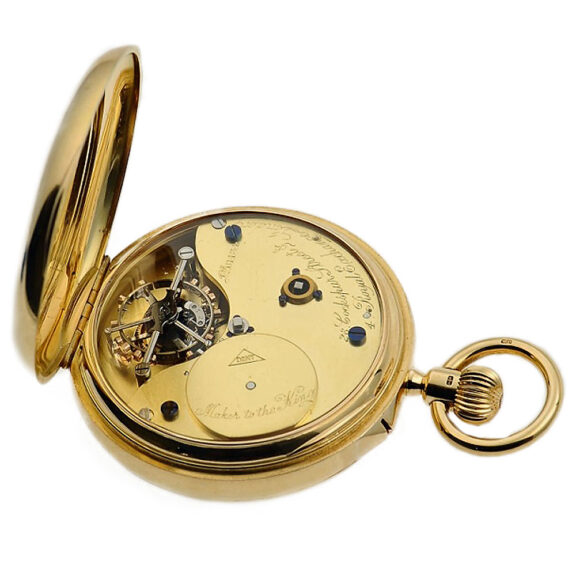
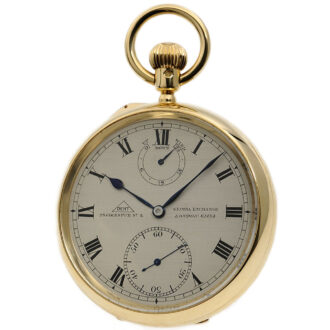
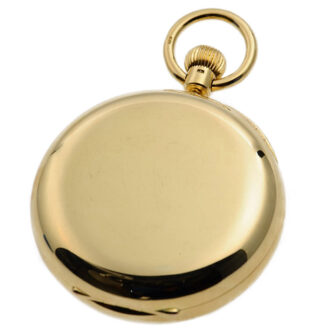
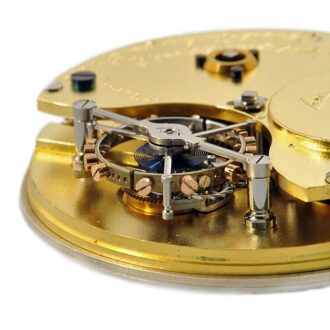
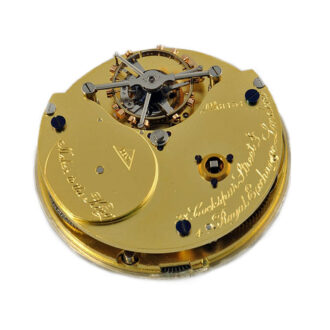
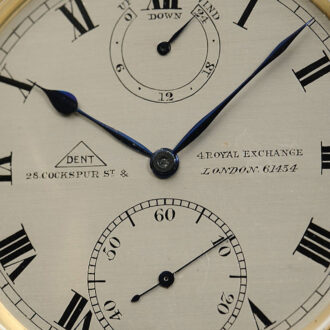
18 Carat gold polished case with glazed movement and turning pendant. Signed, numbered, silvered, ground dial with inlaid radial Roman numerals, auxiliary seconds, 24-hour power reserve indicator, and blued spade hands. Signed, chatoned, frosted gilt 3/4 plate movement with chain/fusee, finely polished three-arm steel tourbillon cage of Nielsen type 1 with polished screws, lever escapement with a counterpoised gold weight, Guillaume gold screw compensation balance, and free-sprung blued balance spring.
–
Diameter: 58 mm
–
Weight: 190 g
–
Signed: Dent Maker to the King, 28 Cockspur Street & 4 Royal Exchange, London
–
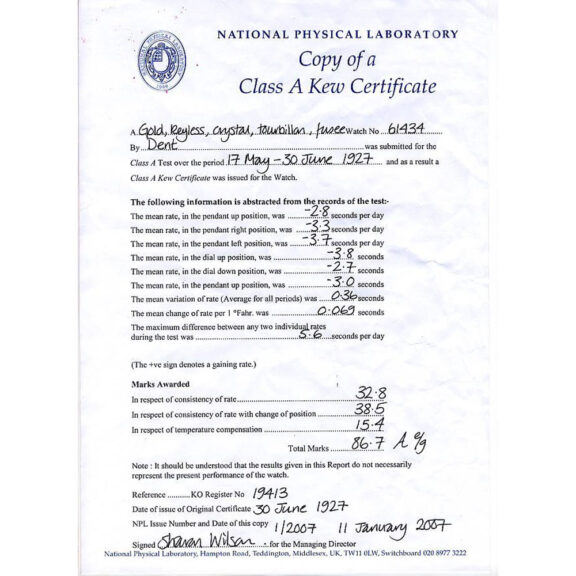
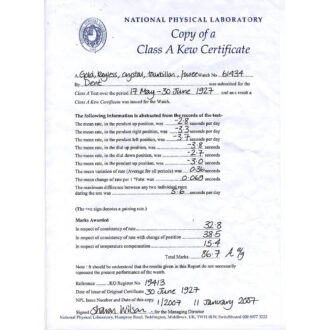
This watch is the last tourbillon that the firm Dent, or rather North & Son, submitted to the Kew-Teddingtonobservatory. There estimate that the watch was probably built as early as 1924 because it had already been tested at Kew once before: on page 859 of the supplement to Vaudry Mercer’s Edward John Dent, the Dent no. 61434 is listed in June 1925 – before the 1927 entry; it is described as gold, keyless and the case is apparently the same as now. As Kew no. 18900 it achieved 82,8 marks and the designation especially good; however, the company must have expected a better result because they submitted the watch again two years later as Kew no. 19413 – this time it was awarded 86,7 marks. The movement is clearly a creation of the Nicole Nielsen company; the tourbillon is very typical of their work. It is described in detail as Nielsen 1 on page 47 of Reinhard Meis, Das Tourbillon, 1986: In particular it was the company Nicole, Nielsen & Co., who mass-produced this type of watch…almost all of these ébauches? were sold to well-known companies….. who signed them with their own name; a footnote states: Information about the company Nicole, Nielsen & Co. is scarce, but the watches indicate that as early as at the turn of the century many of the special parts were purchased in Switzerland”.
–
Tourbillon
In horology, a tourbillon is an addition to the mechanics of a watch escapement to increase accuracy. It was developed around 1795 and patented by the French-Swiss watchmaker Abraham-Louis Breguet on June 26, 1801. In a tourbillon, the escapement and balance wheel are mounted in a rotating cage, in order to negate the effects of gravity when the timepiece (thus the escapement) is stuck in a certain position. By continuously rotating the entire balance wheel/escapement assembly at a slow rate (typically about one revolution per minute), the tourbillon averages out positional errors.
Originally an attempt to improve accuracy, tourbillons are still included in some modern watches. The mechanism is usually exposed on the watch’s face to showcase it.
–
Ebauche
An unfinished movement sold as such. Until circa 1850, an ébauche comprised only the plate, bridges, fusee and barrel. It was known as a blanc and was finished at the établissage.
The modern ébauche is a watch movement, with or without jewels but always without its regulating organ, mainspring, dial and hands. It is also known as a blanc roulant.
Signed: Dent Maker to the King, London
Share this page: