French tourbillon watch made for the King of England Circa 1808
- Kenmerk
- AS1904
- Diameter
- 65 mm
- Estimate
- € 1.000.000 - 2.000.000
- Price sold
- € 1.732.500
Gold tourbillon watch of royal provenance by Breguet
–
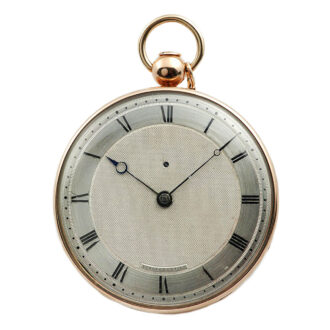
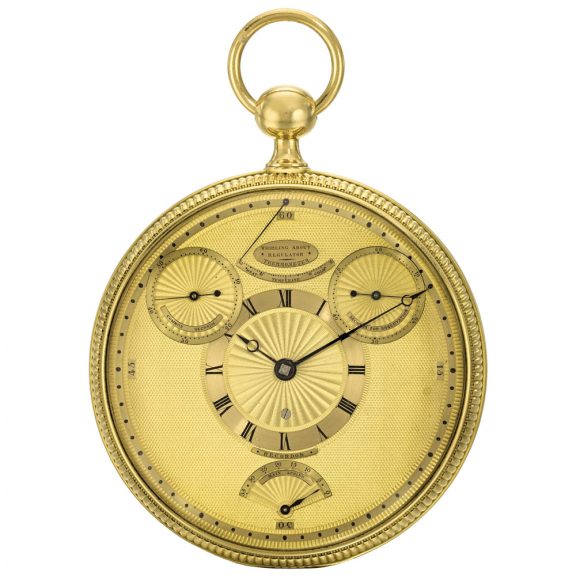
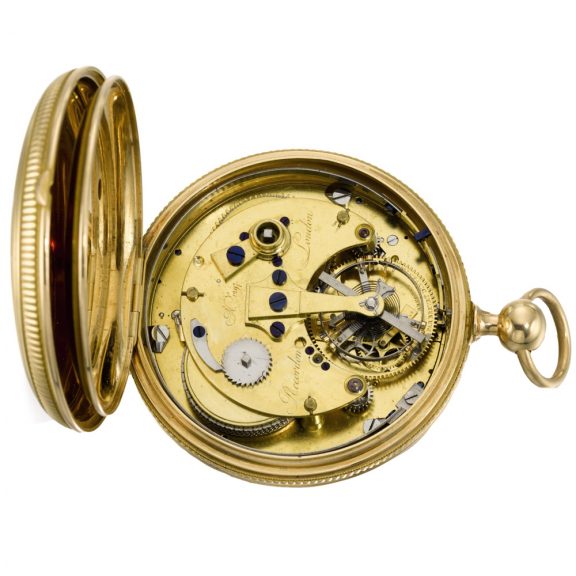
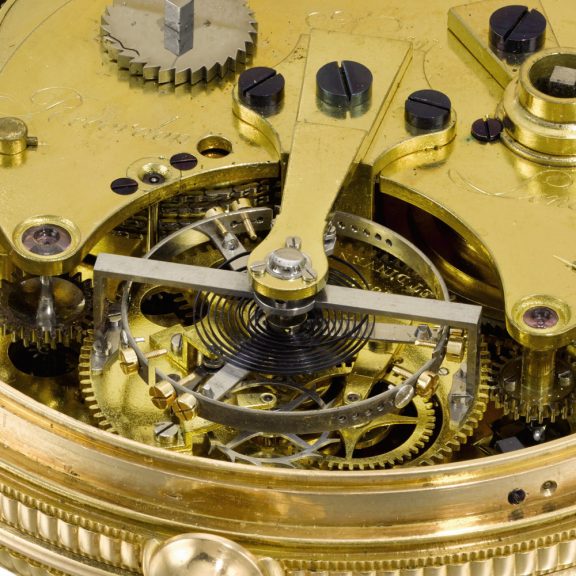
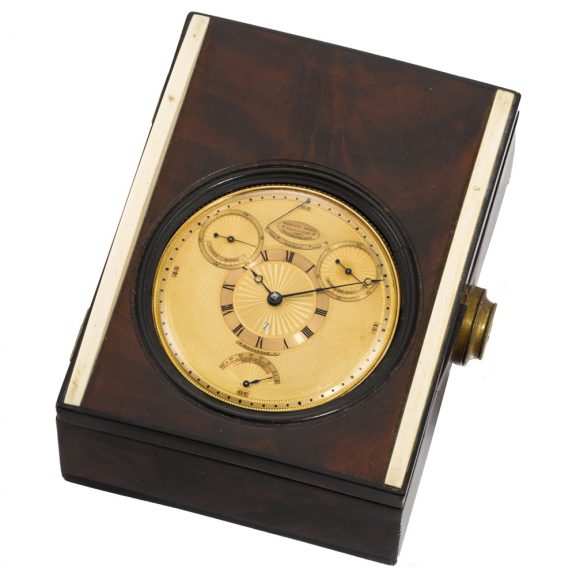
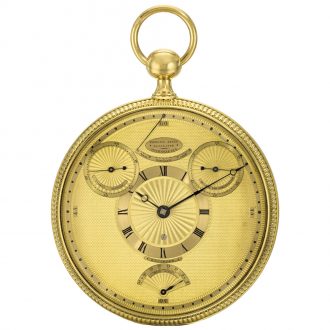
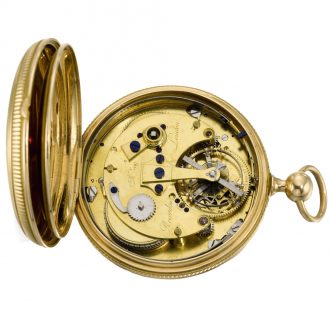
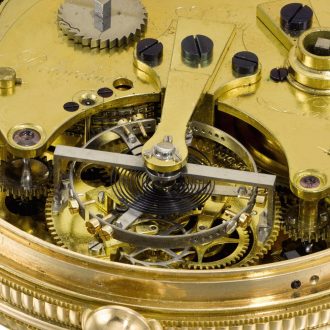
A highly important French gold four minute tourbillon watch of royal provenance with robin escapement, thermometer, and stop slide for timing the seconds, circa 1808. Made for the King of England by Breguet and retailed by Recordon, London. This watch features a gilded movement with a Robin escapement and a single lift mounted to a four minute tourbillon carriage. It has a free-sprung three-arm balance with adjustment screws, a single arm steel cage, and a flat blued steel spring with a terminal curve. The tourbillon carriage is signed by Breguet, Par Brevet d’Invention. It also includes a fusee and chain, and the backplate comes with a winding sleeve. The watch is signed and numbered by Recordon, London, with the number 1297.
–
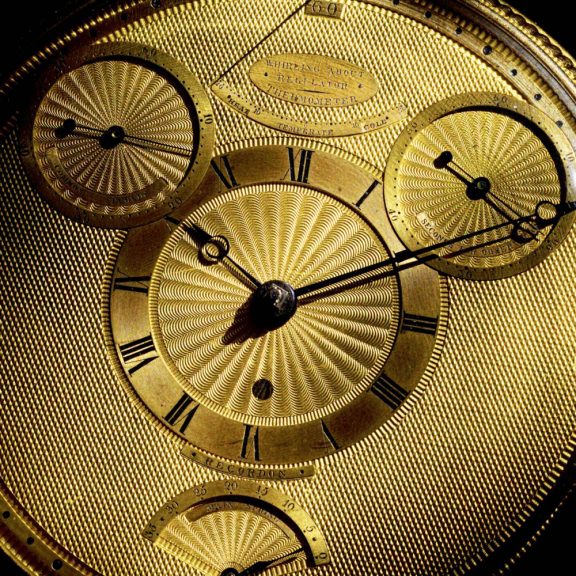
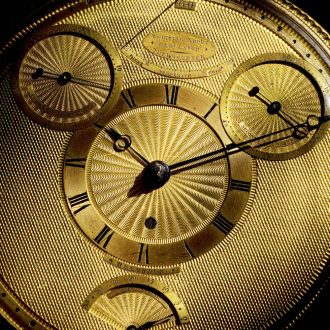
The gold Tavernier dial has multiple contrasting engine turned finishes and a central satin finished chapter ring with black Roman numerals for hours. It also features a minute ring to the edge, blued steel moon hands with an elongated minute hand, and two engine turned subsidiary dials. One is for constant seconds marked Common Seconds, and the other is for timing seconds marked Seconds for Observation. There is a fanform engine turned sector at the base of the dial for the state-of-wind indication, marked Main Spring and a sector for the thermometer marked Heat, Temperate, Cold above XII o’clock. The plaque above is engraved with Whirling About Regulator and Thermometer, and the plaque beneath the chapter ring is signed Recordon.
–
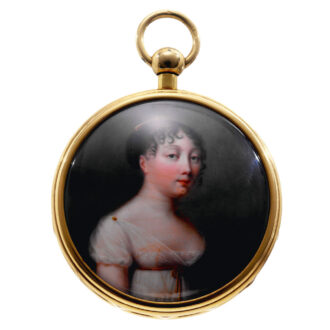
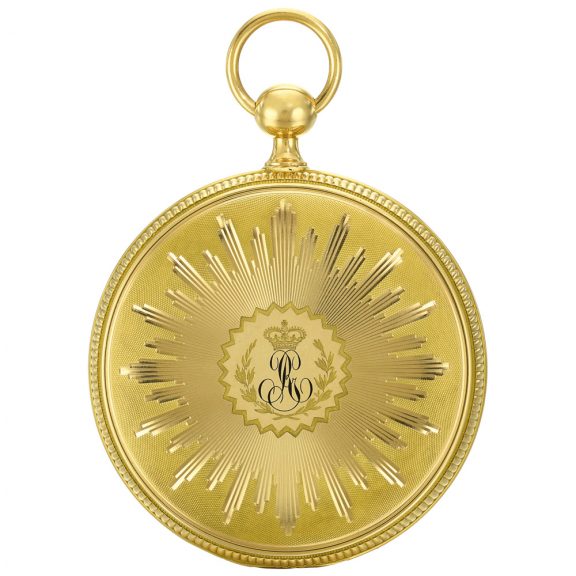
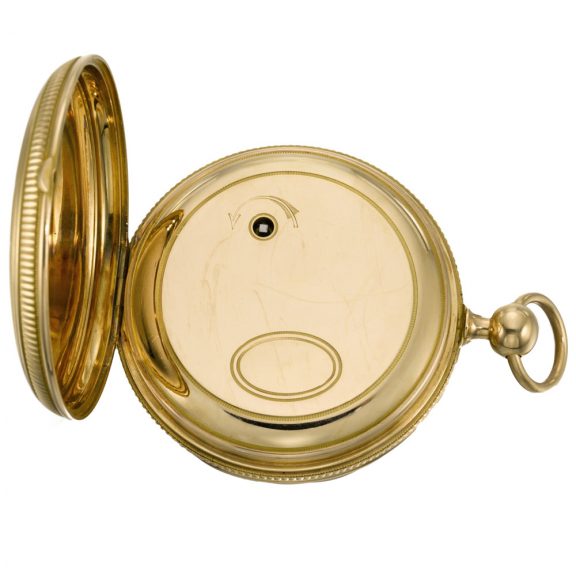
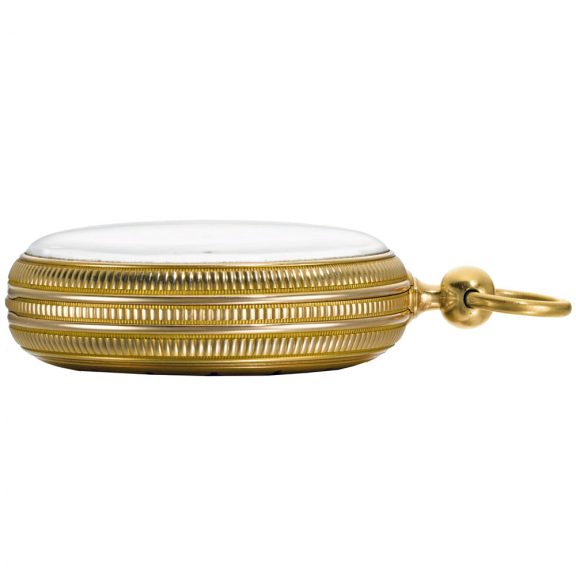
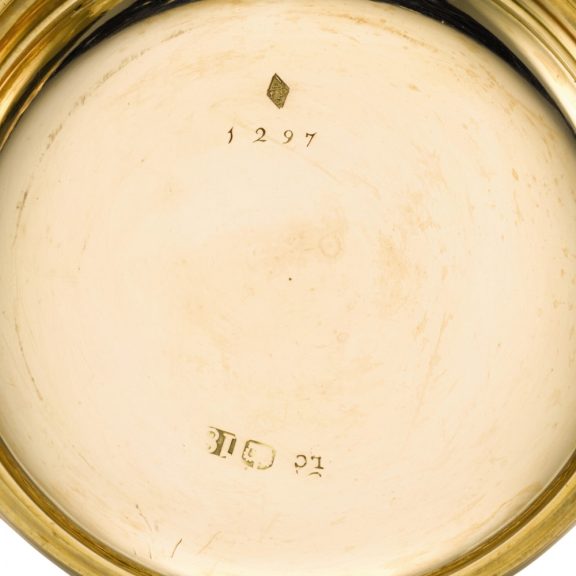
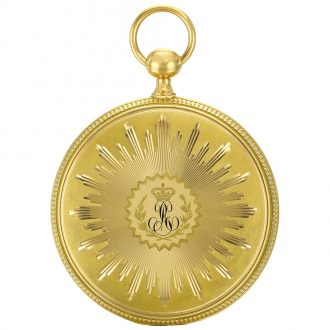
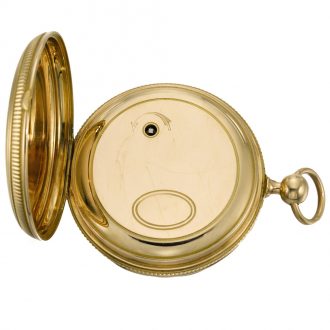
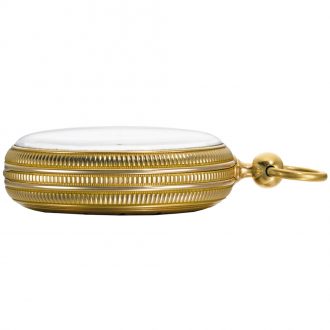
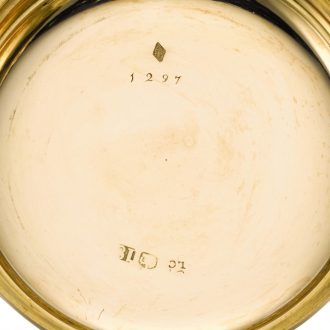
The 18 carat gold case has the back of the case engine turned and brightly cut sunburst decoration. There is a cartouche to the centre with the engraved Cypher of King George III – GR beneath a crown, the initials heightened with black enamel. The case also features heavily reeded bezels and band, a stop slide beneath the bezel at II o’clock marked Marche/Arrête and operating Seconds for Observation, a gold cuvette with a vacant oval cartouche, and a case back numbered 1297 and with maker’s mark PB with a triangle above in a lozenge shaped cartouche for Tavernier. The case back and cuvette have English hallmarks for 18 carat gold and the LC incuse mark of Louis Comtesse.
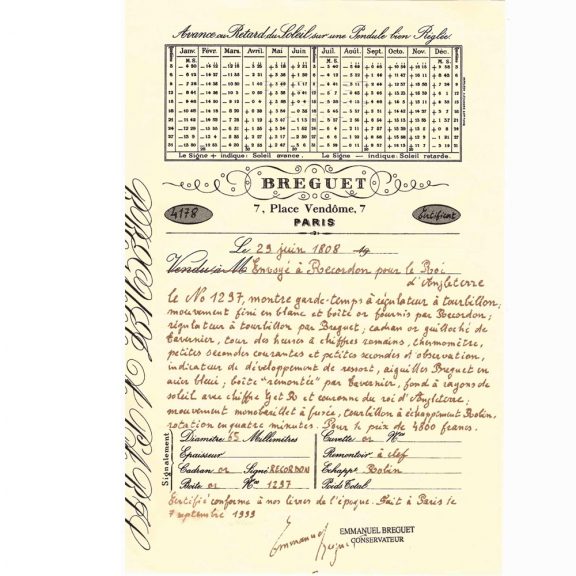
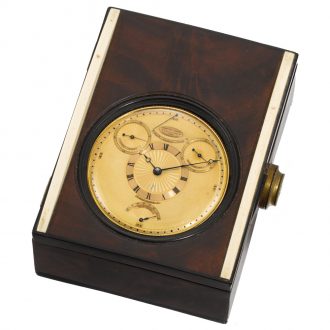
The watch comes with a custom made mahogany box with a hinged lid, ivory mounts to either side, a blue velvetlined interior with a matching watch pad, a Bramah lock stamped J Bramah with a crown, and a key for the Bramah lock with an ivory fob. Additionally, it is accompanied by a Breguet Certificate dated September 7, 1999, confirming the watch’s details as recorded in the Breguet Archives.
–
Diameter: 65 mm
–
Signed: Breguet, Par Brevet d’Invention / Recordon
–
The movement is functioning, and the start/stop function for ‘observation seconds’ is operational. The power reserve sector appears to be indicating correctly. The temperature hand moves loosely within its designated sector at times. The dial is in excellent overall condition, with a few minor spots. The case is in outstanding condition with exceptionally crisp decoration. The mahogany box shows some lifting of the veneer around the lock, and there is a small piece of veneer detached above the lock. The wooden base with a velvet pad for holding the watch has been broken in two, but it still fits firmly and flush.
–
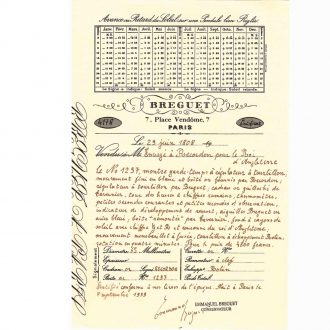
The included Breguet Certificate confirms that this watch was sent to Recordon (Breguet’s London agent) for the King of England on June 29, 1808. It notes the price as FF 4,800. The certificate also confirms the presence of the Robin escapement, the four minute tourbillon carriage, all dial indications, the sunray decoration on the case, and the Royal Cypher of the King of England.
–
This watch is considered one of the most magnificent and important creations by Breguet. It has remained remarkably preserved and, combined with its Royal provenance, stands as one of the finest examples of the master’s work.
–
Abraham-Louis Breguet is believed to have invented the tourbillon in 1795 while living in self imposed exile in Switzerland. Fearing for his life during the Reign of Terror, Breguet left Paris in August 1793 together with his son and sister-in-law. In Switzerland, Breguet lacked tools and materials, which hampered his production, but this period allowed him to develop some of his most ingenious inventions. In addition to the tourbillon, these included his perpetual calendar, ruby cylinder, sympathique clocks, constant force escapements, and montres à tact. Breguet returned to Paris on April 20, 1795, and the patent application for his tourbillon device is dated 1801. Breguet made his first tourbillon watch (no. 22) in 1800. His second tourbillon watch, numbered 169, was made in 1808 as a tribute to Breguet’s friend and fellow watchmaker, John Arnold. Breguet presented the watch to Arnold’s son, John Roger Arnold, on April 30, 1809. Both of these early tourbillon watches had rotating carriages of one minute duration. Following the production of his first two tourbillon watches, Breguet introduced a small series of tourbillon watches with their carriages rotating once every four minutes, and it is to this group that the present watch, no. 1297, belongs. According to George Daniels in his book “The Art of Breguet,” these watches were made between 1808 and 1815. Daniels notes that this series of Breguet four minute tourbillon watches follow the same basic design as no. 169, but they are superior both for movement detail and by their larger yet slimmer size. In common with no. 169, Breguet’s fourminute tourbillon watches had balances beating at 21,600 vibrations per hour. This improved the watches’ rates and meant that they were less susceptible to variations caused by the motion of the owner as the watch was being worn. Although this higher beat rate would usually require a stronger mainspring, as Daniels explains, Breguet’s introduction of the four minute carriage in place of the one minute carriage compensated for this change.
–
The present watch, no. 1297, is believed to be the first one sold. According to the Breguet Archives, it was sent to Recordon for the King of England on June 29, 1808. Among the four minute tourbillons from this series that are now known, this particular watch is the only one with a dial labelled in English. Interestingly, it is also the only watch from the group to be labelled as a “Whirling About Regulator,” which is a literal translation from the French term “Régulateur à Tourbillon.” All the watches identified from this series so far have indications for constant seconds, a timing seconds dial, and a sector for power reserve indication. However, no. 1297 stands out as the only watch known in the group to have a thermometer addition. The original price of FF 4,800 noted on the Breguet certificate, which appears to be the highest figure paid for any of the watches from this series, may be due to this additional feature. Additionally, no. 1297 is the only watch in the group to have each of its indications clearly labelled in writing on the dial. All the other examples seen from the series only have the writing “Régulateur à Tourbillon” and the signature “Breguet et Fils” on the dial, except for no. 1188, which has a later white enamel dial with a signature but without mention of the tourbillon.
–
Breguet No. 1297 is notable for using a Robin escapement. At the time of Daniels’ book, “The Art of Breguet,” no. 1297 seemed to have been unknown to the author. Daniels mentioned that the tourbillon was made in limited numbers with various escapements, but apparently, he was unaware of Breguet’s tourbillon with a Robin escapement. Interestingly, most tourbillon watches from this series, except for the present watch and no. 2396, are fitted with Breguet’s échappement naturel.
–
The Breguet archives note that the present watch was sent to Recordon for the King of England on June 29, 1808. The Breguet certificate details that the case was decoratively engraved by Tavernier with the sunray design and the letters G & R with the crown of the King of England. At the time of the watch’s manufacture, the Napoleonic Wars (1803–1815) were ongoing. Remarkably, the watch was ordered and delivered, considering the naval blockade of the British and the prohibition of trade with the UK. The watch was supplied via Breguet’s London Agent, Recordon, to avoid a direct connection between the King and a French product. The risk of sending such a valuable watch between two warring countries must have been a significant concern for both Breguet and Recordon, given the chance of the watch’s seizure was a real possibility. The cuvette is unsigned and has a vacant cartouche, while the dial and movement are signed by Recordon. The only visual indication that the watch was produced by Breguet is the signature located on the tourbillon carriage, which is in such a discreet location that it is unlikely to have been detected during a cursory examination of the watch. The inside case back has prominent English hallmarks and the mark of the English based case maker, Louis Comtesse, who was based at 13 Batemans Buildings in Soho, London. By contrast, the mark of Breguet’s caseworker, Tavernier, is both small and discreet. Although the watch could have “passed” as an English made watch, it seems unlikely that the King would have been unaware of the true origins of the watch.
–
In 1810, King George III’s mental illness caused him to step down, and the Prince of Wales became Prince Regent. A bill from 1812 directed to the Prince Regent listed outstanding payments for three Breguet watches and a Breguet clock. The invoices showed that partial payments were made, and a letter requested assistance in obtaining the outstanding balance of £700. Ultimately, a payment of £300 was made in May 1813, with the final balance of £400 paid in October of the same year.
–
George III (1738-1820) was the King of Great Britain and Ireland. Despite being known for the American War of Independence, he was also a significant supporter of the arts. He received education under the Earl of Bute and showed a keen interest in scientific instruments and watchmaking. As King, he appointed George Adams as his Mathematical Instrument Maker, commissioning him to create pneumatic and mechanical instruments. Additionally, his notes on watchmaking were featured in the 1955 Exhibition, “Five Centuries of British Timekeeping,” held at Goldsmiths’ Hall.
–
In 1770, King George III acquired the first watch with a lever escapement from Thomas Mudge. He became involved in a dispute between John Harrison and the Board of Longitude over tests for Harrison’s chronometer. The King arranged an independent trial for Harrison’s last timekeeper, H5, which performed superbly. Despite his initial refusal, King George III helped the Harrisons appeal to the Prime Minister and Parliament. Finally, on June 21, 1773, an Act of Parliament recognised John Harrison as the solver of the Longitude problem.
–
King George III’s passion for clocks led to the purchase of Breguet No. 1297. It’s possible that Recordon informed the King about Breguet’s new ‘whirling about regulator.’ This timepiece includes a thermometer, possibly a specific request from the King. As a man of science, he would have appreciated the tourbillon’s action, the dial’s precision, and the “observation seconds” dial for timing events.
Signed: Breguet and Recordon
Share this page: