Swiss perpetual calendar with moon phases Circa 1869-1872
- Kenmerk
- FA0049
- Diameter
- 55 mm
- Estimate
- € 25.000 - 40.000
- Price sold
- € 31.650
Gold perpetual calendar with moon phases by Louis Audemars
–
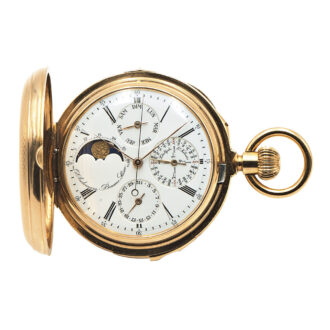
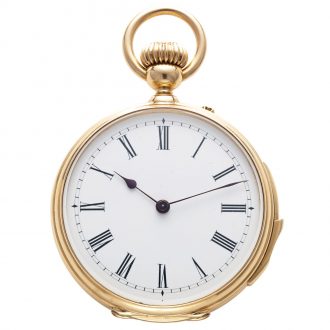
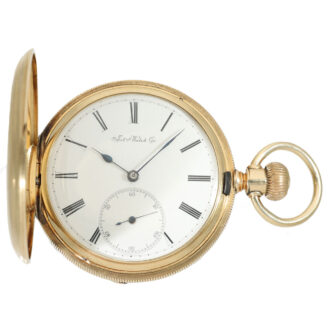
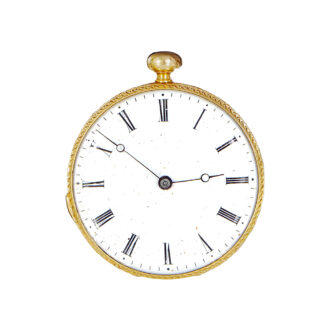
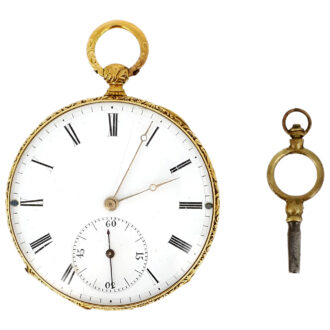
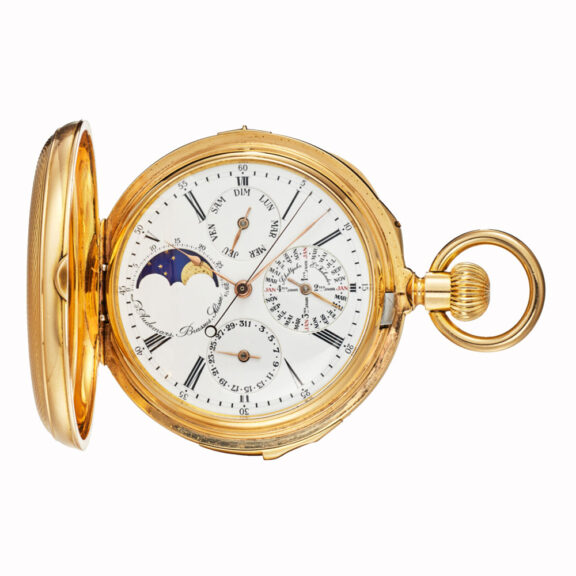
A Swiss pocket watch with quarter repeater, dead independent seconds, perpetual calendar with leap-years indication and moon phases by Louis Audemars, circa 1869-1872.
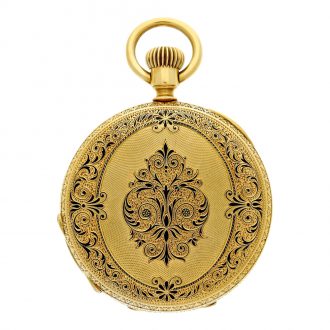
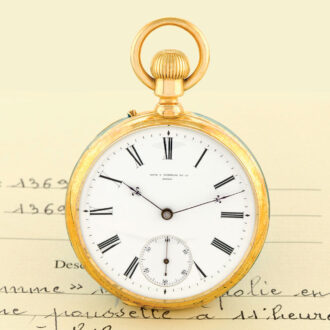
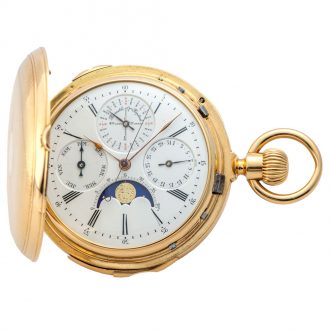
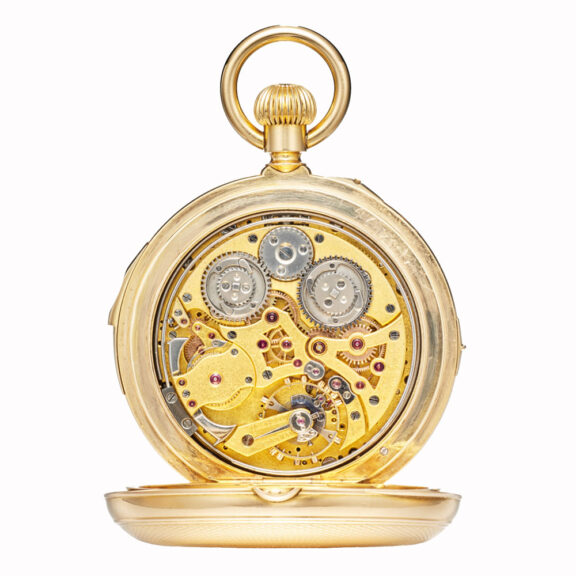
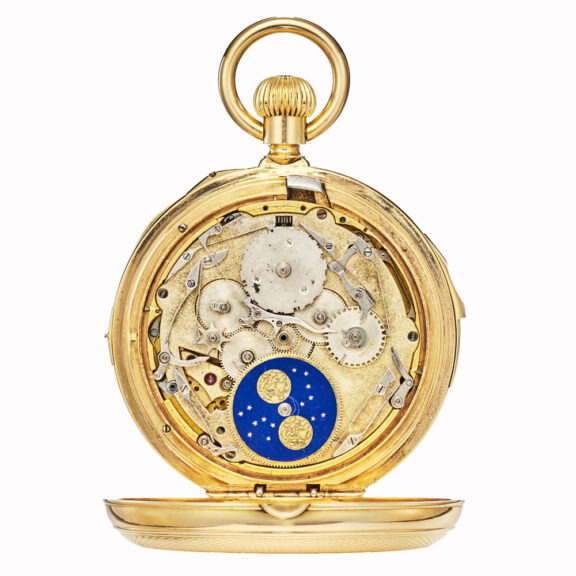
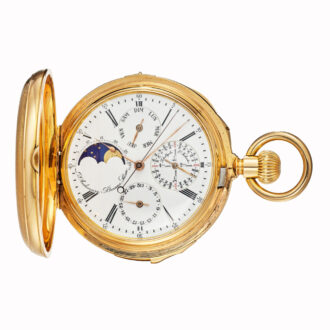
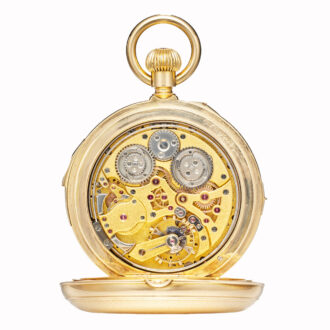
18K Yellow gold, hunting cased, keyless winding, round-shaped, pocket watch, with nine horological complications. Quarter repeater on two steel gongs, activated by the slide at 6 o’clock. Dead independent seconds, exterior graduation with central hand, activated by the rectangular push-piece located on the border of the case, at 12 o’clock. Two barrels with differential gears and bidirectional-winding inspired by Sylvain Mairet’s (1805-1890) works (1850 / 1855). Half-instantaneous perpetual calendar. Date of the month, subsidiary dial at 6 o’clock. Day of the week, subsidiary dial at 12 o’clock; indications given in French. Month of the year, subsidiary dial at 3 o’clock, indications given in French. Four-year cycle of leap-years, subsidiary dial at 3 o’clock; indications given in German. Age and phases of the moon, subsidiary dial, graduated from 0 to 29 1/2, and aperture at 9 o’clock. Cover and case back guilloché engine turned.
–
Diameter: 54 mm
–
A Swiss pocket watch with quarter repeater, dead independent seconds, perpetual calendar with leap-years indication and moon phases by Louis Audemars, circa 1869-1872.
18K Yellow gold, hunting cased, keyless winding, round-shaped, pocket watch, with nine horological complications. Quarter repeater on two steel gongs, activated by the slide at 6 o’clock. Dead independent seconds, exterior graduation with central hand, activated by the rectangular push-piece located on the border of the case, at 12 o’clock. Two barrels with differential gears and bidirectional-winding inspired by Sylvain Mairet’s (1805-1890) works (1850 / 1855). Half-instantaneous perpetual calendar. Date of the month, subsidiary dial at 6 o’clock. Day of the week, subsidiary dial at 12 o’clock; indications given in French. Month of the year, subsidiary dial at 3 o’clock, indications given in French. Four-year cycle of leap-years, subsidiary dial at 3 o’clock; indications given in German. Age and phases of the moon, subsidiary dial, graduated from 0 to 29 1/2, and aperture at 9 o’clock. Cover and case back guilloché engine turned.
–
Diameter: 54 mm
–
Signed: Louis Audemars, Brassus
–
It should be noted, however, that the production sheets of the watch No. 11 167 are unfortunately no longer present in the Historical Archives of the Louis Audemars house, now kept by Mr. Paul Audemars in England.
At the time of its creation, this type of watch with horological complications represents the pinnacle of production because it’s only circa 1873- 1875 that we will build watches with minute-repeater and chronograph. The Louis Audemars house in Le Brassus (Vallée de Joux), founded in 1811 by Louis-Benjamin Audemars (1782-1833), is one of the specialists.
Only, are even more complicated the pieces made on an exceptional basis, as those built for the industrial, national or universal exhibitions by this house which also supplies its colleagues: Breguet, Oudin and Le Roy (who will become L. Leroy & Co.) in Paris; Patek Philippe and Vacheron Constantin in Geneva; etc.
Later, other exceptional watchmakers from the Vallée de Joux are also specialized in this type of production: Louis-Elisée Piguet (1836-1924), Ami LeCoultre (1843-1921), Léon-Ernest Aubert (1845-1921) 1920), Victorin Piguet (1850-1937), etc.
–
It should be noted, however, that the production sheets of the watch No. 11 167 are unfortunately no longer present in the Historical Archives of the Louis Audemars house, now kept by Mr. Paul Audemars in England.
At the time of its creation, this type of watch with horological complications represents the pinnacle of production because it’s only circa 1873- 1875 that we will build watches with minute-repeater and chronograph. The Louis Audemars house in Le Brassus (Vallée de Joux), founded in 1811 by Louis-Benjamin Audemars (1782-1833), is one of the specialists.
Only, are even more complicated the pieces made on an exceptional basis, as those built for the industrial, national or universal exhibitions by this house which also supplies its colleagues: Breguet, Oudin and Le Roy (who will become L. Leroy & Co.) in Paris; Patek Philippe and Vacheron Constantin in Geneva; etc.
Later, other exceptional watchmakers from the Vallée de Joux are also specialized in this type of production: Louis-Elisée Piguet (1836-1924), Ami LeCoultre (1843-1921), Léon-Ernest Aubert (1845-1921) 1920), Victorin Piguet (1850-1937), etc.
Signed: Louis Audemars, Brassus
Share this page: