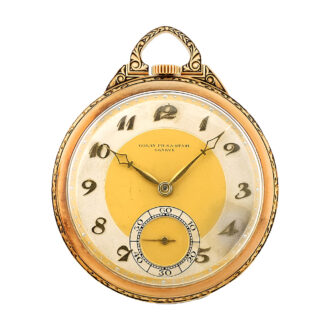
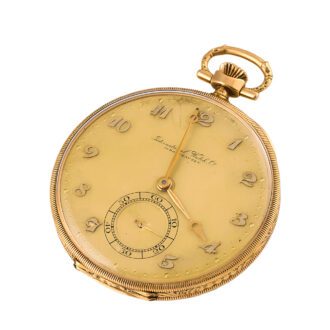
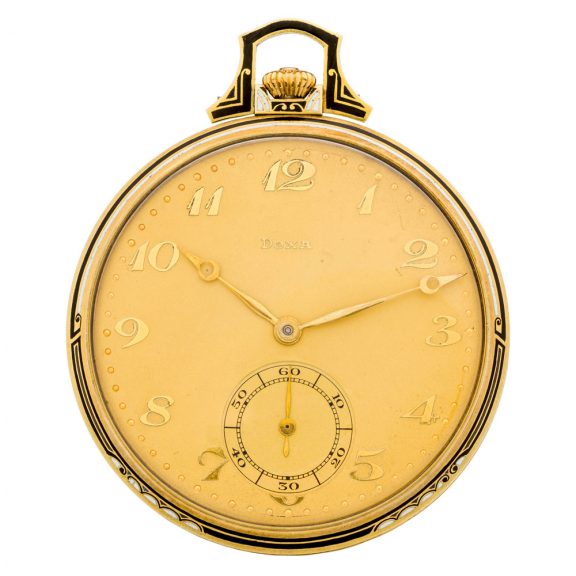
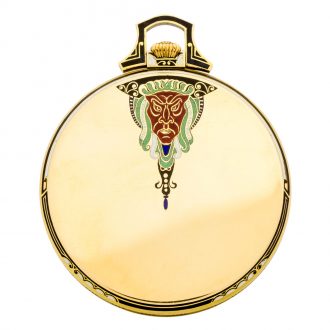
Rare Swiss 14K gold and enamel Art Deco lever watch Circa 1920
- Kenmerk
- BA3510
- Diameter
- 47 mm
- Estimate
- € 1.750 - 3.500
- Price sold
- € 2.150
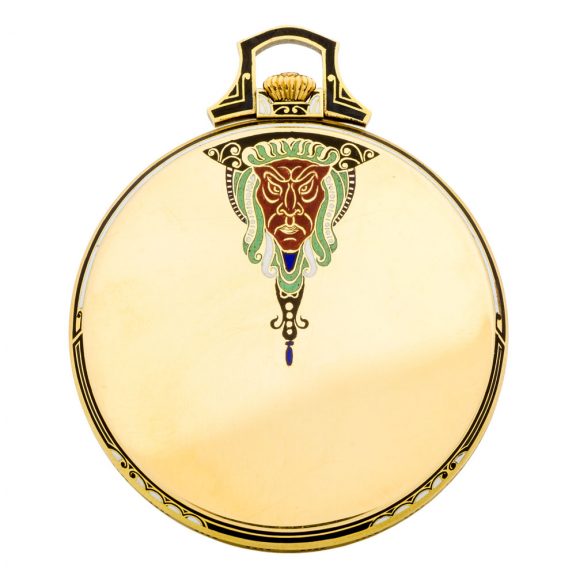
Gold new-old-stock watch with enamel decoration
–
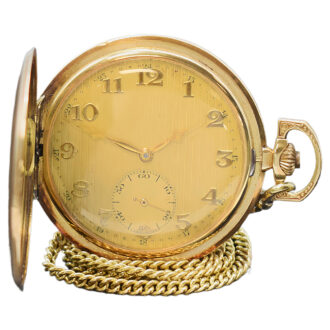
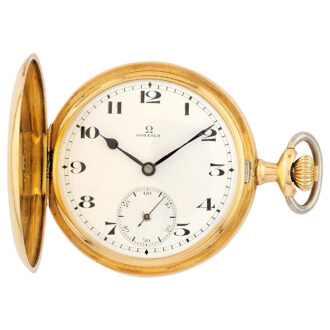
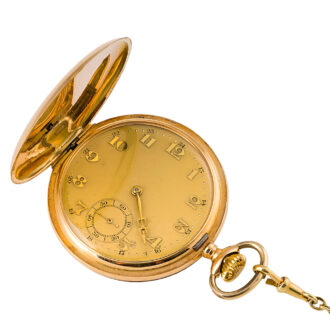
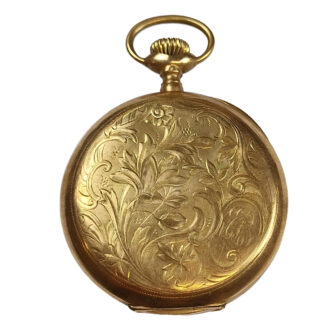
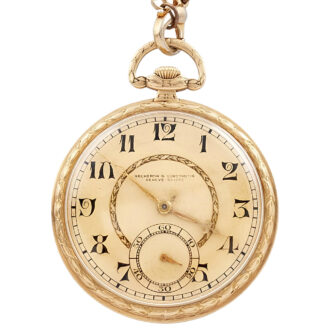
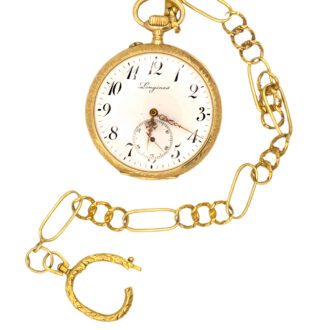
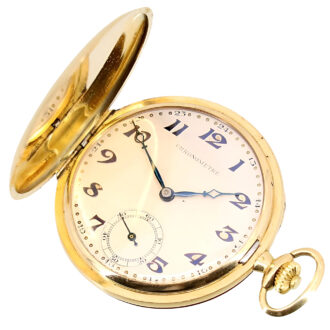
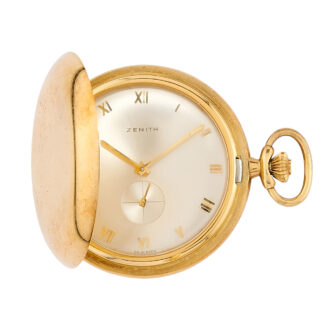
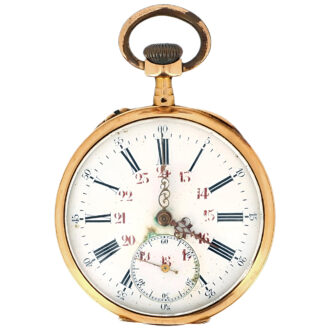
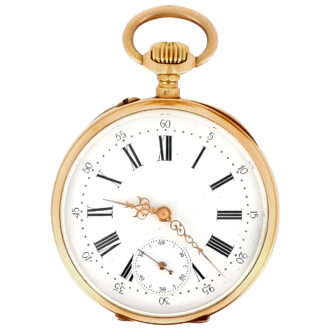
A very fine and rare, new-old-stock Swiss 14 carat gold and enamel open faced keyless Art Deco pocket watch, The Mask, circa 1920. The movement with a lever escapement. Gilt dial with applied Arabic hours numerals, outer dot minute divisions, subsidiary seconds at 6 o’clock and original, gold Breguet hands. A polished case, the back with a very fine polychrome enamel Chinese mask, the bezels, pendant and bow are decorated to match. Dial and movement signed, case signed and numbered.
–
Diameter: 47 mm
–
Signed: DOXA
–
The journey of DOXA started with Georges Ducommun in the small town of Le Locle in the Jura mountains, Switzerland. Georges was one of 13 children and only 12 years old when he began his apprenticeship with an established watchmaker in 1880. He had a temperament for hard work and discipline, combined with a passion for mechanical precision and beauty.
By 1889, Georges had built a solid reputation for ingenuity, attention to detail, quick service and customer orientation. At age 21, he opened his own business under the name “Georges Ducommun, Fabriques DOXA”. DOXA is the Greek word for glory.
Georges’ unique craftsmanship was recognized beyond the Jura region, Neuchâtel and Switzerland. His work was honoured at the Exposition Universelle et Internationale, at the World’s Fair held in Liège, Belgium in 1905 and in 1906, his anti-magnetic DOXA won the gold medal at the World’s Fair in Milan, Italy.
Early 20th century, endurance races were all the rage and a reliable dashboard mounted clock with an adequate power reserve was needed. To meet this demand, Georges filed a patent in 1907 for the eight-day DOXA caliber, which became standard equipment on Bugatti’s racing cars and an industry standard. Instrument panels in other automotive brands promptly featured a DOXA, with ships and aeroplanes following soon afterwards.
Georges was driven to innovate to achieve immutable durability and split second precision. When he passed away in 1936, his son-in-law, Jacques Nardin (grandson of Ulysse Nardin), took over the business. The focus remained on travel and sport timepieces, but DOXA also continued to develop watches for all types of customers. Innovations included alarms, ring watches and technical advances such as a date pointer and a jumping second hand.
In 1957, a minimalist dress watch collection came on the market.
In 1964, partnering with diving legend Claude Wesly and his team, underwater light visibility was tested in Lake Neuchâtel, with the result being the iconic bright orange DOXA dial.
Subsequently, in 1967, the company partnered with the legendary oceanographer and diver Jacques-Yves Cousteau to develop the SUB 300 featuring a patented rotating bezel and the iconic orange dial. A professional-grade SUB dive watch, the first accessible to sports divers. This collaboration firmly established DOXA’s reputation in the diving world. The SUB 300T Conquistador followed in 1968. Cousteau, co-inventor of the Aqua Lung underwater breathing apparatus and originator of modern-day scuba diving, likes the DOXA SUB concept so much that he negotiates an exclusive distributorship for his US based company.
In 1966, the Swiss Army began forming an elite corps of military divers, equipping them with the DOXA SUB 300T Professional. In 1968, DOXA also launched the Army watch, designed for military divers, featuring a black case, black bezel and sand-beige dial for exceptional underwater readability.
The advent of quartz technology marked a turbulent time for the Swiss watchmaking industry. A new era began when the Jenny family acquired DOXA in 1997, merging an enduring appeal of iconic collections with a family active in watchmaking for four generations. The headquarters were transferred to Biel/Bienne.
Signed: DOXA
Share this page: