Rare Swiss Singing Bird watch made for the Turkish market Circa 1820
- Kenmerk
- AS1910
- Diameter
- 63 mm
- Estimate
- € 400.000 - 800.000
- Price sold
- € 783.000
Gold and enamel pocket watch by Frères Rochat
–
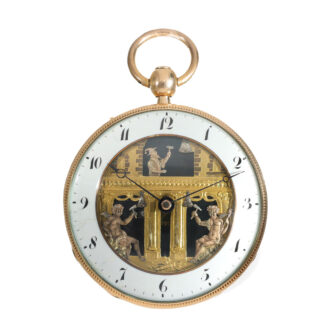
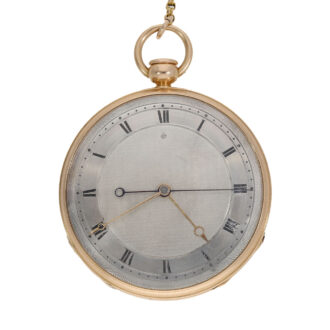
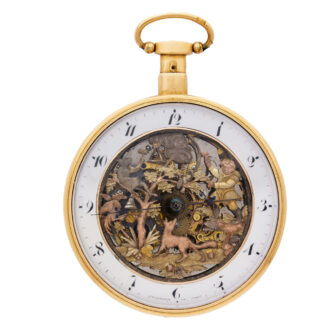
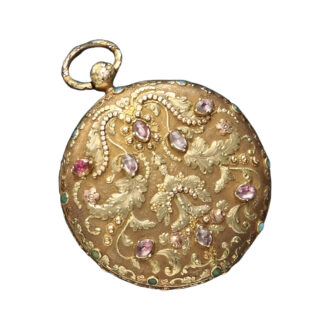
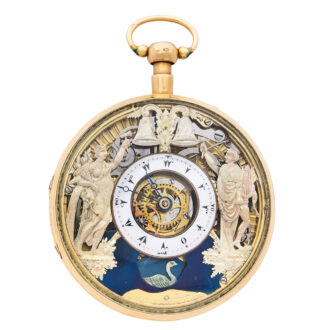
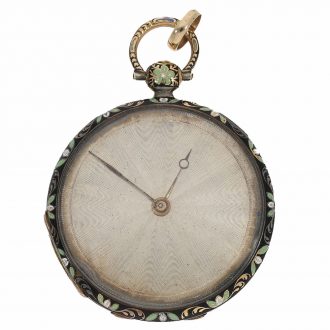
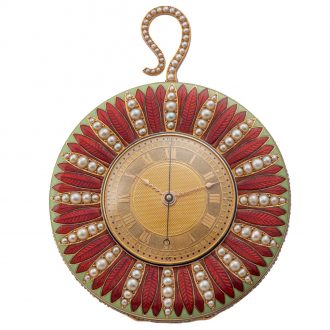
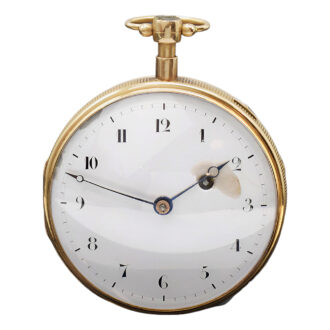
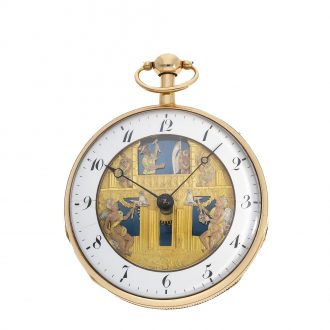
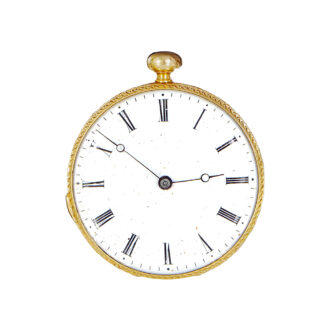
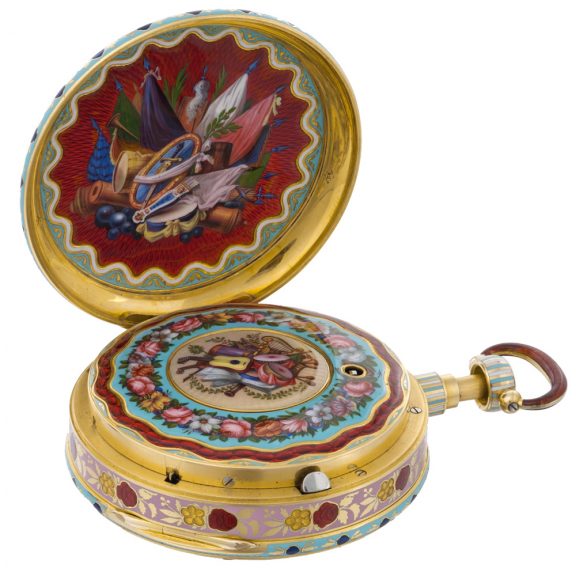
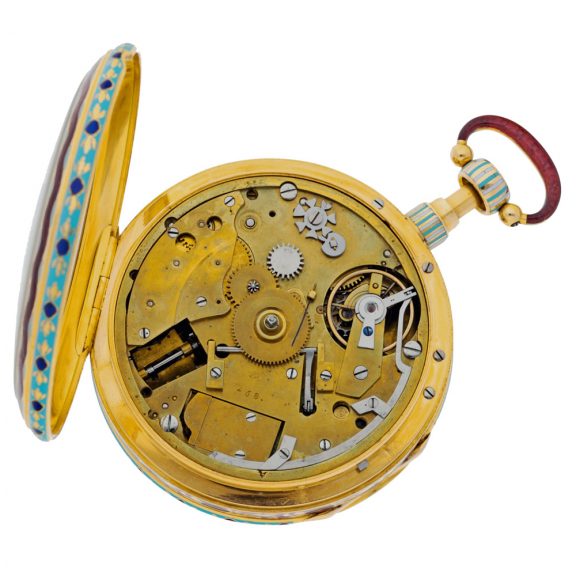
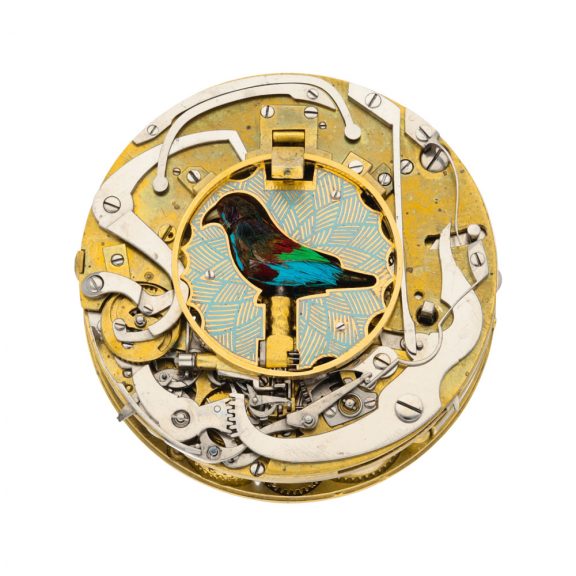
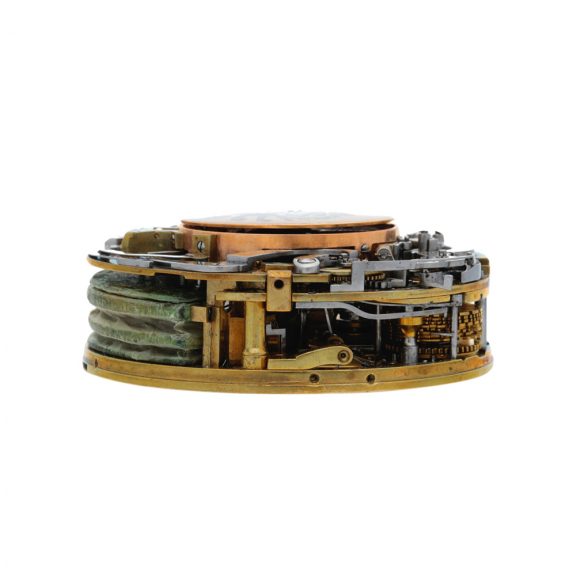
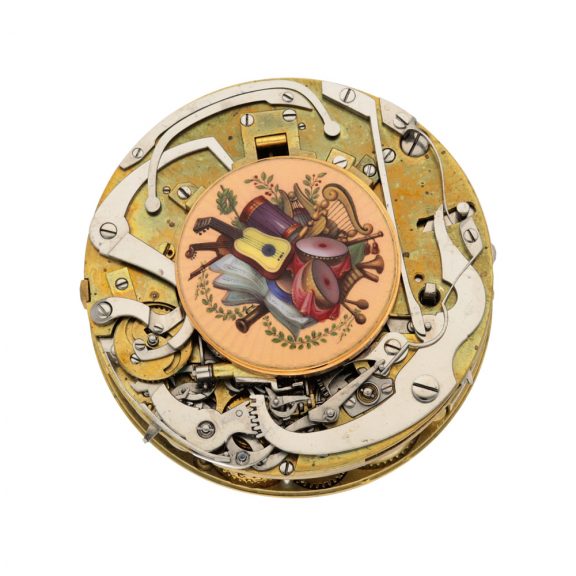
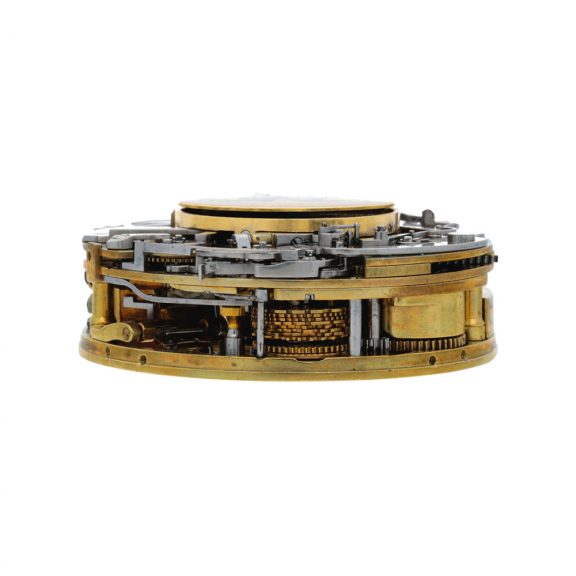
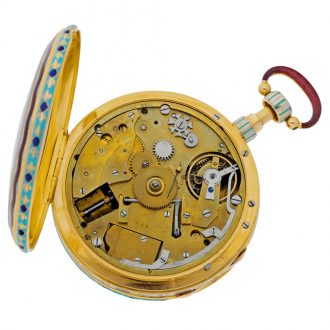
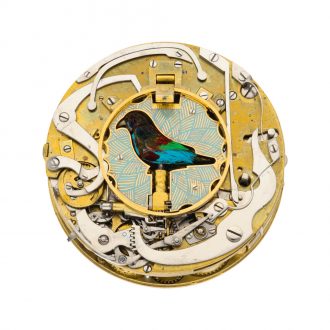
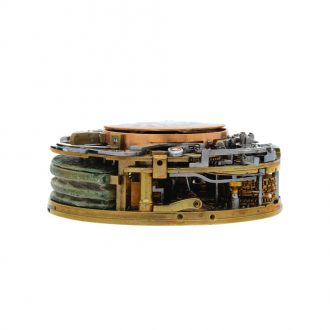
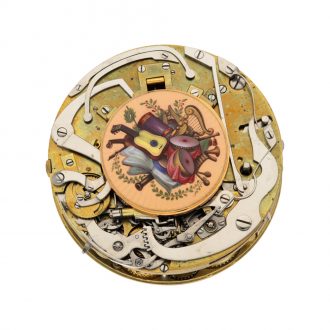
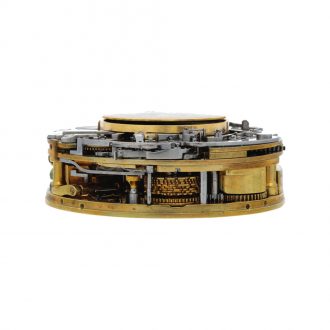
A magnificent and exceptionally rare Swiss gold and enamel Singing Bird watch made for the Turkish market, circa 1820. This exceptional piece showcases a gilded movement with a cylinder escapement and a simple three arm gold balance. It is marked with FR within an oval cartouche for Frères Rochat. The singing bird mechanism is pumpwound using the pendant and has a locking slide to the inner bezel within the case back. The bellows and bird songs are controlled by a sliding stack of eight cams. The top four cams regulate the singing valves and go through four revolutions per play, while there are additional fixed cams that control the movement of the bird. The white enamel dial features Turkish numerals and an outer minute ring, and it is signed Breguet et Fils.
–
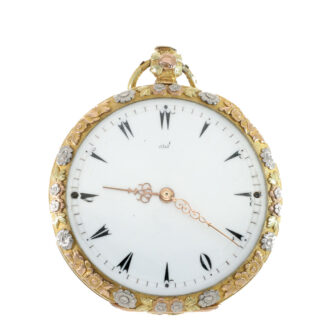
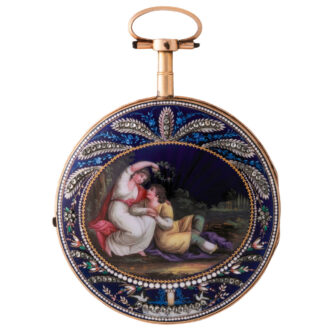
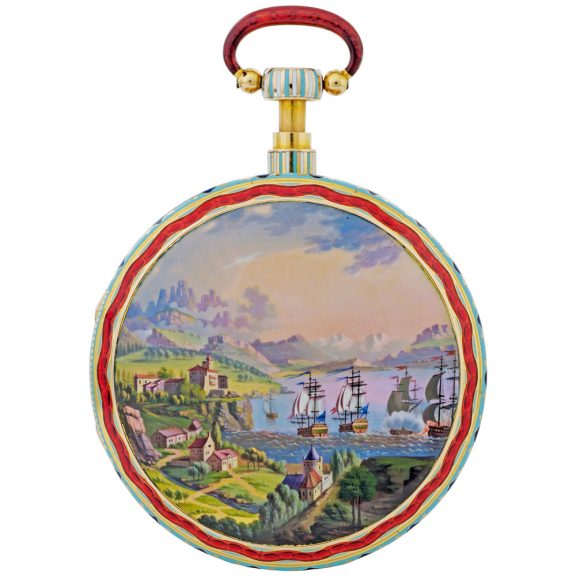
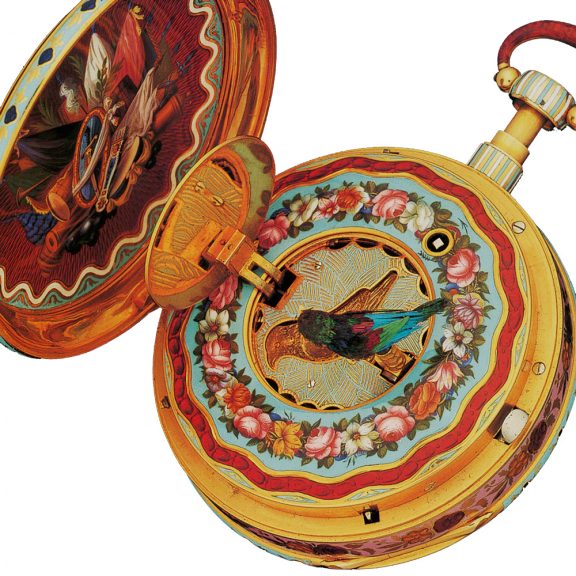
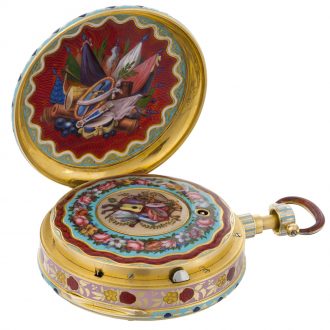
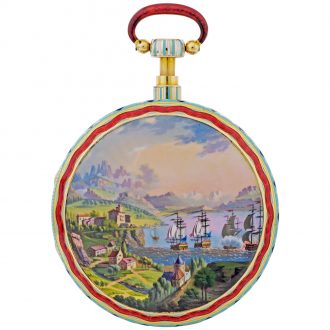
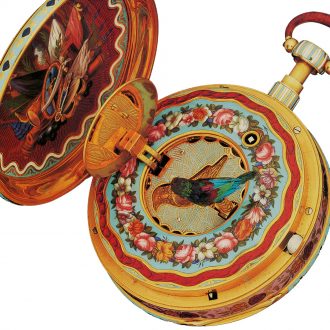
The gold case is decorated with opaque turquoise and translucent red guilloché enamel, as are the bezels, pendant, and bow. The case back features a painted scene of battleships exchanging fire with a town, mountains, and a setting sun in the background. The band and bezels are further adorned with enamel flowers and foliage. Inside the case back, there is a fixed cuvette with a central hinged circular panel painted with music themed trophies against a translucent pink guilloché enamel ground. Depressing the pendant opens the panel to reveal a bird shaped reserve surrounded by a gold plate with a blue feather design. When the panel opens, a singing bird with vibrant plumage emerges. The surrounding cuvette is decorated with a floral wreath on an opaque turquoise enamel ground and an outer translucent red guilloché enamel waveform border. The inside case back is painted with war themed trophies against a red guilloché enamel ground, bordered with opaque white and turquoise enamel. The case maker’s mark is DB within a lozenge for Dupont & Bonnet.
–
Diameter: 63 mm
–
Signed: Breguet et Fils
–
The movement is not operational, and the singing bird is not functioning. It was likely last restored by the previous owner, Seth Atwood, the founder of the Time Museum in Rockford, Illinois, in 1982. A copy of the restoration report from that time is available upon request. The case is in excellent original condition, with the enamel showing minimal signs of wear. There are some light surface scratches on the rear scene, but they do not distort the image. There is a minor loss on the red flower to the right of the pendant. Some scratches are present on the inside bezel beneath the crystal on the dial side, likely from screw removal and replacement. The enamels on the inside back are in very good condition, with no signs of loss. The dial is also in very good condition, with no visible hairlines or damage. Some very light spots of discolouration are only visible under magnification and raking light, and some light speckling on the lower half is barely noticeable to the naked eye.
–
The mechanical singing bird automata are among the most captivating creations, particularly those made by Frères Rochat, known for their exceptional quality, realistic movements, and melodious song. The firm collaborated with top case makers to encase their automata in exquisite gold cases, adorned with decorative enamel panels and polychrome scenes, often embellished with pearls and other precious materials. David Rochat (1746–1812) from Le Brassus in the Vallée du Joux, along with his three sons, Jacques François Elisée (1771–1836), David Frédéric Henri (1774–1848), and Samuel Henri (1777–1854), worked at the end of the 18th century. They supplied Jaquet-Droz & Leschot with singing bird parts and spent time at Frédéric Leschot’s Geneva workshop. Jacob Frisard, Jaquet-Droz’s chief specialist, is credited with inventing the whistle and sliding piston that allowed for the miniaturisation of the singing bird automaton. The Rochat family later established an independent business in Geneva, producing high quality singing bird movements. The watch case in question bears the stamp of DB for Dupont & Bonnet, gold watch case makers in Geneva from 1812 to 1822. They first registered this mark in 1812 and reregistered it on October 17, 1815. Their workshop was located at 7 Rue de Cornavin, and their mark was removed when the firm went into liquidation on October 1, 1822.
–
Singing bird automata are typically found in larger snuff boxes or exotic bird cages. Watches featuring singing birds are extremely rare, especially those with the intricate mechanism of a bird emerging from within the case, as seen in the present watch. Simpler versions include birds singing in a cage mounted on the watch’s dial or perched on a branch attached to the dial. Another example of a watch with a singing bird rising from within the case is housed at the Fitzwilliam Museum, Cambridge; this watch is signed by Hillaire Bassereau and is illustrated in A. Chapuis, E. Droz, Automata, 1958, p. 202, fig. 245.
Signed: Breguet et Fils
Share this page: