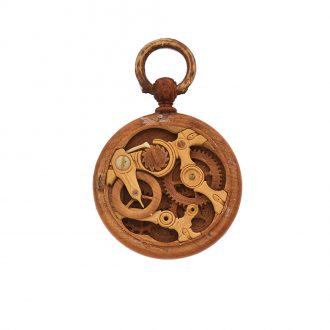
Russian pocket watch entirely made of boxwood Circa 1860
- Kenmerk
- FF0028
- Diameter
- 36 mm
- Estimate
- € 5.000 - 9.000
- Price sold
- -
Wooden pocket watch
–
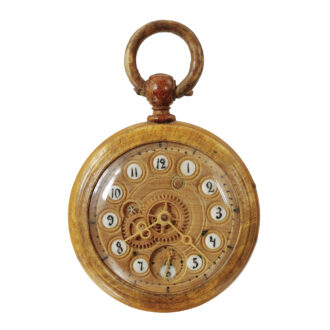
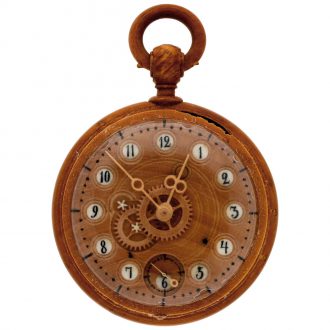
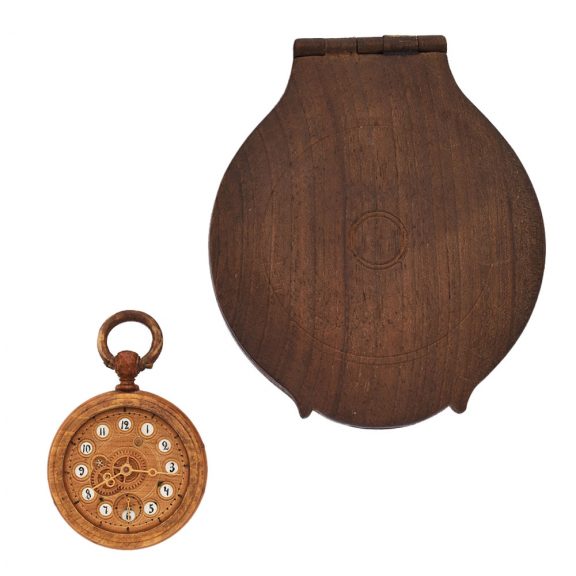
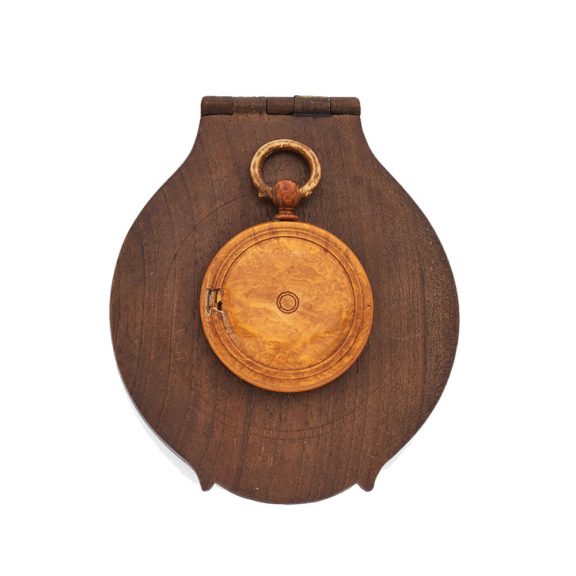
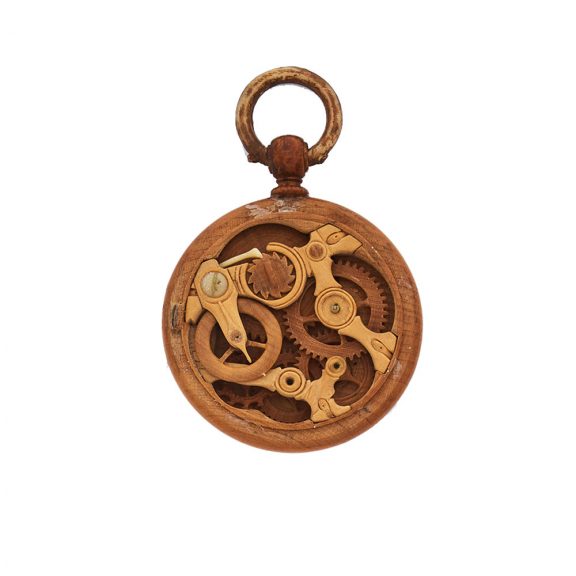
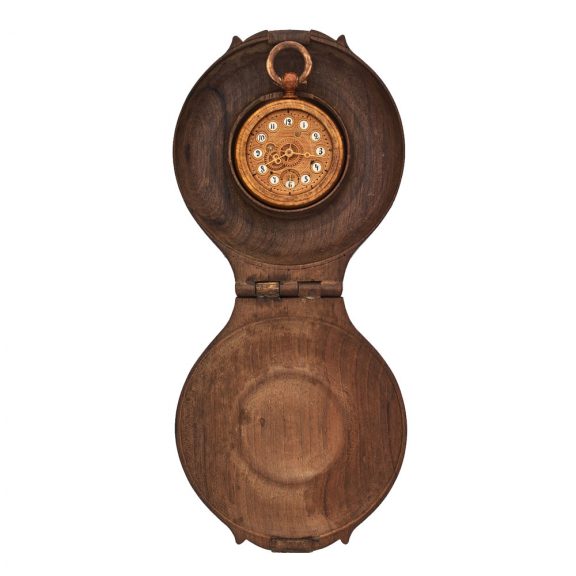
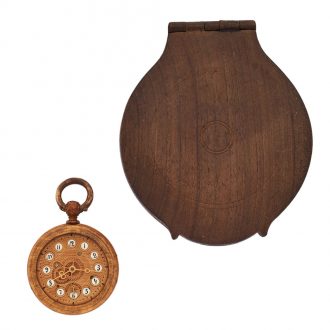
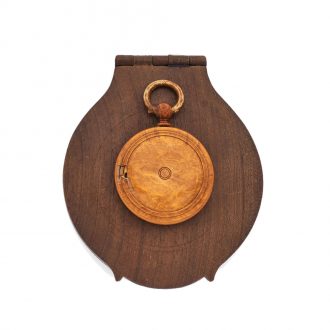
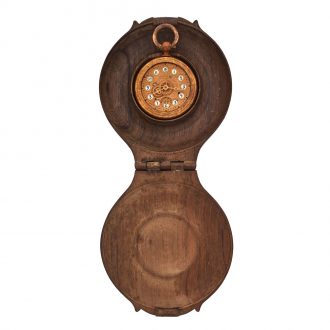
A Russian wooden pocket watch entirely in boxwood accompanied by an original period wooden case, circa 1865. Mechanical key wound movement entirely made of wood with pin bridges, barrel with steel mainspring, cylinder escapement, wooden balance with steel balance spring in the centre.
Wooden dial with white cartouches in Arabic numerals, pearled minute track and small second hand, skeleton mechanism visible in the centre.
Round watch in a circular box wood case, hinged back, bezel with ribs turned on the edges, signed inside in Cyrillic characters.
–
Diameter 35.5 mm
–
Signed: Mikhail Semynonovitch Bronnikov, Vjatka, Russia (today the city of Kirov)
–
Bronnikov’s inventive design features a movement which is an integral part of the case, the dial which serves as the pillar plate and the bridges and clock supported by brackets milled in the back part of the band. The same idea was later employed by the celebrated Albert Potter. Bronnikov, a family from Vjatka, Russia specialized in the making of all wood and all ivory watches. The first recorded member of the family was Ivan Bronnikov (c. 1770 – 1860), a joiner and turner. His son, Semyon Ivanovitch (1800 – 1875), made a pocket watch entirely carved out of wood for an 1837 exhibition. The future czar Alexander II is said to have purchased the watch. Two of Semyon’s seven sons, Mikhail Semyonovitch and Nicolai Semyonovitch, continued his work. Mikhail’s son Nicolai Mikhailovitch was the last watchmaker in the family.
–
Nicolai Mikhailovitch travelled to Moscow in 1909 or 1910 and is said to have worked there for the firm of Paul Buhre. The small town of Vjatka (population today is just over 400,000) is situated east of St. Petersburg on the river Vjatka, between the Volga and the Ural Mountains. It is an important metallurgical centre, which suggests that it was not for the lack of metal that the Bronnikovs made wooden watches. Unlike metal, wood is not subject to the thermal variations created by very warm and extremely cold temperatures. All-wood watches were expensive, selling for approximately 120 rubles whereas a gold watch cost from 90 to 100 rubles. In 1867 the Russian Ministry of Internal Affairs ordered two pairs of Bronnikov watches. A Prize was won for wood and ivory watches at the St. Petersburg Exhibition in 1870.
–
In 1873, the Bronnikovs took part in the Vienna International Exhibition, and in 1896 Mikhail Semyonovitch won a silver medal for a palm wood watch with palm wood chain which he showed at the All-Russian Industrial Exhibition in Nizhny Novgorod. In 1900 Bronnikov watches were sent to the Paris International Exhibition. In 1902 Nicolai Mikhailovitch exhibited a birch wood watch at the All-Russian Exhibition in St. Petersburg. The clockwork parts were made of various woods, including walnut, honeysuckle, boxwood, and hardened bamboo; the cases were from birchwood, or boxwood, and the dials were often decorated with ivory or mother of pearl. Bronnikov watches feature an unusual type of construction: rather than having the wheels installed between two plates as is usually the case, the dial also serves as the pillar plate, as well as being an integral part of the case. These watches were not intended for everyday use but rather as expensive and rare souvenirs. Known signatures include ‘M.S. Bronnikov in Vjatka’, ‘The Bronnikov Brothers in Vjatka’, and ‘N.M. Bronnikov in Vjatka’.
Share this page: