Watch with ‘L’angelo della Vita’ enamel miniature Circa 1996
- Kenmerk
- SB0615
- Diameter
- 44 mm
- Estimate
- € 75.000 - 150.000
- Price sold
- € 209.400
Superb, fine and unique gold open faced lever with ‘L’angelo della Vita’
–
–
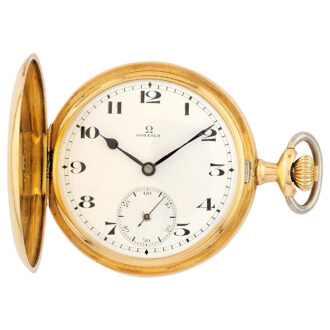
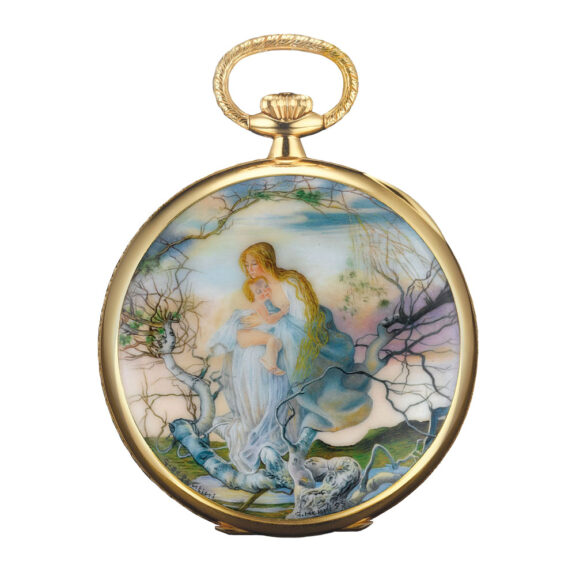
A superb, fine and unique Swiss gold open faced keyless lever watch with ‘L’angelo della Vita’ enamel miniature by G. Menni, circa 1996, manual winding nickel lever movement stamped with the seal of Geneva, mono-metallic compensation balance, 18 jewels. White enamel dial, Roman numerals, spade hands and subsidiary seconds. 18 Carat gold case, both polished bezels, band and bow finely engraved, polychrome enamel case back by G. Menni after a painting by Giovanni Segantini depicting the ‘Angel of Life’ (1894) bearing the painter’s name to the bottom left and the enameller signature to the bottom right. Case, dial and movement signed. With a Patek Philippe Certificate of Origin, a presentation case with outer packaging and an Extract from the Archives confirming production in 1996 and sale on October 28th, 1998.
–
–
Diameter 44 mm
–
Signed: Patek Philippe – G. Menni
–
The beautiful enamel scene is a miniaturization of the famed painting ‘L’angelo della Vita’ by the 19th century Italian artist Giovanni Segantini and bears the signature of G. Menni, 95. Menni is among Patek Philippe’s most celebrated enamellers, having painted approximately 50 miniature enamels for the firm from the early 1980’s until the late 1990’s. Along with Sussan Rhor, Menni is considered one of the finest in the rare art of miniature enameling and one of the select few considered skilled enough to sign their work for Patek Philippe.
–
Ref. 652 was produced from approximately 1936 until 1995, in the late 1960s Patek Philippe began enhancing examples of this reference with details such as engraving and enamel scenes, each decorated watch being created as a unique example.
–
The painting created by Giovanni Segantini (15 January 1858 – 28 September 1899) in 1894, called ‘L’angelo della Vita” (the angel of life) is associated with the tradition of redemption and regeneration. The mother was holding the baby lovingly in the pose of Madonna while the snow on the mountains behind began to melt. Fresh leaves were growing out of the seemingly dead birch tree, suggesting a possibility of rebirth. The tree in the painting is a religious symbol of the tree of life which, although bare and dead in the winter, will be reborn and blossom in the spring. This painting is traditionally regarded as one of Segantini’s masterpiece as it shows the manifestation of the change from ‘Valid naturalism Art’ to ‘Mystical Symbolism’ in 19th century paintings. This work has been exhibited in the most prestigious European Art Fairs as in the Central Committee in Rome to the International Sacred Art in 1894, in 1926 in Venice, in 1935 to the Paris Musée des Ecoles étrangères contemporaines, in 1956 in St. Gallen and in 1964 at Arco in Monaco.
–
Signed: Patek Philippe – G. Menni
–
The beautiful enamel scene is a miniaturization of the famed painting ‘L’angelo della Vita’ by the 19th century Italian artist Giovanni Segantini and bears the signature of G. Menni, 95. Menni is among Patek Philippe’s most celebrated enamellers, having painted approximately 50 miniature enamels for the firm from the early 1980’s until the late 1990’s. Along with Sussan Rhor, Menni is considered one of the finest in the rare art of miniature enameling and one of the select few considered skilled enough to sign their work for Patek Philippe.
–
Ref. 652 was produced from approximately 1936 until 1995, in the late 1960s Patek Philippe began enhancing examples of this reference with details such as engraving and enamel scenes, each decorated watch being created as a unique example.
–
The painting created by Giovanni Segantini (15 January 1858 – 28 September 1899) in 1894, called ‘L’angelo della Vita” (the angel of life) is associated with the tradition of redemption and regeneration. The mother was holding the baby lovingly in the pose of Madonna while the snow on the mountains behind began to melt. Fresh leaves were growing out of the seemingly dead birch tree, suggesting a possibility of rebirth. The tree in the painting is a religious symbol of the tree of life which, although bare and dead in the winter, will be reborn and blossom in the spring. This painting is traditionally regarded as one of Segantini’s masterpiece as it shows the manifestation of the change from ‘Valid naturalism Art’ to ‘Mystical Symbolism’ in 19th century paintings. This work has been exhibited in the most prestigious European Art Fairs as in the Central Committee in Rome to the International Sacred Art in 1894, in 1926 in Venice, in 1935 to the Paris Musée des Ecoles étrangères contemporaines, in 1956 in St. Gallen and in 1964 at Arco in Monaco.
Signed: Patek Philippe – G. Menni
Share this page: