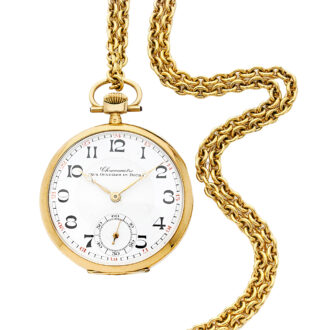
Highly important Swiss 18K gold pair cased watch Circa 1831
- Kenmerk
- SB0671
- Diameter
- 43 mm
- Estimate
- € 500.000 - 1.000.000
- Price sold
- € 825.000
–
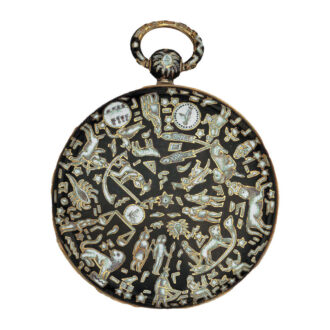
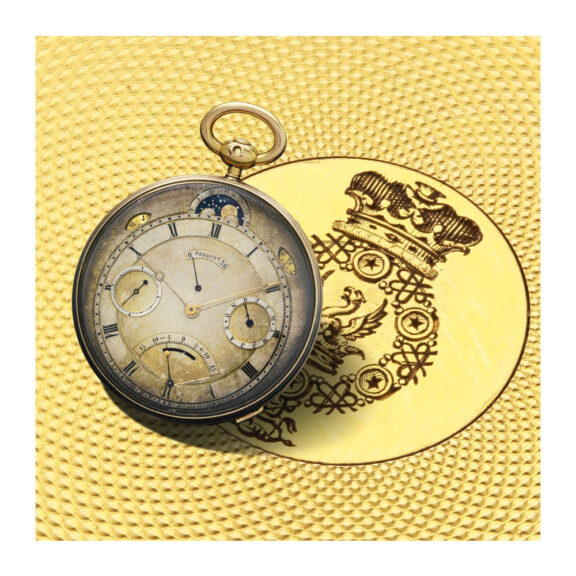
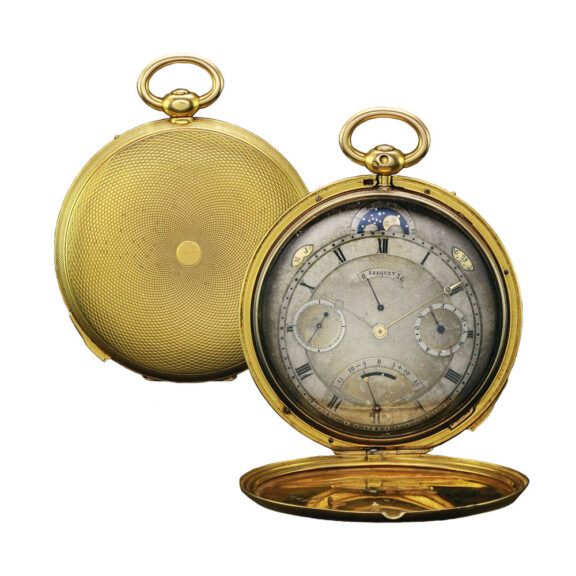
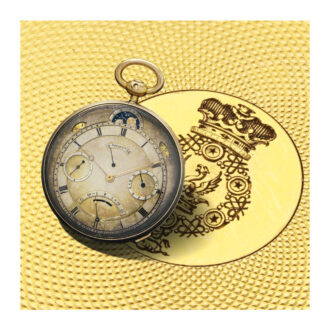
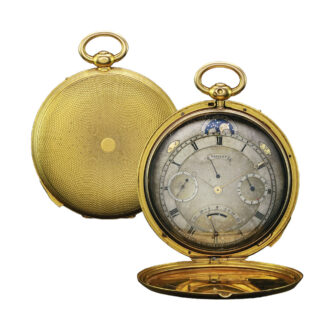
This highly important and historically interesting Breguet pocket watch was sold on 13 October 1831 to Lord Henry Seymour Conway for 7.000 francs. It has an extra-thin 18K gold pair case and is built on chronometer principles. Besides telling the time, it shows the equation of time, the power reserve, the date and the moon phases, and it repeats the hours, quarters and half-quarters on demand.
–
The gilt brass movement has a lever escapement, a compensation balance with a balance spring and regulator, and Breguet’s parachute shock protection. The repeater strikes with a hammer on a gong.
–
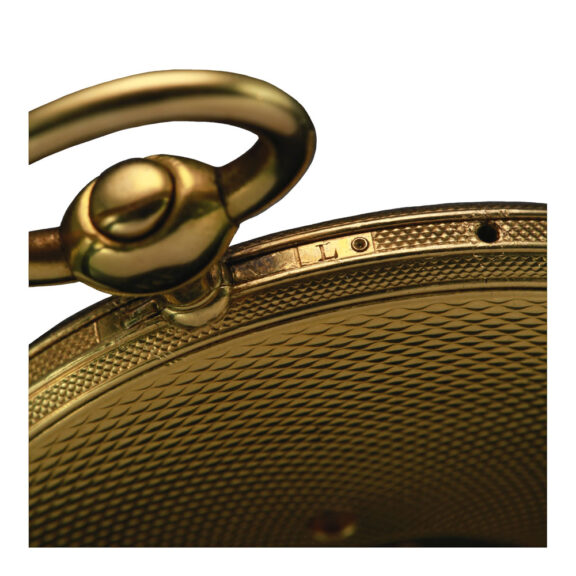
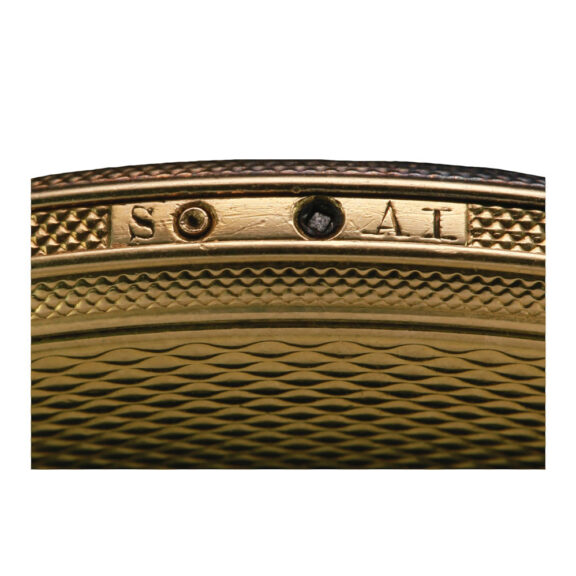
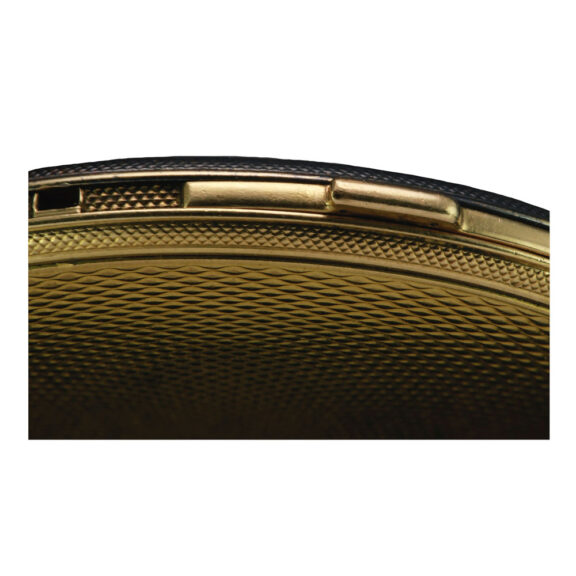
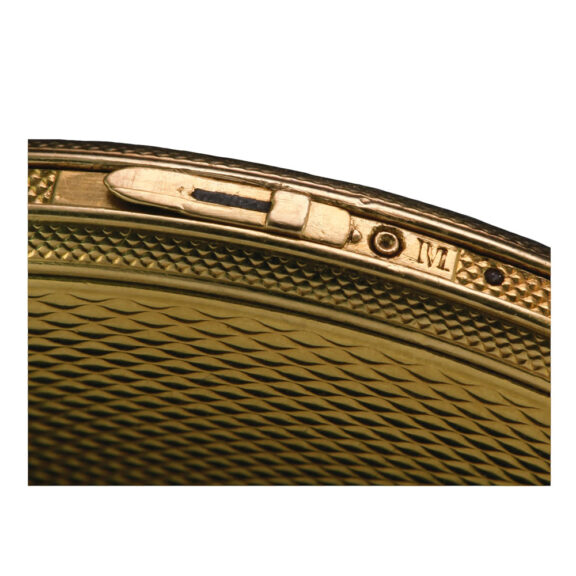
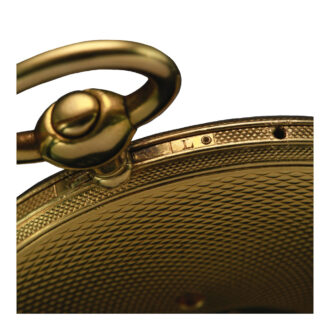
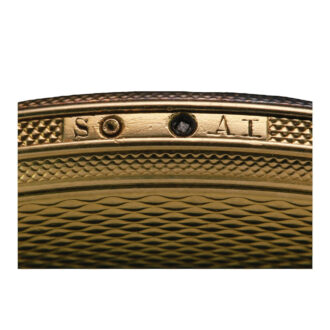
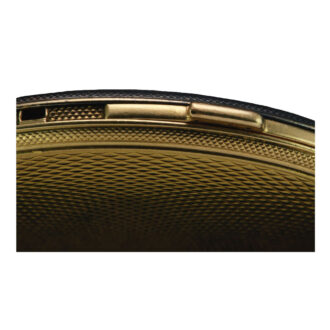
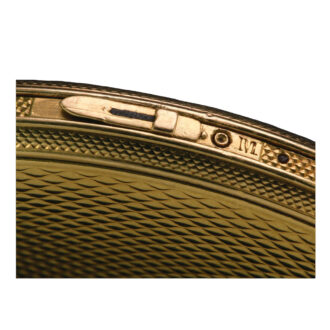
An outer guilloché case with a push button between XII and I to release the main body of the watch, the striking activated through a device between III and V o’clock. The inner case with a guilloché back featuring the Seymour family crest surrounded by the collar of the Order of the Garter, surmounted by a Royal Crown. The case band with a lever to open the hole for the winding key, a sliding device for the repeating mechanism and push pin corrector for the calendar function, a hole for setting the regulation device on the balance on the back.
–
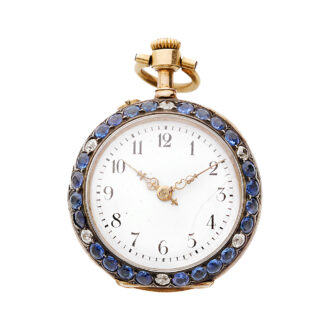
Silver guilloché dial with a sector for the equation of time between V and VII o’clock, a semi circular aperture for the slow/fast regulation indicator, subsidiary dials at IX for the auxiliary seconds and at III for months indicated by letters, apertures between I and II for the date and between X and XI for the day, an aperture for the moon phases above XII and power reserve indication below.
–
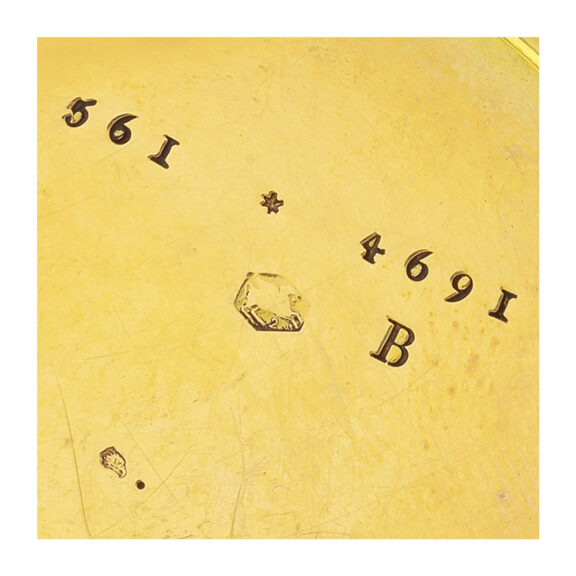
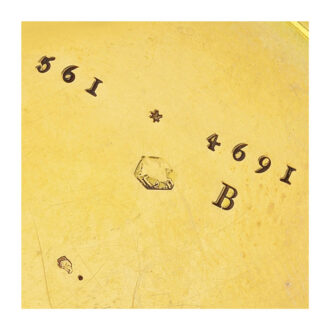
Cases stamped with maker’s mark LJ for Louis Joly and numbered with matching numbers, the inside case back numbered with a different number. Comes with a certificate dated 2008.
–
Thickness: 8.8 mm
–
Signed: Breguet
–
This historically important watch is one of the most complicated Breguet ever made in such a slim case.
–
Only three Breguet watches with this combination of complications and design are known today. Their highly complex movements in an extra-slim case make them among the most impressive and expensive watches Breguet ever made. When new, they sold for between 7.000 and 8.800 francs, an enormous sum at the time. The three watches are:
–
Breguet No. 4214
The first of the three watches was sold on 20 June 1827 for 7.800 francs to Captain Richard Seymour Conway (1800–1870), then known as Lord Yarmouth and later the 4th Marquess of Hertford. When he died, he left his fortune, including this watch, to his illegitimate son Sir Richard Wallace (1818–1890), the art collector and philanthropist. The watch later became part of Sir David Lionel Salomons’ Breguet collection. Today it is on display at the L.A. Mayer Museum for Islamic Art in Jerusalem (Inv. WA 87-71). George Daniels describes it in detail in The Art of Breguet (p. 269).
–
Breguet No. 4254
The second watch was sold on 1 November 1828 for 8.800 francs to the Marquis de Lamberville. It is similar to Nos. 4214 and 4691, but slightly simpler, because its dial has no power reserve indicator.
–
The Breguet archives show that it was serviced for the Marquise de la Tour du Pin Montauban on 29 December 1851, and for a Mr Brunet in 1853. On 16 February 1854 Breguet bought the watch back from Mr Brunet, restored it to new condition and gave it a new number, 717. On 27 June 1854 it was sold for 8.000 francs to Mr Moïana, on behalf of the Viceroy of Egypt, Saïd Pasha. In the same year it was serviced for him. After Saïd Pasha’s death in 1863, the watch passed to his successor, Ismaïl Pasha.
–
Breguet No. 4691: the present watch
The third and last watch of this kind is the present one, No. 4691. It is very close to the first, No. 4214, bought by Lord Yarmouth. It was sold on 13 October 1831 for 7.000 francs to Lord Henry Seymour Conway (1805–1859), whose eccentric behaviour earned him the nickname “Milord l’Arsouille”. He was the youngest son of Francis Charles Seymour Conway, 3rd Marquess of Hertford, and the younger brother of Lord Yarmouth. This made him the uncle of Sir Richard Wallace.
–
Lord Henry Seymour Conway, Captain Richard Seymour Conway and Sir Richard Wallace
Lord Henry Seymour Conway was a leading figure in the world of horse racing. In 1834 he founded the Jockey Club de Paris and became its first president. The club set out to encourage horse breeding in France. That same year France published its first racing rules and official racing calendar, fifty years after England.
–
The club’s exclusive members included two royal dukes. One of them was Ferdinand-Philippe, Duc d’Orléans, the eldest son of King Louis-Philippe. His family had been loyal clients of Breguet ever since the watchmaker started out in 1775. His grandfather, Louis-Philippe II, Duc d’Orléans, bought one of Breguet’s first self-winding watches.
–
At the time, a Breguet watch was highly fashionable and an instant sign of status. It is tempting to picture the Duc d’Orléans and Lord Henry admiring Breguet No. 4691 together. Five years later the Duc d’Orléans would own the extraordinary Breguet Sympathique.
–
Lord Henry died in Paris in August 1859, without heirs. The watch passed to his elder brother, Richard Seymour Conway, 4th Marquess of Hertford, who now owned both No. 4214 and No. 4691. Lord Henry was buried in the Hertford-Wallace family vault at Père Lachaise cemetery in Paris, where his brother and Sir Richard Wallace also lie.
–
Richard Seymour Conway, 4th Marquess of Hertford 1800–1870
Richard Seymour Conway was descended from the Dukes of Somerset and grew up in Paris. In 1829 he bought a townhouse in the rue Laffitte. He loved French culture and had a deep passion for French decorative art, especially the grace and elegance of the late 18th century. In 1835 he bought the Château de Bagatelle, a pavilion that had once belonged to the Comte d’Artois.
–
He lived in grand style and received the aristocratic, artistic and literary elite of Paris. His guests included Count Nieuwerkerke, Baron de Rothschild, Gioacchino Rossini, Napoleon III and Empress Eugénie. The Empress often came to Bagatelle while the Prince Imperial took riding lessons at a nearby stable.
–
With his great fortune, he spent 35 years collecting outstanding works of art. He began with 18th-century French masters such as Watteau, Greuze and Boucher, including Boucher’s Nymph Playing the Flute. He also collected fine furniture by great cabinetmakers such as Gaudreaus, Riesener and Leleu, much of it from the private apartments of Louis XV and Marie-Antoinette. These pieces found a natural home at Bagatelle, where he died in 1870.
–
He left all his property in Paris and London to his illegitimate son, Richard Jackson, later known as Sir Richard Wallace. Richard’s mother, Mrs Agnes Jackson, née Wallace, had had a long love affair with the Marquess.
–
Sir Richard Wallace 1818–1890
Richard Jackson, later known as Richard Wallace, was born in London on 26 July 1818. From the age of six he was brought up in Paris by his father, Richard Seymour Conway, and his grandmother. He later became his father’s private secretary.
–
In 1870 Wallace inherited his father’s vast fortune, estimated at 60 million francs. It included the unentailed estates and a large collection of European art. Wallace added to it, especially with medieval and Renaissance works. He also bought the collections of the Comte de Nieuwerkerke, Napoleon III’s Director of Fine Arts: European arms and armour, and medieval and Renaissance decorative art.
–
Wallace loved France and was a great philanthropist. During the Prussian siege of Paris he helped its people in many ways. He paid for military ambulances, homes for victims of the bombardment, and a hospital in Levallois, which still exists. In recognition, Queen Victoria honoured him in 1871. That same year France made him a Commander of the Legion of Honour.
–
After the siege and the Commune, the water network of Paris was badly damaged and drinking water had become expensive. In 1872 Wallace gave the city 40 drinking fountains, paid for entirely by himself. They were both useful and beautiful. They gave the poor free drinking water and offered an alternative to alcohol. The fountains, spread across the city, still bear his name today.
–
Wallace died in Paris on 20 July 1890. His widow left a large part of his collection of furniture, paintings and works of art to the British nation. Today it forms the Wallace Collection in London.
–
The watch after Wallace
Of the two watches, only Breguet No. 4691 stayed in the family after Wallace’s death. It passed to the heirs of his wife, Julie Castelnau. According to family tradition, the watch was to stay in the family until the death of the last member to bear the name Wallace.
Signed: Breguet
Share this page: