Highly important Swiss 18K gold pair cased watch Circa 1831
- Kenmerk
- SB0671
- Diameter
- 43 mm
- Estimate
- € 500.000 - 1.000.000
- Price sold
- € 825.000
Gold extra flat complicated lever watch
–
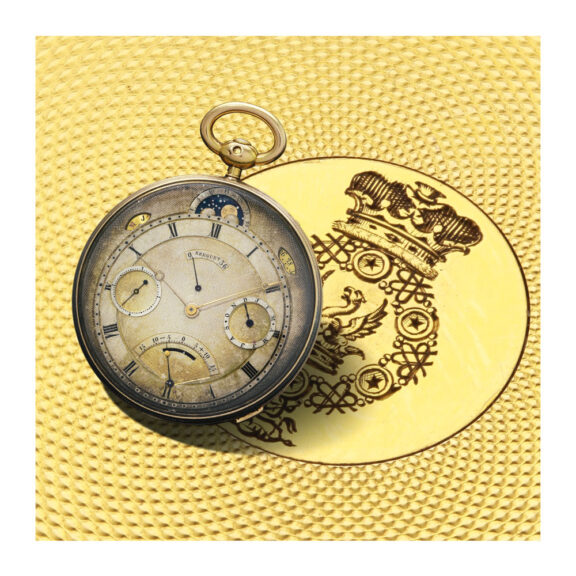
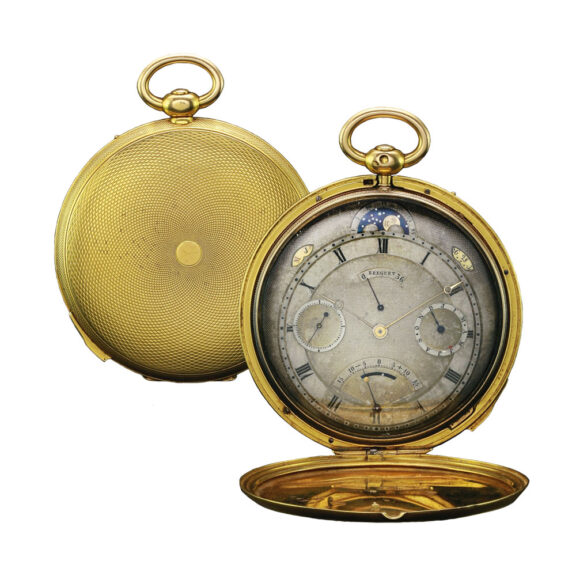
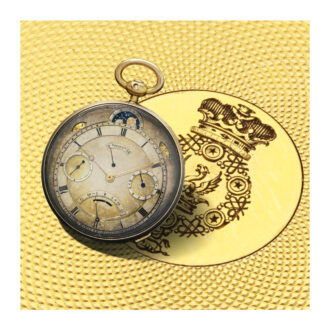
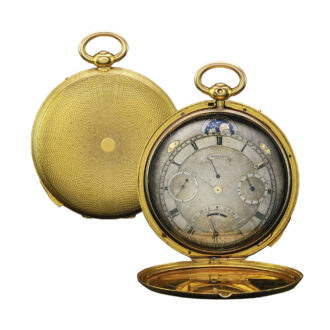
A highly important and historically interesting Swiss extra flat 18 carat gold pair cased half quarter repeating pocket watch with equation of time, power reserve indication, calendar and moon phases based on chronometer principles, circa 1831. Sold on October 13th, 1831, to Lord Henry Seymour Conway for the sum of 7.000 Francs. Gilt brass lever escapement with a compensation balance, parachute suspension and a spiral spring with regulator, striking and repeating with a hammer onto a gong.
–
A highly important and historically interesting Swiss extra flat 18 carat gold pair cased half quarter repeating pocket watch with equation of time, power reserve indication, calendar and moon phases based on chronometer principles, circa 1831. Sold on October 13th, 1831, to Lord Henry Seymour Conway for the sum of 7.000 Francs. Gilt brass lever escapement with a compensation balance, parachute suspension and a spiral spring with regulator, striking and repeating with a hammer onto a gong.
–
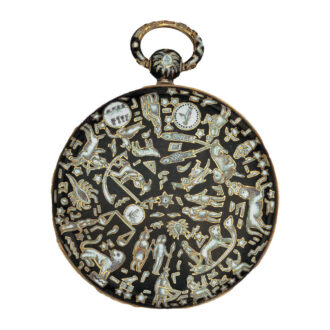
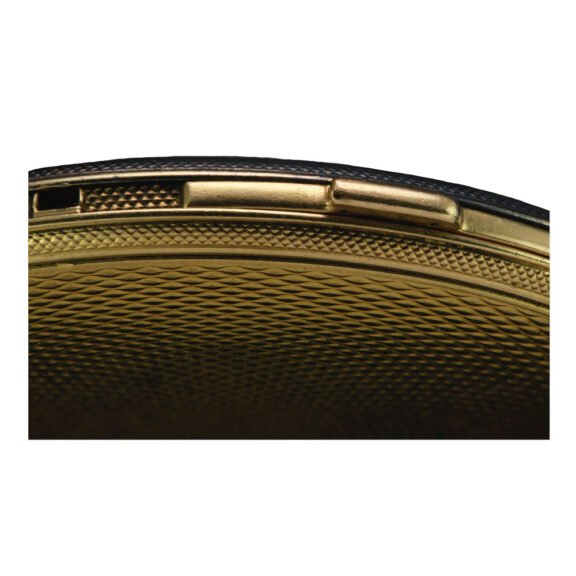
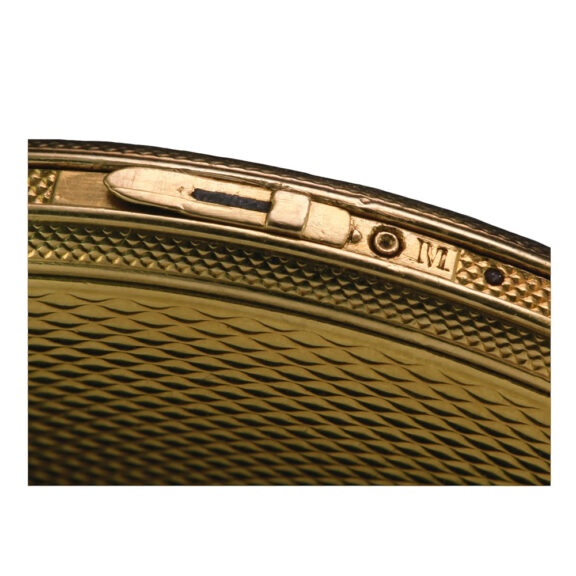
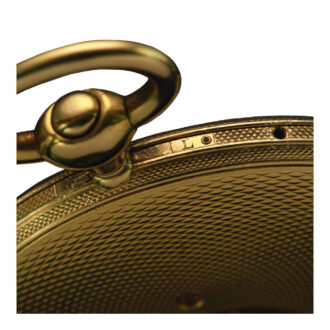
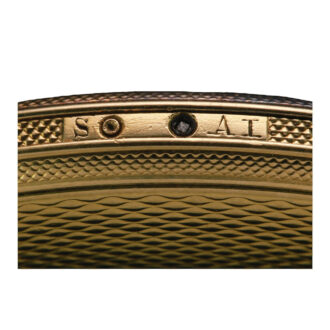
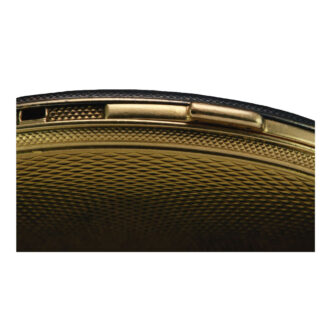
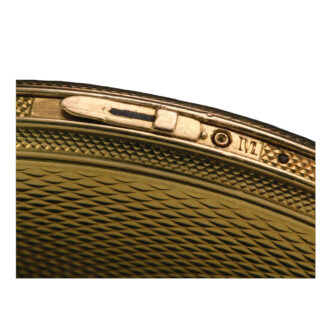
An outer guilloché case with a push button between XII and I to release the main body of the watch, the striking activated through a device between III and V o’clock. The inner case with a guilloché back featuring the Seymour family crest surrounded by the collar of the Order of the Garter, surmounted by a Royal Crown. The case band with a lever to open the hole for the winding key, a sliding device for the repeating mechanism and push pin corrector for the calendar function, a hole for setting the regulation device on the balance on the back.
–
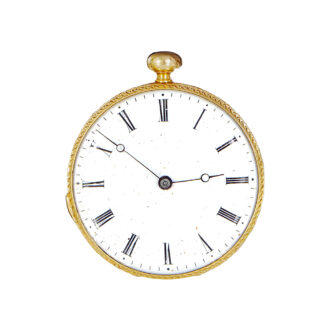
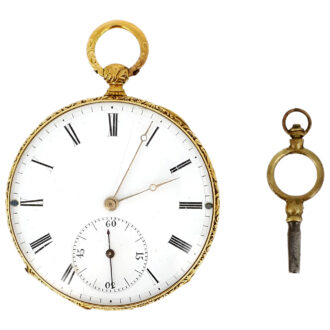
Silver guilloché dial with a sector for the equation of time between V and VII o’clock, a semi circular aperture for the slow/fast regulation indicator, subsidiary dials at IX for the auxiliary seconds and at III for months indicated by letters, apertures between I and II for the date and between X and XI for the day, an aperture for the moon phases above XII and power reserve indication below.
–
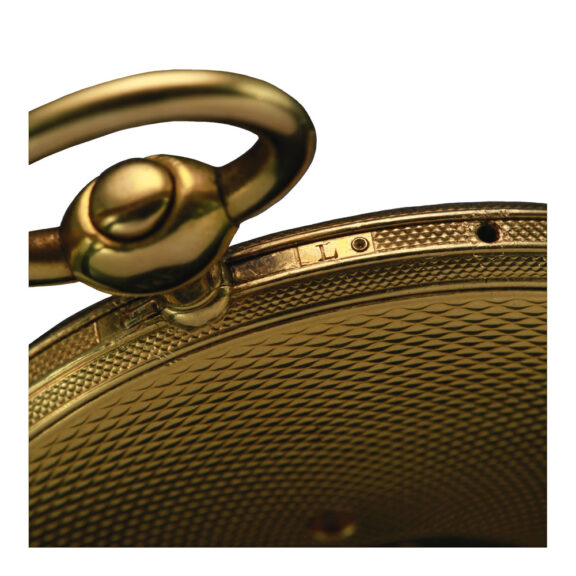
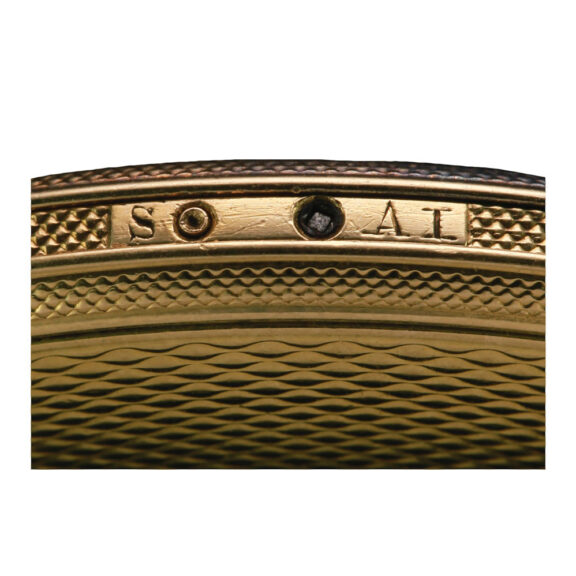
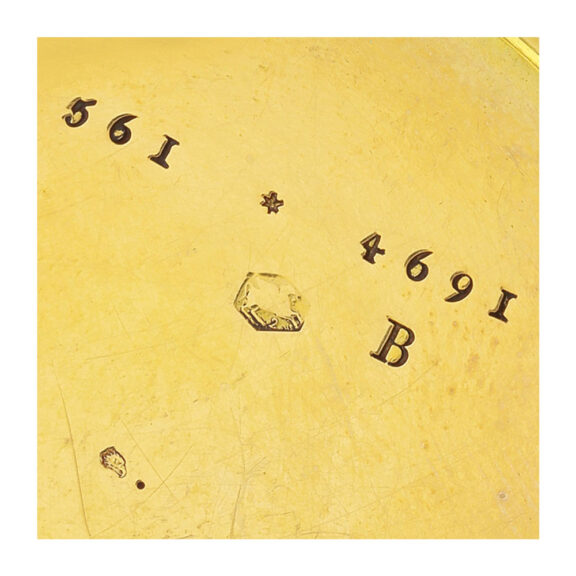
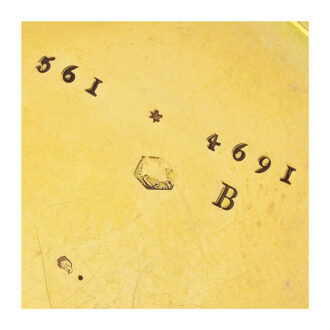
Cases stamped with maker’s mark LJ for Louis Joly and numbered with matching numbers, the inside case back numbered with a different number. Comes with a certificate dated 2008.
–
Silver guilloché dial with a sector for the equation of time between V and VII o’clock, a semi circular aperture for the slow/fast regulation indicator, subsidiary dials at IX for the auxiliary seconds and at III for months indicated by letters, apertures between I and II for the date and between X and XI for the day, an aperture for the moon phases above XII and power reserve indication below.
–
Cases stamped with maker’s mark LJ for Louis Joly and numbered with matching numbers, the inside case back numbered with a different number. Comes with a certificate dated 2008.
–
Diameter inner case: 42.6 mm
–
Diameter incl. outer case: 46.5 mm
Diameter inner case: 42.6 mm
–
Diameter incl. outer case: 46.5 mm
–
Thickness inner case: 7.7 mm
–
Thickness incl. outer case: 8.8 mm
–
Signed: Breguet
–
This timepiece is a historically interesting, highly important watch. It is one of the most complex examples to have been made by Breguet in such a slim case.
–
Today, only three watches are known to have been made by Breguet that pertain to such a specific complication type and design as found in the present watch. Their highly complex movements, contained within an extra slim case, make these some of the most impressive and expensive timepieces made by Breguet. Their original price of sale ranged from 7.000 to 8.800 Francs, an enormous sum of money at the time. These watches are the:
–
BREGUET 4214
Chronologically the first of the three timepieces, recorded as No. 4214. It was initially sold on June 20th, 1827, to Captain Richard Seymour Conway (1800-1870), 4th Marquess of Hertford (also known as Lord Yarmouth) for the sum of 7.800 Francs. Upon his death, Seymour Conway bequeathed his fortune, including the watch to Sir Richard Wallace (1818- 1890), his illegitimate son, an art collector and philanthropist. Later, the watch entered into the Breguet watch collection belonging to Sir David Lionel Salomons. This watch is exhibited today at the L.A. Mayer Museum for Islamic Art in Jerusalem (Inv. WA 87-71) and is precisely described in The Art of Breguet by George Daniels, p. 269.
–
BREGUET 4254
The second timepiece, No. 4254, was sold on November 1st, 1828, to Monsieur le Marquis de Lamberville, for the sum of 8.800 Francs. Although similar to numbers 4214 and 4691, the Breguet No. 4254 was slightly less complex as it was without a power reserve indication to the dial. The Breguet Archives note that No. 4254 was revised for Madame la Marquise de la Tour du Pin Montauban on December 29th, 1851, and, later, for a Mr Brunet, in 1853. Breguet purchased the watch back from Mr Brunet on February 16th, 1854, the watch was restored to a new state and transferred to Breguet’s new number of 717. On June 27th, 1854, the revised watch was sold to Mr Moïana for 8.000 Francs and marked for the account of His Majesty the Viceroy of Egypt. In 1854, the watch was revised for Saïd Pacha the Viceroy of Egypt after whose death the watch was passed, in 1863, to his successor Ismaïl Pacha.
–
BREGUET 4691
The third and final watch of its kind is the present timepiece, No. 4691. It is very similar to the first example, the Breguet No. 4214 bought by Lord Yarmouth. Sold for the sum of 7.000 Francs on October 13th, 1831, to Lord Henry Seymour Conway (1805-1859), commonly referred to as ‘Milord L’Arsouille’ due to his eccentric behavior. He was the youngest son of Lord Francis Charles Seymour Conway, third Marquess of Hertford and the younger brother to Captain Richard Seymour Conway (Lord Yarmouth). He was therefore also the uncle of Sir Richard Wallace (1818-1890), the famous art collector and philanthropist.
–
Lord Henry Seymour Conway, Captain Richard Seymour Conway and Sir Richard Wallace
–
Lord Henry Seymour Conway was known for his involvement within the Horse Racing society and was the founder and first President of the ‘Jockey Club de Paris’ in 1834, an organization which was known for encouraging and promoting horse breeding in France. The year 1834 saw the first publication, 50 years later than in England, of the French racing regulation along with the official French Racing Calendar.
–
The elite membership of the Jockey Club included two Royal Dukes, one of whom was Ferdinand-Philippe, the Duc d’Orléans and eldest son of King Louis Philippe. Ferdinand-Philippe’s family had been faithful patrons of Breguet since the horologist’s beginnings in 1775. Ferdinand-Philippe’s grandfather, Louis Philippe II, purchased one of Breguet’s first self winding watches. During this period, Breguet watches were highly fashionable and instantly marked the status of their owner. It is tempting to imagine the Duc d’Orleans and Lord Conway admiring the Breguet watch, No. 4691, together. Interestingly, five years later, the Duc d Orléans would be the owner of the extraordinary Breguet Sympathique.
–
Lord Seymour Conway died in August of 1859 in Paris, leaving no surviving heirs, therefore the watch was bestowed upon his younger brother, Richard Seymour Conway, 4th Marquess of Hertford who thus found himself in possession of two Breguet watches No. 4214 and 4691. Lord Henry Seymour Conway was buried in the Hertford Wallace family vault at Père Lachaise cemetery in Paris where his brother the 4th Marquess of Hertford, Richard Seymour Conway is also buried, alongside Sir Richard Wallace.
–
Richard Seymour Conway, 4th Marquess of Hertford (1800- 1870) came from the same fine British aristocracy. Descendant of the Duke of Somerset, Richard Seymour Conway was brought up in Paris where he acquired, in 1829, a hotel situated on Lafitte street. Consumed by French culture whilst nourishing a deep passion for the French decorative arts, he was seduced by ‘the pavilion’ reflecting the grace and elegance of the late 18th century. In 1835, he acquired La Folie de Bagatelle, which previously belonged to the Count of Artois. Lord Henry Seymour Conway lived a illustrious life, receiving the aristocratic, artistic and literary elite of Paris. In fact, he frequented noble persons including the Count Niewekerke, the Baron of Rothschild, Gioacchino Rossini, Napoleon III and even the Empress Eugenie, who often came to Bagatelle to attend horse riding lessons that the Imperial Prince took at a nearby riding stable. The owner of a considerable fortune, Richard Seymour Conway spent 35 years purchasing outstanding works of art, beginning with paintings by great masters of the 18th century in France, such as Watteau, Greuze and the Nymph playing the flute by François Boucher.
–
Added to the extensive collection was also prestigious furniture, mostly stamped by large cabinet makers: Gaudreaus, Reisener or Leleu, derived most often from the private apartments of Louis XV and Queen Marie Antoinette. These exceptional decorative ensembles naturally found their place in the Bagatelle Pavilion, where Richard Seymour Conway died. Richard Seymour Conway left all of his property in both Paris and London to his illegitimate son, Richard Jackson with whose mother, Mrs Alice Jackson, born Wallace he had had a long love affair with.
–
Richard Jackson, who subsequently took on the name Richard Wallace, was born in London on the 26th of July in 1818 and was brought up from the age of six years at Bagatelle, in Paris by his father, Richard Seymour Conway and grandmother. Later he acted as confidential secretary to his father. Richard Wallace was heir in 1870 to a vast fortune left by his father which was then estimated at 60 million Francs. The inheritance included his father’s unentailed estate and extensive European Art Collection, which Wallace later expanded by adding pieces, including several medieval and renaissance works of art to the collection. He also bought the collections of the European arms and armour as well as medieval and Renaissance decorative arts formed by the comte de Nieuwerkerke, Napoleon III’s Director of Fine Arts. Both a Francophile and philanthropist, Richard Wallace concerned himself with coming to the aid of Parisians who were hit by the Prussian occupation. Wallace was known for his benevolent endeavours, including the creation of military ambulances, homes for victims of the bombing and the construction in 1872 of a hospital (still existing) in Levallois. His generosity led to him being knighted by Queen Victoria in 1871 and during the same year, he additionally received ‘la Croix de Commandeur’ from the Légion d’Honneur’ in France.
–
Furthermore, after the siege of Paris and the Commune, the routing of water networks was badly damaged and water had become an expensive commodity. In 1872, Wallace took it upon himself to provide the city of Paris with 40 water fountains which had both a practical and an aesthetic function. The fountains helped the needy access drinking water and were also used to distract from the excessive alcohol consumption. The fountains which still bear his name today were built fully at Wallace’s expense and were distributed across the capital.
–
Wallace died on July 20th, 1890, in Paris. His widow donated to the British nation an important part of his collection, furniture, paintings and art objects, which today form the Wallace Collection national museum.
–
Only the No. 4691 Breguet watch remained in the family after Wallace’s death and went on to the heirs of his wife, Julie Castelnau, from whom he adopted Edmund, son of her first marriage. By oral tradition in the family since then, the watch was to remain in the same hands until the death of the last member bearing the name Wallace.
Thickness inner case: 7.7 mm
–
Thickness incl. outer case: 8.8 mm
–
Signed: Breguet
–
This timepiece is a historically interesting, highly important watch. It is one of the most complex examples to have been made by Breguet in such a slim case.
–
Today, only three watches are known to have been made by Breguet that pertain to such a specific complication type and design as found in the present watch. Their highly complex movements, contained within an extra slim case, make these some of the most impressive and expensive timepieces made by Breguet. Their original price of sale ranged from 7.000 to 8.800 Francs, an enormous sum of money at the time. These watches are the:
–
BREGUET 4214
Chronologically the first of the three timepieces, recorded as No. 4214. It was initially sold on June 20th, 1827, to Captain Richard Seymour Conway (1800-1870), 4th Marquess of Hertford (also known as Lord Yarmouth) for the sum of 7.800 Francs. Upon his death, Seymour Conway bequeathed his fortune, including the watch to Sir Richard Wallace (1818- 1890), his illegitimate son, an art collector and philanthropist. Later, the watch entered into the Breguet watch collection belonging to Sir David Lionel Salomons. This watch is exhibited today at the L.A. Mayer Museum for Islamic Art in Jerusalem (Inv. WA 87-71) and is precisely described in The Art of Breguet by George Daniels, p. 269.
–
BREGUET 4254
The second timepiece, No. 4254, was sold on November 1st, 1828, to Monsieur le Marquis de Lamberville, for the sum of 8.800 Francs. Although similar to numbers 4214 and 4691, the Breguet No. 4254 was slightly less complex as it was without a power reserve indication to the dial. The Breguet Archives note that No. 4254 was revised for Madame la Marquise de la Tour du Pin Montauban on December 29th, 1851, and, later, for a Mr Brunet, in 1853. Breguet purchased the watch back from Mr Brunet on February 16th, 1854, the watch was restored to a new state and transferred to Breguet’s new number of 717. On June 27th, 1854, the revised watch was sold to Mr Moïana for 8.000 Francs and marked for the account of His Majesty the Viceroy of Egypt. In 1854, the watch was revised for Saïd Pacha the Viceroy of Egypt after whose death the watch was passed, in 1863, to his successor Ismaïl Pacha.
–
BREGUET 4691
The third and final watch of its kind is the present timepiece, No. 4691. It is very similar to the first example, the Breguet No. 4214 bought by Lord Yarmouth. Sold for the sum of 7.000 Francs on October 13th, 1831, to Lord Henry Seymour Conway (1805-1859), commonly referred to as ‘Milord L’Arsouille’ due to his eccentric behavior. He was the youngest son of Lord Francis Charles Seymour Conway, third Marquess of Hertford and the younger brother to Captain Richard Seymour Conway (Lord Yarmouth). He was therefore also the uncle of Sir Richard Wallace (1818-1890), the famous art collector and philanthropist.
–
Lord Henry Seymour Conway, Captain Richard Seymour Conway and Sir Richard Wallace
–
Lord Henry Seymour Conway was known for his involvement within the Horse Racing society and was the founder and first President of the ‘Jockey Club de Paris’ in 1834, an organization which was known for encouraging and promoting horse breeding in France. The year 1834 saw the first publication, 50 years later than in England, of the French racing regulation along with the official French Racing Calendar.
–
The elite membership of the Jockey Club included two Royal Dukes, one of whom was Ferdinand-Philippe, the Duc d’Orléans and eldest son of King Louis Philippe. Ferdinand-Philippe’s family had been faithful patrons of Breguet since the horologist’s beginnings in 1775. Ferdinand-Philippe’s grandfather, Louis Philippe II, purchased one of Breguet’s first self winding watches. During this period, Breguet watches were highly fashionable and instantly marked the status of their owner. It is tempting to imagine the Duc d’Orleans and Lord Conway admiring the Breguet watch, No. 4691, together. Interestingly, five years later, the Duc d Orléans would be the owner of the extraordinary Breguet Sympathique.
–
Lord Seymour Conway died in August of 1859 in Paris, leaving no surviving heirs, therefore the watch was bestowed upon his younger brother, Richard Seymour Conway, 4th Marquess of Hertford who thus found himself in possession of two Breguet watches No. 4214 and 4691. Lord Henry Seymour Conway was buried in the Hertford Wallace family vault at Père Lachaise cemetery in Paris where his brother the 4th Marquess of Hertford, Richard Seymour Conway is also buried, alongside Sir Richard Wallace.
–
Richard Seymour Conway, 4th Marquess of Hertford (1800- 1870) came from the same fine British aristocracy. Descendant of the Duke of Somerset, Richard Seymour Conway was brought up in Paris where he acquired, in 1829, a hotel situated on Lafitte street. Consumed by French culture whilst nourishing a deep passion for the French decorative arts, he was seduced by ‘the pavilion’ reflecting the grace and elegance of the late 18th century. In 1835, he acquired La Folie de Bagatelle, which previously belonged to the Count of Artois. Lord Henry Seymour Conway lived a illustrious life, receiving the aristocratic, artistic and literary elite of Paris. In fact, he frequented noble persons including the Count Niewekerke, the Baron of Rothschild, Gioacchino Rossini, Napoleon III and even the Empress Eugenie, who often came to Bagatelle to attend horse riding lessons that the Imperial Prince took at a nearby riding stable. The owner of a considerable fortune, Richard Seymour Conway spent 35 years purchasing outstanding works of art, beginning with paintings by great masters of the 18th century in France, such as Watteau, Greuze and the Nymph playing the flute by François Boucher.
–
Added to the extensive collection was also prestigious furniture, mostly stamped by large cabinet makers: Gaudreaus, Reisener or Leleu, derived most often from the private apartments of Louis XV and Queen Marie Antoinette. These exceptional decorative ensembles naturally found their place in the Bagatelle Pavilion, where Richard Seymour Conway died. Richard Seymour Conway left all of his property in both Paris and London to his illegitimate son, Richard Jackson with whose mother, Mrs Alice Jackson, born Wallace he had had a long love affair with.
–
Richard Jackson, who subsequently took on the name Richard Wallace, was born in London on the 26th of July in 1818 and was brought up from the age of six years at Bagatelle, in Paris by his father, Richard Seymour Conway and grandmother. Later he acted as confidential secretary to his father. Richard Wallace was heir in 1870 to a vast fortune left by his father which was then estimated at 60 million Francs. The inheritance included his father’s unentailed estate and extensive European Art Collection, which Wallace later expanded by adding pieces, including several medieval and renaissance works of art to the collection. He also bought the collections of the European arms and armour as well as medieval and Renaissance decorative arts formed by the comte de Nieuwerkerke, Napoleon III’s Director of Fine Arts. Both a Francophile and philanthropist, Richard Wallace concerned himself with coming to the aid of Parisians who were hit by the Prussian occupation. Wallace was known for his benevolent endeavours, including the creation of military ambulances, homes for victims of the bombing and the construction in 1872 of a hospital (still existing) in Levallois. His generosity led to him being knighted by Queen Victoria in 1871 and during the same year, he additionally received ‘la Croix de Commandeur’ from the Légion d’Honneur’ in France.
–
Furthermore, after the siege of Paris and the Commune, the routing of water networks was badly damaged and water had become an expensive commodity. In 1872, Wallace took it upon himself to provide the city of Paris with 40 water fountains which had both a practical and an aesthetic function. The fountains helped the needy access drinking water and were also used to distract from the excessive alcohol consumption. The fountains which still bear his name today were built fully at Wallace’s expense and were distributed across the capital.
–
Wallace died on July 20th, 1890, in Paris. His widow donated to the British nation an important part of his collection, furniture, paintings and art objects, which today form the Wallace Collection national museum.
–
Only the No. 4691 Breguet watch remained in the family after Wallace’s death and went on to the heirs of his wife, Julie Castelnau, from whom he adopted Edmund, son of her first marriage. By oral tradition in the family since then, the watch was to remain in the same hands until the death of the last member bearing the name Wallace.
Signed: Breguet
Share this page: