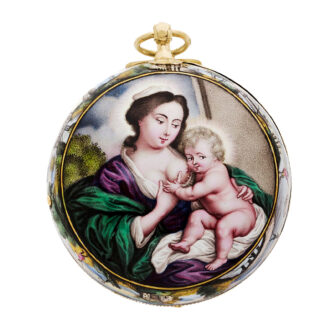
Superb English astronomical scallop-form verge watch 1665
- Kenmerk
- AS1624
- Diameter
- 52 mm
- Estimate
- € 50.000 - 120.000
- Price sold
- € 55.600
Gilt metal verge in rock crystal case by Josephus Quash
–
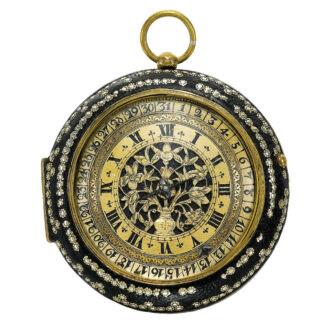
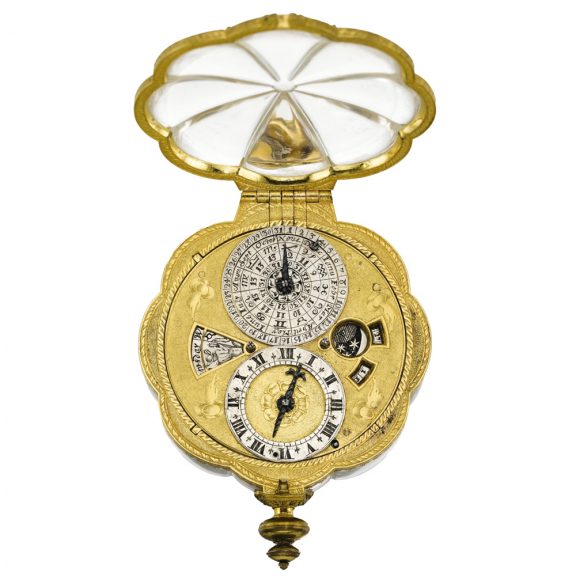
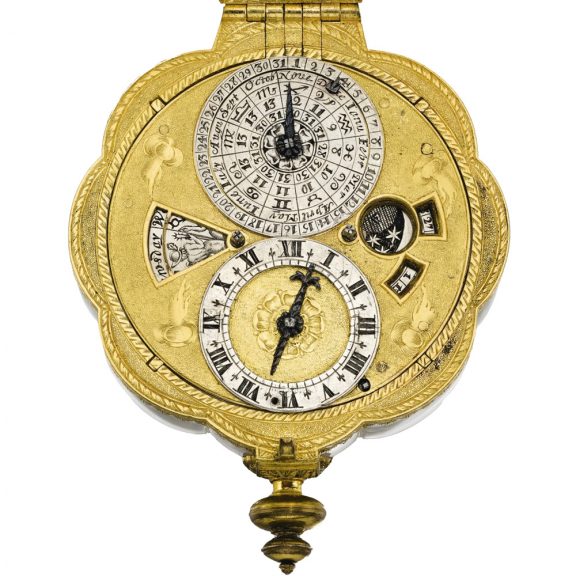
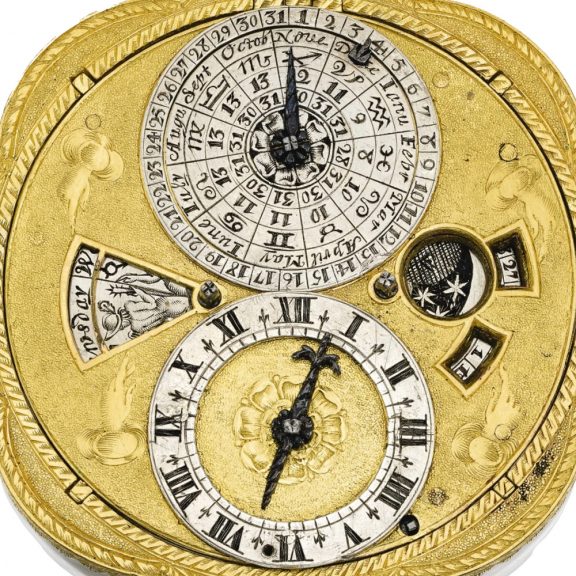
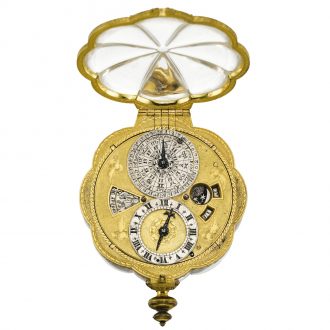
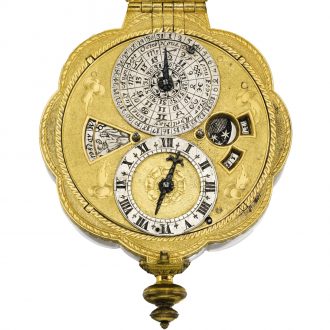
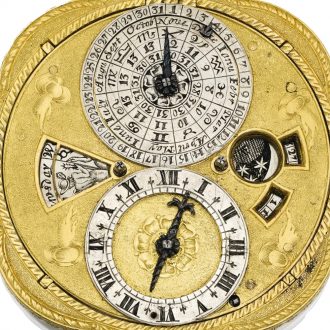
A magnificent over-sized English gilt metal astronomical rock crystal scallop-form pendant watch, circa 1665. This rare form watch features a gilded full plate movement with verge escapement, decoratively pierced and floral engraved silver screwed-on balance cock, plain flat steel balance, worm and wheel set-up, fusee and gut line, unusual silver fluted baluster pillars, and is signed by Josephus Quash of Londini. The dial is gilded with stippled ground, upper dial with central revolving disc indicating the date via a blued steel bug, turned blued steel hand indicating the month with corresponding signs of the Zodiac and dates in each month upon which the signs of the Zodiac commence and end according to the Julian calendar, lower dial with Roman numerals and quarter-hour divisions, turned blued steel fluorite hand, fan-form aperture indicating days of the week with corresponding allegorical figures, and three apertures to the right for moon-phases with the time of moon rise below and moon age above. The case is made of rock crystal scallop-form with radiating facets, engraved gilt metal mounts, fluorite pendant, and substantially turned terminal to base.
–
Diameter: 52 mm
–
Signed: Josephus Quash, Londini
–
With its large and impressive rock crystal case, this watch features a complex and skilfully arranged astronomical dial. The uppermost dial consists of a central revolving disc with four concentric rings and a fixed fifth outer ring. The inner two rings indicate the dates in each month when the signs of the Zodiac commence and end according to the Julian calendar, with the signs on the ring next to those dates. Both are read, together with the months shown in the third ring, against the central hand. The date is indicated via a bug mounted to the edge of the month disc. On the lower dial, a single hand indicates the hours on the Roman numeral chapter ring. The fan-shaped aperture to the left shows the days of the week with the corresponding allegorical figure, while all three apertures to the right relate to the moon – the circular aperture shows the moon phases, with windows directly above and below for moon age and time of moon rise. Astronomical dials of nearly identical design and layout to the present piece can be found on watches signed by other eminent 17th-century makers including Benjamin Hill – an example by the latter was formerly in the collection of George Daniels.
–
The silver chapter ring has been repaired in the past and is slightly warped, with scuffs and scratches on the surface. There is a blank hole to the left of the 6 o’clock position. The date ring has scuffs and light scratches, and the main surface has been re-gilded and is in attractive condition. The rock crystal has some light scratches but is generally in good condition, with some rubbing on the gilding of the terminal. The case is a rock crystal scallop form with radiating facets, engraved gilt metal mounts, a fluorite pendant, and a substantially turned terminal to the base. The movement is running at the time of cataloguing and is in clean condition.
–
Britten states that Joseph Quash was born around 1623 and apprenticed to George Smith through Oswald Durrant on October 11, 1637. He became a member of the Clockmaker’s Company on May 4, 1646. In his book “The Early Clockmakers of Great Britain” (NAG Press 1981, p. 452), Brian Loomes mentions that Quash bound several apprentices for other masters, including Ahasuerus Fromanteel, David Bouquet, and Robert Grinkin. Quash was working in London’s Blackfriars in 1662 and served as the Steward of the Clockmaker’s Company in 1674.
Signed: Josephus Quash, Londini
Share this page: