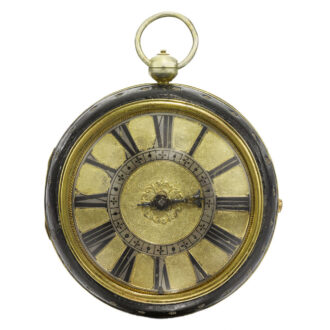
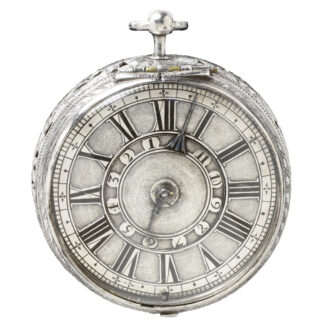
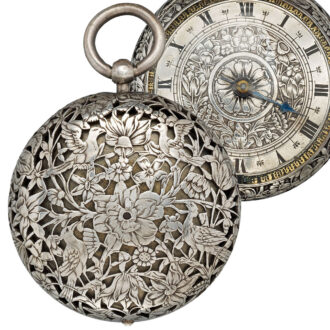
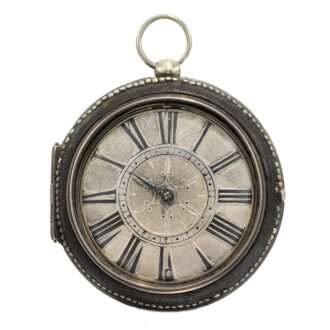
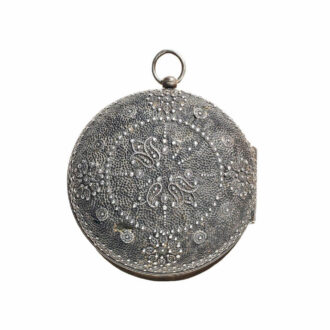
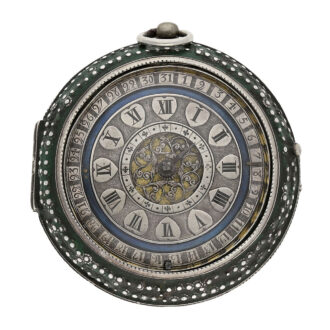
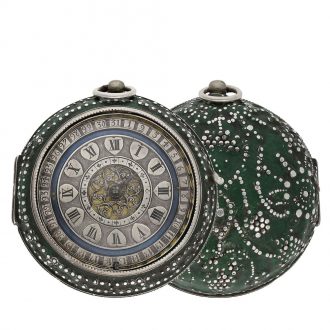
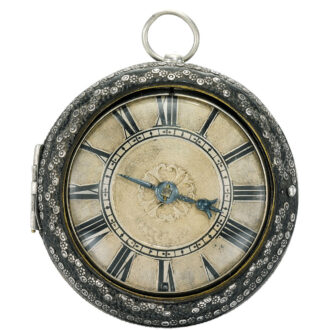
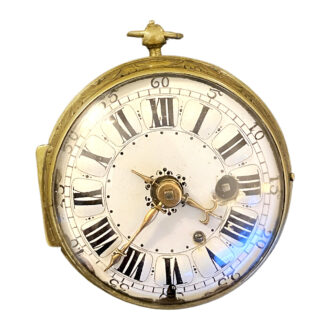
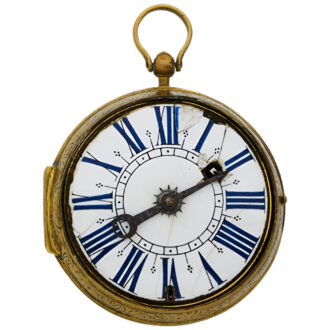
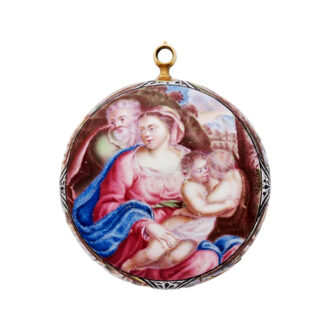
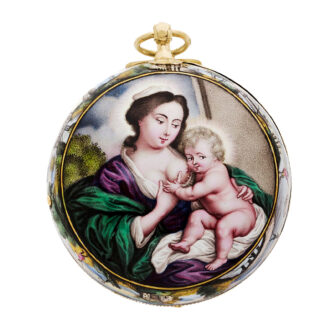
English silver single-handed astronomical verge watch Circa 1670
- Kenmerk
- FB0254
- Diameter
- 55 mm
- Estimate
- € 17.500 - 35.000
- Price sold
- € 22.550
Silver astronomical verge watch
–
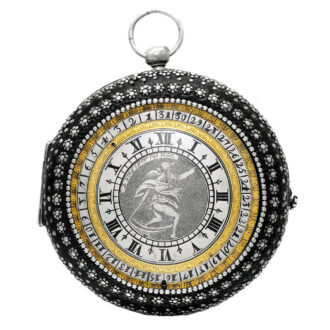
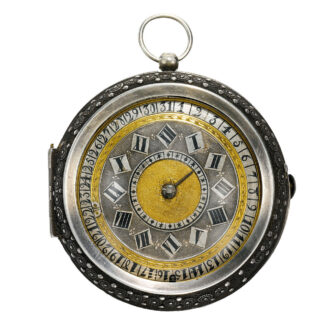
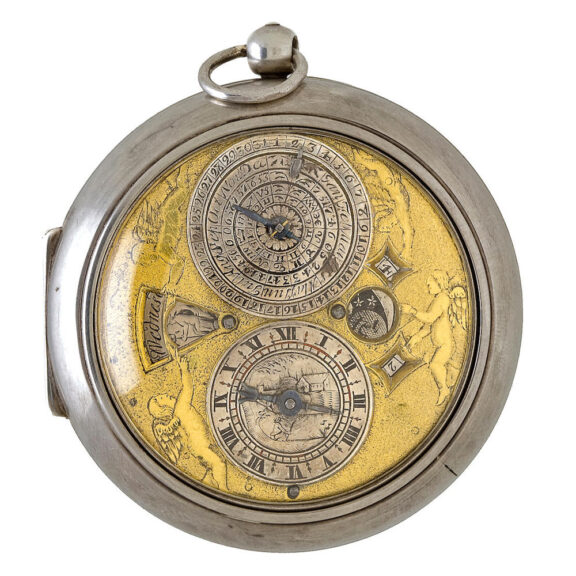
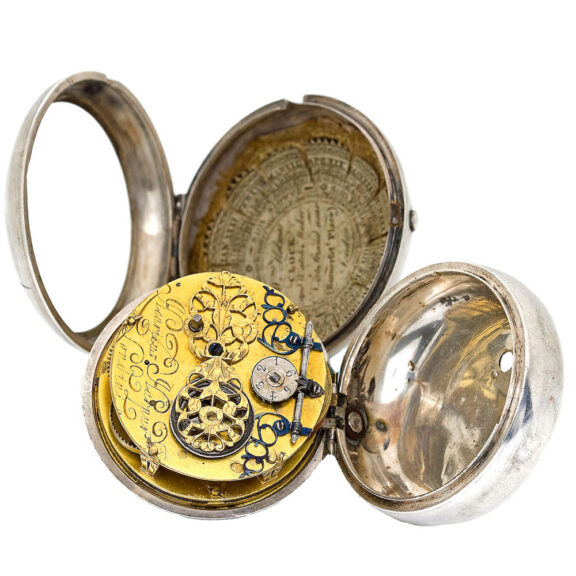
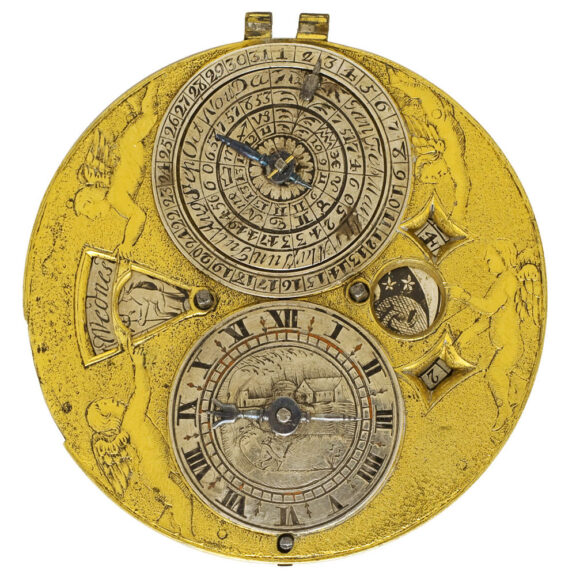
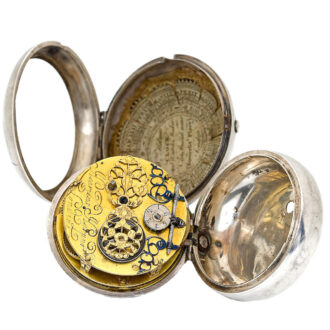
A rare pre balance spring single-handed English silver pair cased astronomical verge watch with year calendar indicating date, month, sign of the zodiac and time of sunrise with further indications for day of the week, and the age and aspect of the moon with the corresponding time of moonrise, circa 1670. Round pre-balance spring movement with Egyptian pillars, verge escapement with four-wheel train, fusee with gut line and regulation by means of [restored] tangent screw set up to the mainspring arbor; floral pierced cock secured to the backplate by means of a screw.
Matted gilt brass dial plate with two subsidiary silver dials and two groups of apertures between them; the plate further chased with cherubs pointing to the several apertures. The upper subsidiary dial is a calendar consisting of a fixed outer date ring enclosing a rotating disc carrying a blued steel pointer to indicate the date on the ring. The centre of this disc is engraved with sectors for each month and the corresponding sign of the Zodiac. Each sector also indicates the Julian day of the month on which the Sun enters each sign and, in addition, the average hour of sunrise for each month. To indicate the current month, a blued steel hand moves independently over the disc. The lower subsidiary hour dial has a Roman chapter ring enclosing an engraved scene of a riverbank with a town in the distance. There is a single-blued steel hand.
–
Diameter: 55 mm
–
Signed: Henricus Harpur Londini
–
The apertures between the dials each reveal a portion of a silver disc beneath. The indications are:
1. The day of the week and its ruling deity;
2. A set of three apertures positioned to show the age and aspect of the Moon and the time of moonrise.
There are setting squares adjacent to the apertures.
The calendar work is a self-contained unit pinned by means of three feet to the top plate of the movement. All the wheelwork is fitted into recesses within the calendar plate. A six leaf lantern pinon on the fusee arbor engages the hour wheel [30 teeth] which, in turn, has a lantern pinion of four leaves driving the day of the week wheel [56 teeth]. The 13-leaf pinon on the day wheel engages all three remaining wheels. The first of these is a silver moon disc [59 teeth] engraved with the figure of the moon and concentric rings of numerals for its age and time of rising. Finally, two superimposed wheels [60 & 62 teeth] carry, respectively, the Zodiac disc and month hand. These latter two wheels are held together by tension washers which permit them to slip past each other and move at different rates causing the hand to progress through the month sectors engraved on the disc.
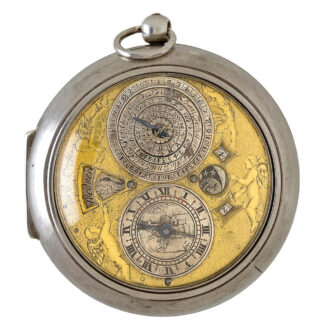
The cases are silver and plain except for the shutter to the winding aperture on the inner case. The pendant has a loose ring. Two pairs of steel springs on the edge of the calendar plate secure and release the movement from the case. 55mm diam. of outer case
This watch belongs to a small group of pre-balance spring English watches, all of which incorporate a similar year calendar display with concentric date and month indications, flanked by day of the week and lunar apertures. Similar calendar work can be found on slightly earlier French watches made during the first quarter of the 17th century. Although the watches seem to differ only in detail, no single watchmaker can be associated with them. Virtually all are signed by different makers. The earliest appears to be an oval silver watch by Robert Grinkin, Jr. (free 1632) which indicates the times of sunset rather than sunrise (Camerer Cuss Collection). Another, by Nathaniel Barrow (free 1660) has a Gregorian calendar and a movement that appears to have been modernized late in the 17th century.(Collection of the Clockmakers Company).
The design of the calendar as an attachment and its similarity to others by diverse makers suggests that the calendar plate was the work of a specialist and supplied to watchmakers as needed. Instrument making and clock making were allied trades and were closely associated through shared apprentices.
Signed: Henricus Harpur Londini
Share this page: