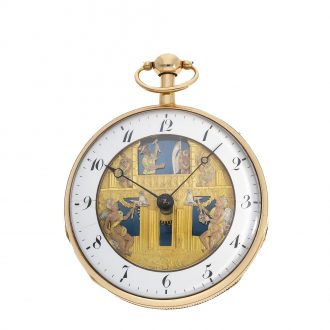
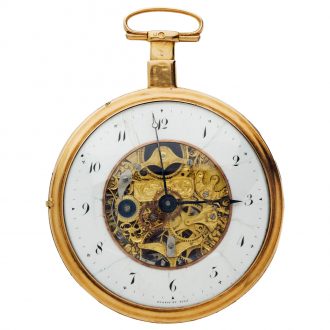
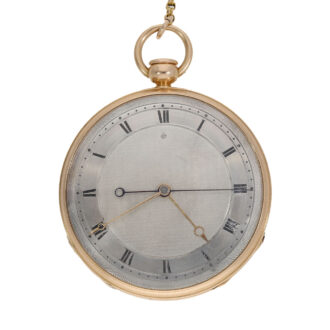
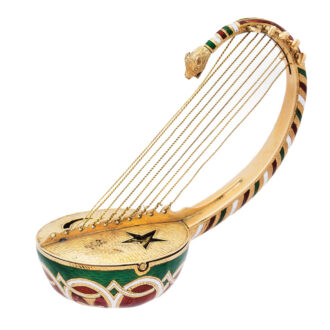
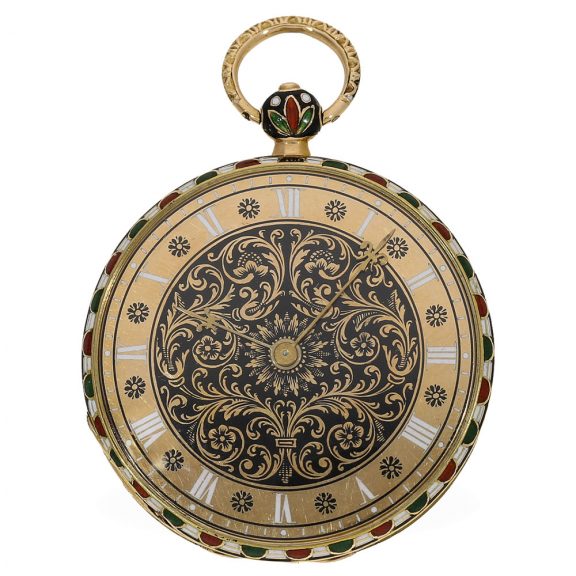
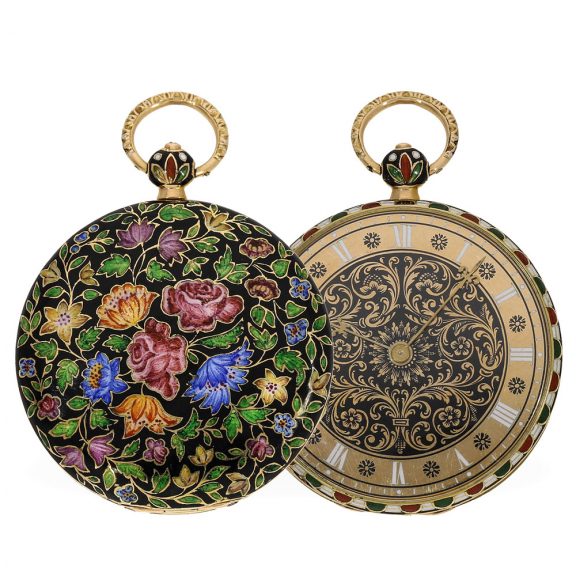
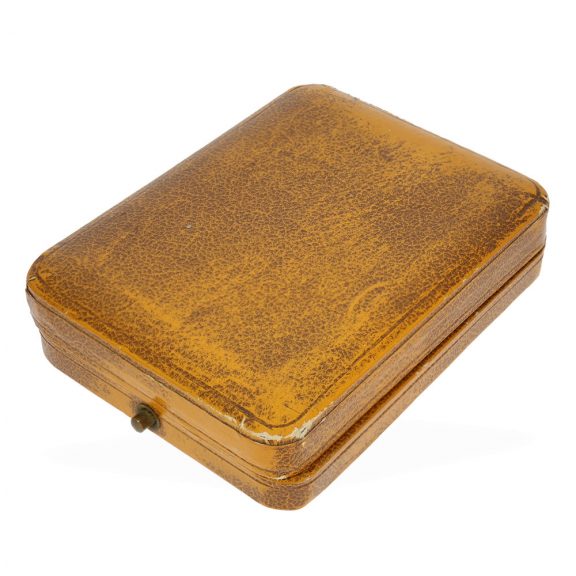
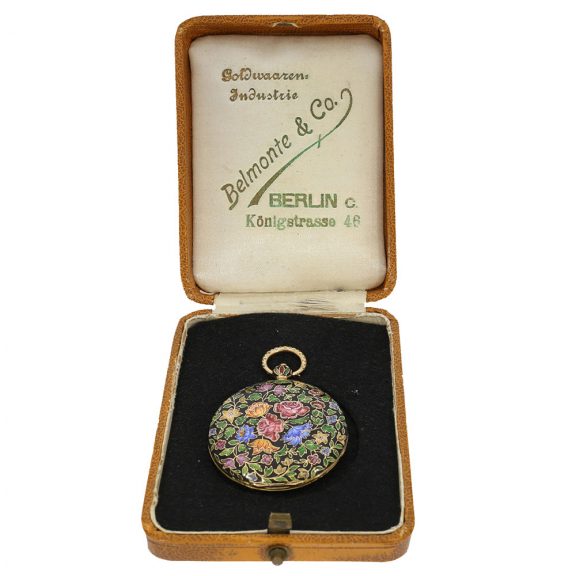
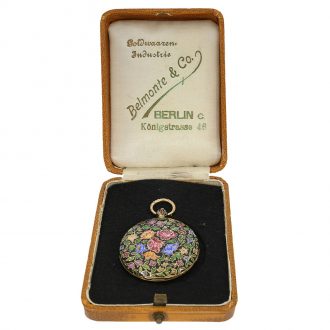
Swiss 18 carat gold and enamel cylinder pocket watch Circa 1820
- Kenmerk
- HC1090
- Diameter
- 38 mm
- Estimate
- € 2.500 - 6.000
- Price sold
- € 3.700
Gold decoratively enamelled watch
–
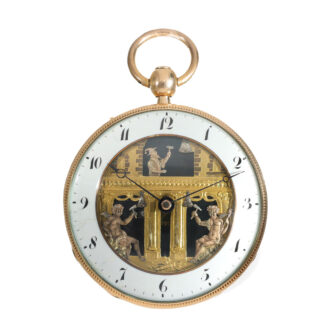
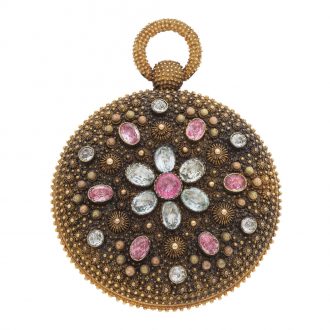
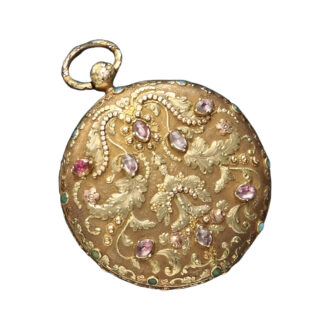
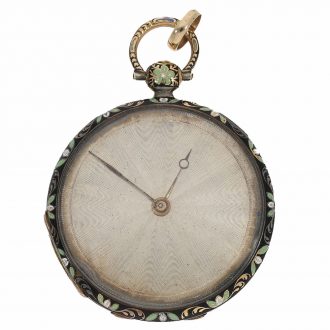
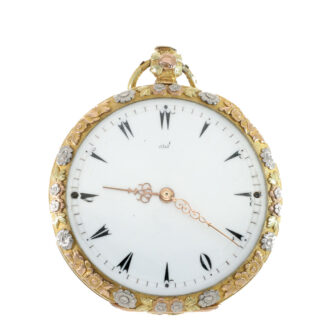
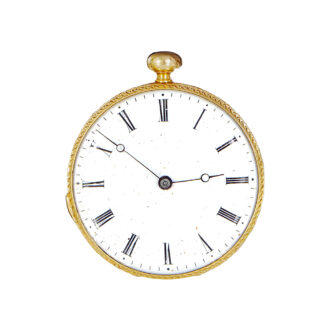
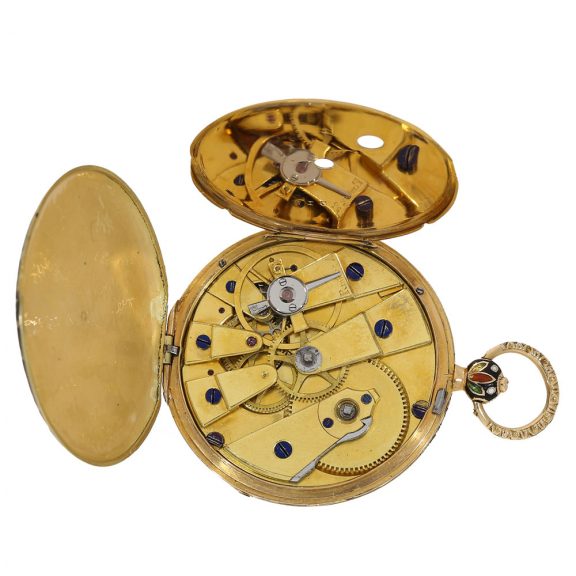
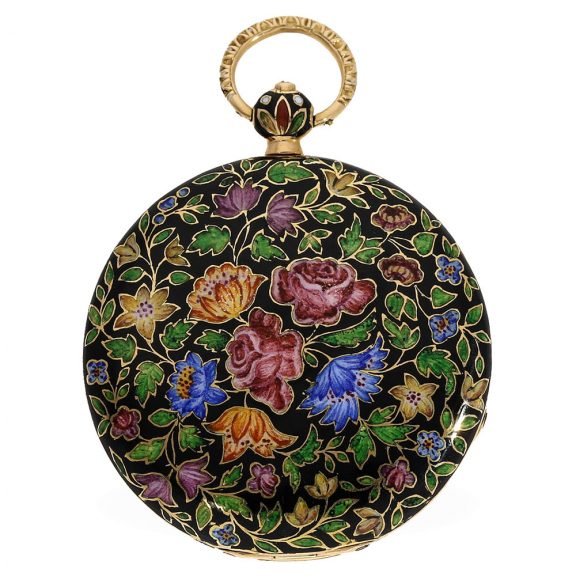
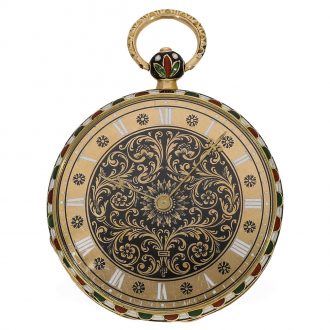
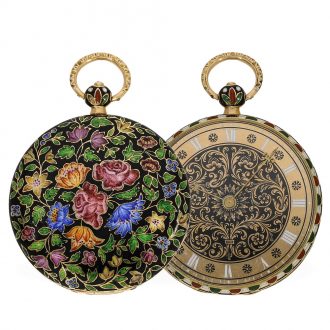
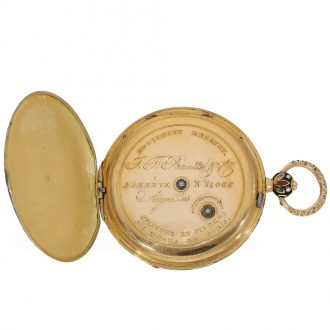
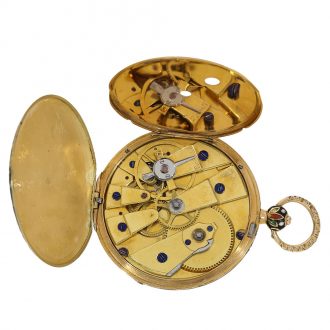
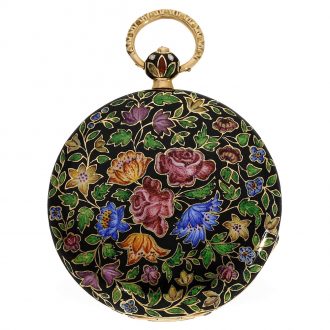
A numbered, exceptional quality gold and enamel pocket watch made by Bautte & Cie. in Genève, Switzerland, circa 1820. The open faced case of this watch was crafted from 18 carat gold and is decorated with extremely fine enamel work of multicoloured flowers against a black background in a golden frame on the back. The also of outstanding quality gold dial has central black enamel decoration, white Roman numerals for the hours, black floral half hour markers, outer minute divisions and gold fleur de lys hands. The movement has a lépine caliber and a cylinder escapement with six rubies.
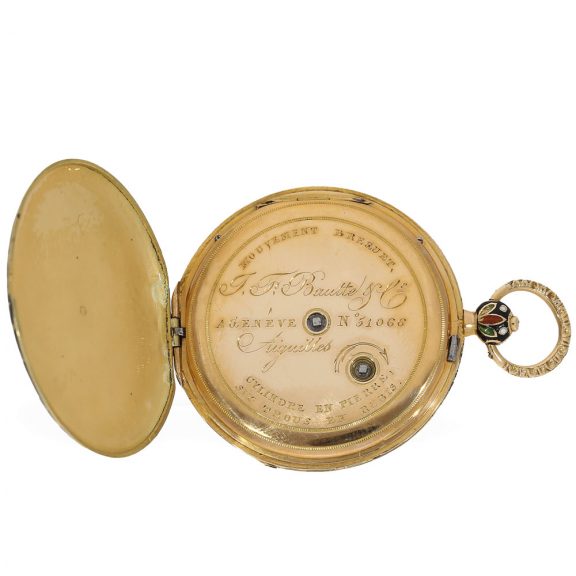
The cuvette is numbered, marked Mouvement Breguet and signed.
–
Diameter: 38 mm
–
Weight: 34 g
–
Signed: J.F. Bautte & Cie à Genève
–
Jean François Bautte
Jean-Francois Bautte was born on March 26, 1772, in Geneva. He was the son of the enamel painter Abraham Bautte (c. 1745-1772) and Marie Anne Mare (1747-1782). Jean-Francois was orphaned early as a baby. He later began working as a messenger for the case maker Jacques-Dauphin Moulinié (1761-1838), where he learned the craft of a case maker. This was followed by training as a guillocheur, watchmaker and goldsmith. In 1791, the 19 year old created his first watches.
–
Moulinie & Bautte
On August 1, 1793, he became Moulinié ‘s partner under the company name Moulinié & Bautte, case makers. This was followed by training as a guillocheur, watchmaker and goldsmith. From 1791, the 19 year old created his first watches. Moulinié and Bautte also traded in complete watches; the movements were usually bought in while the cases came from their production.
During this time, he married Susanne Jeanne Grandpierre. From this marriage, three children were born, Anne Bautte (1794-1875), Catherine Bautte (1796-1873) and Jacques-Dauphin Bautte (1806-1885). After Susanne died in 1832, he married Marthe Elisabeth Jacqueline Sechehaye (1794-1818) a year later,
–
Moulinie, Bautte & Moynier
After the Napoleonic Wars, the small factory grew into a manufactory that united all watchmaking crafts of the time under one roof. Watchmaker Jean-Gabriel Moynier joined the company on October 1, 1804. The company was now called “Moulinié, Bautte & Moynier” or “Moulinié, Bautte & Cie”. In those years, Bautte was the most important watch dealer in Geneva. The perfect craftsmanship, for which only the purest gold and enamel in wonderful colour nuances were used, impressed the customers immensely – such a quality was otherwise only found in Paris or London. As an outstanding businessman, Bautte traded with all European royal courts and thus became one of the most famous watchmakers.
–
Rossel Bautte & Cie
After his death, Jacques-Dauphin Bautte and Jean Samuel Rossel took over this factory, and it was renamed Rossel-Bautte & Cie . Jean Samuel Rossel was the son-in-law and married Catherine Bautte. The name was later changed to Rossel & Fils. The Bautte company was taken over by the Girard-Perregaux factory in 1906.
–
Jean-Francois Bautte died on November 30, 1837, and was buried at Plainpalais Cemetery in Genève.
Signed: J.F. Bautte & Cie à Genève
Share this page: