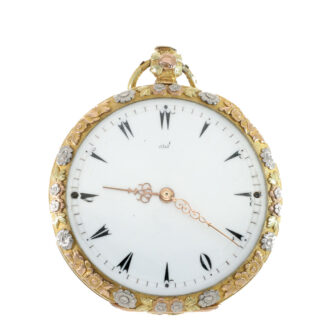
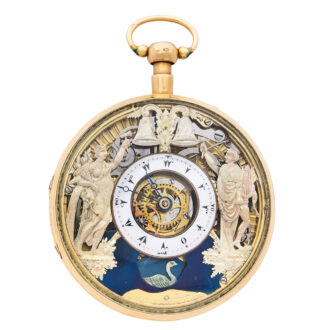
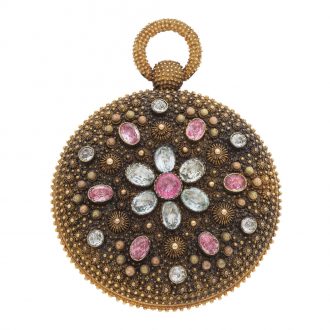
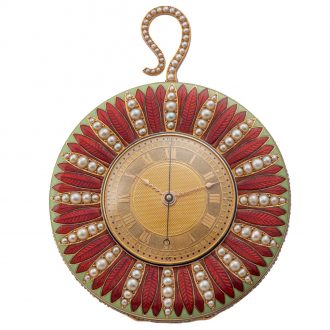
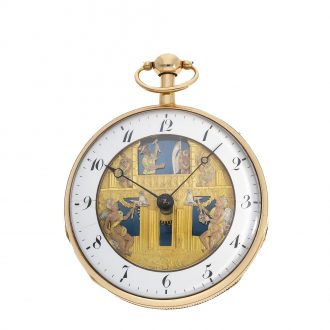
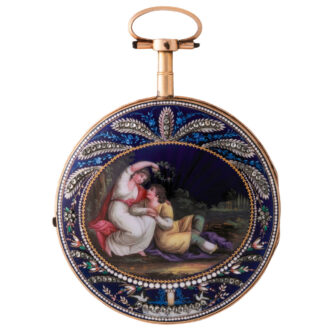
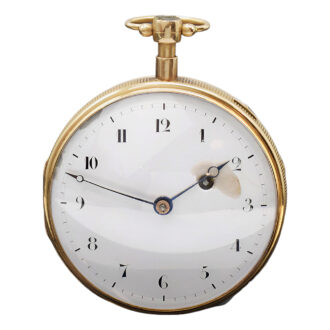
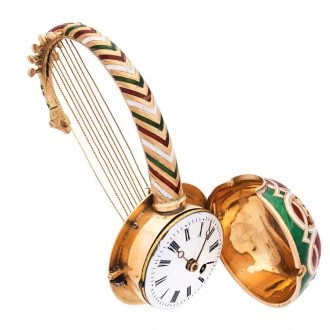
Fine Swiss 18 carat gold and enamel nanga form watch Circa 1820
- Kenmerk
- FF0025
- Diameter
- -
- Estimate
- € 7.500 - 15.000
- Price sold
- -
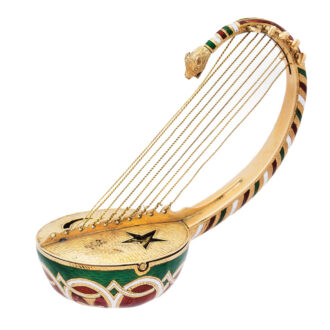
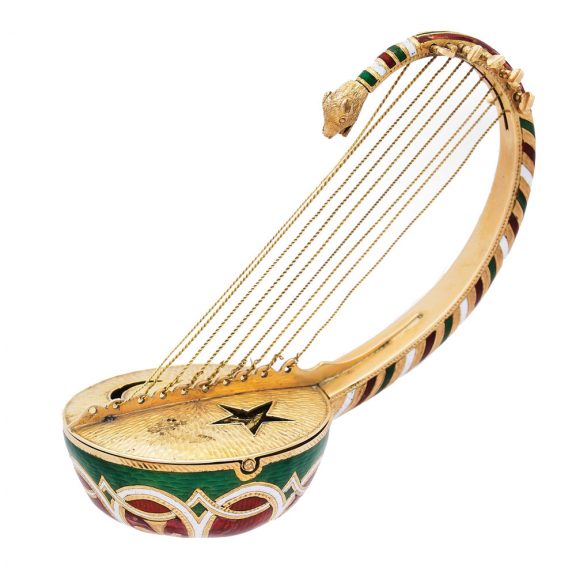
Large gold form watch The Nanga
–
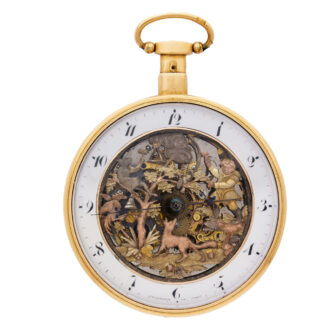
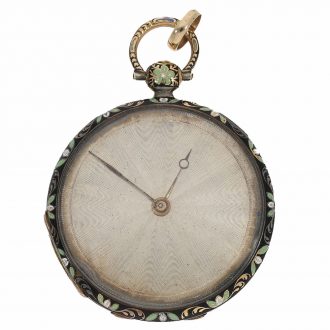
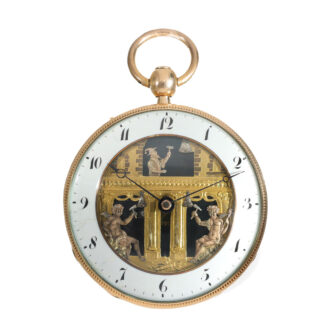
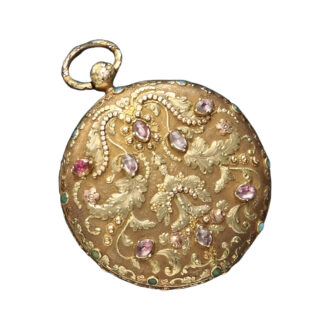
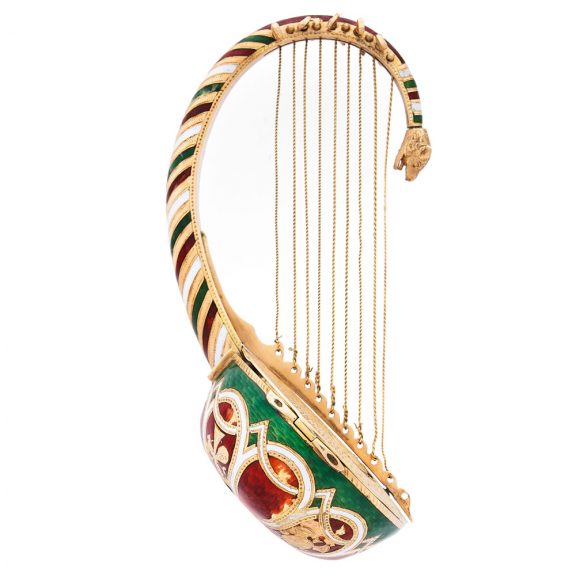
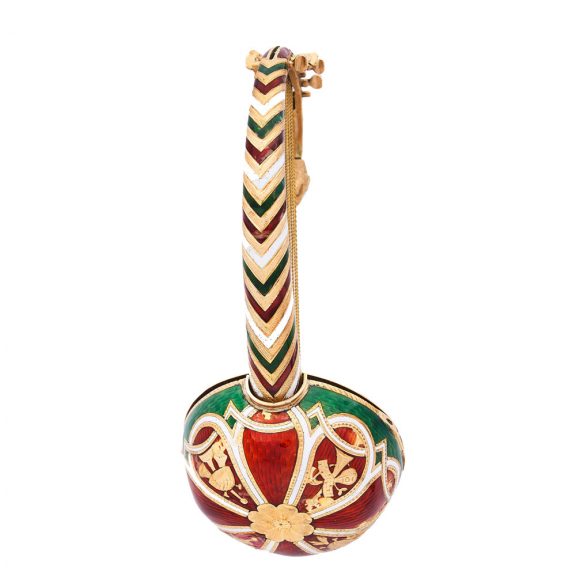
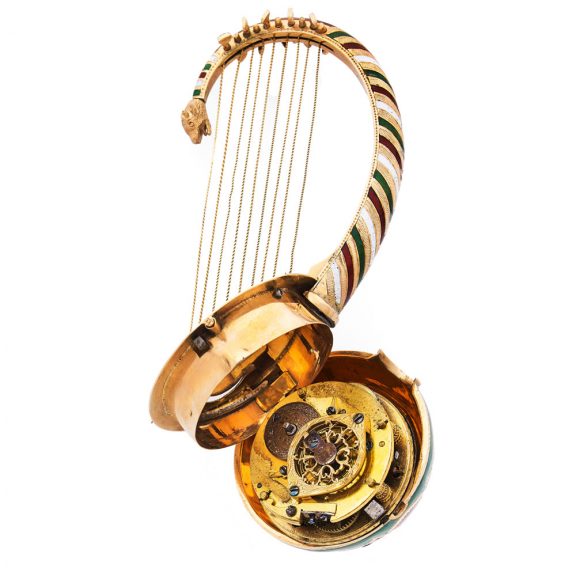
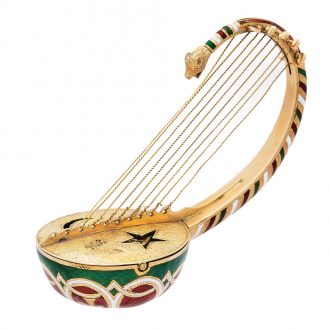
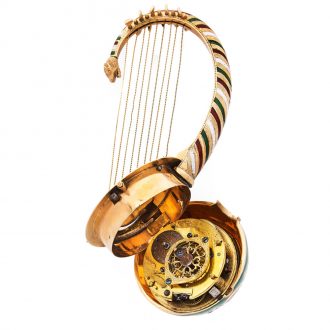
A Swiss 18 carat gold large form watch in polychrome enamel in the shape of an old harp called The Nanga, made for the Ottoman market, circa 1820. Full plate gilt movement with key winding, verge escapement, engraved and pierced cock, three piece balance, advance/delay adjustment on the balance bridge.
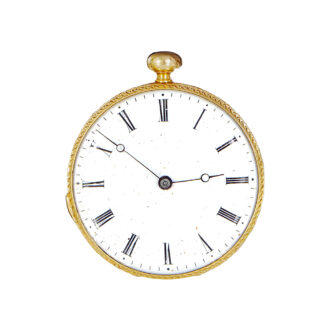
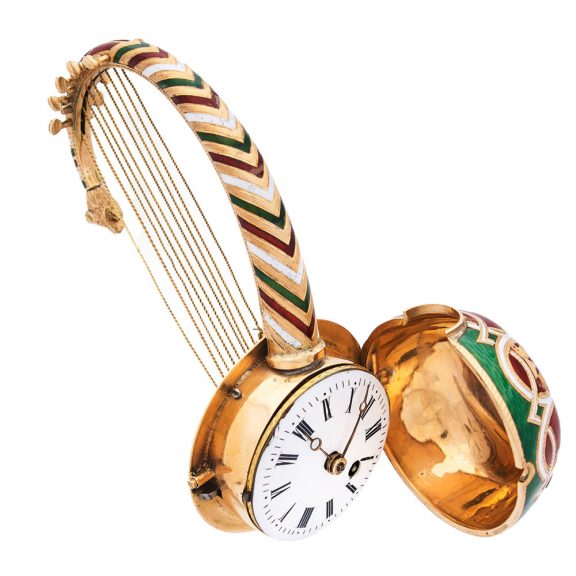
Concealed dial inside in white enamel with Roman numerals for the hours, stylized hands, stylized decoration on either side of the dial.
–
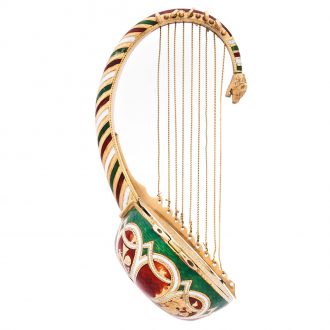
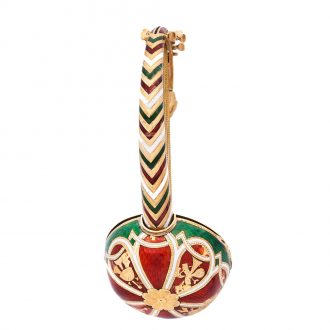
Hinged case in the shape of an old harp called The Nanga, a button on the case band to open the case, decorated with translucent green, white and red champlevé enamel, red enamelled background, centred with a stylised gold flower, the panels decorated with music trophies, yellow gold soundboard decorated with bark and pierced with the symbols of the star and the crescent, curved neck with white, green and red geometric decoration, nine gold strings, snake head at the end.
–
Diameter 32 mm
–
Length: 73 mm
–
Weight: 34.3 g
–
Signed: No name
–
In the Ottoman Empire, although the harp was not a traditional instrument in Ottoman or Turkish music, some types of plucked string instruments were used and played a role in the musical culture of the region. Ottoman music included a wide range of string instruments, but the Western harp as we know it today was not common. However, similar instruments and Western influences introduced some aspects of the harp to the Ottoman Empire, especially in the 19th century.
Similar Instruments in Ottoman Music
In Ottoman classical music, plucked string instruments such as the qanûn (plucked zither) and the oud (fretless lute) were popular. The qanûn, in particular, shares similarities with the harp in terms of playing technique (plucked strings) and sound. This instrument was highly regarded in Ottoman imperial courts and music salons.
–
Influence of Western Instruments and Cultural Exchange
With the opening of the Ottoman Empire to Western influences, particularly in the 19th century under Sultan Abdülmecid I, who promoted modernization and cultural exchange with Europe, some Western instruments, including the harp, began to appear in noble circles and at court. The harp, seen as a prestigious and sophisticated instrument, attracted attention and was played in more Westernized contexts, such as European-influenced classical music concerts.
The Harp in Ottoman Visual Arts and Literature
Although rare, the harp occasionally appears in Ottoman artistic representations, particularly in miniature form or in works influenced by Europe. Ottoman artists, curious about European novelties, sometimes integrated the harp into their works to symbolize cultural openness and musical richness.
Adaptation and integration in Ottoman music
While the harp was not part of the traditional instruments of Ottoman music, it began to be used in ensembles influenced by European classical music, particularly in concert contexts organized for European guests or within embassies.
Since Ottoman court music was already a fusion of various traditions (Turkish, Arabic, Persian, Greek), the integration of certain aspects of European music, including the harp, illustrates a desire for modernization and cultural diversity.
Although the harp is not a traditional instrument of Ottoman music, it was gradually introduced into the Ottoman Empire through cultural exchanges with Europe, particularly in the 19th century. Its influence was felt most in circles close to the imperial court and among the elite, reflecting the growing interest of the Empire in Western arts and musical practices.
The Nanga, the most primitive form of ancient harp
The Nanga is the most primitive form of ancient Egyptian harp. The Nanga consisted of a wooden body shaped like a boat or arch, the back of which was divided in the centre by a soundbar built into the back; on this bar was fixed a cylindrical stick around which one end of the strings was wound, the soundboard or parchment being stretched over the back without interfering with the stick.
The other end of the strings was fixed to pegs placed on the side of a curved neck, so that the strings did not rest directly on the soundboard. There were only 3 or 4 strings, each producing only one note. Some of these nangas are on display in the British Museum.
Share this page: