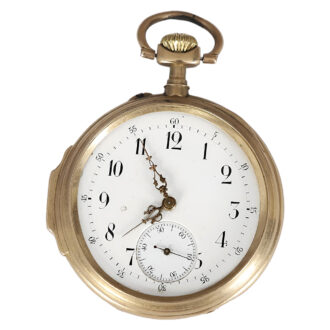
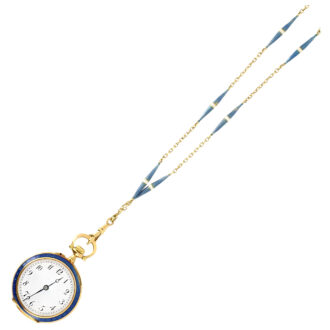
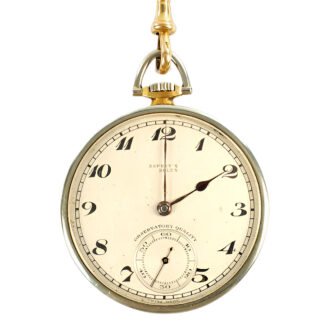
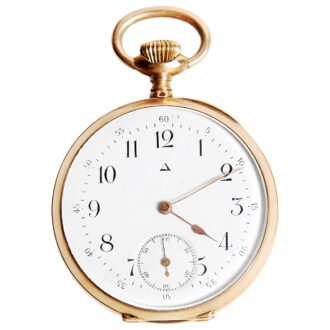
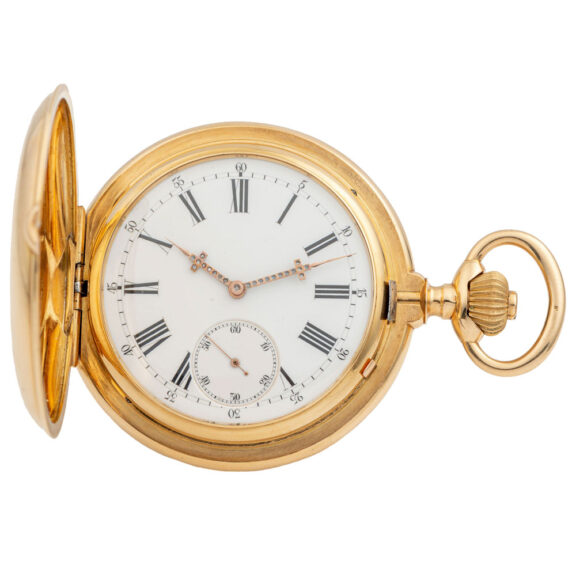
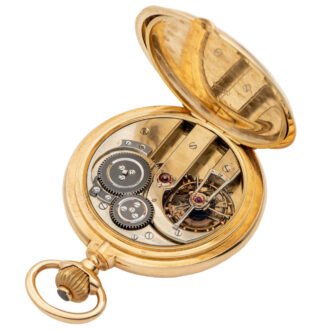
Swiss gold watch with one minute tourbillon Circa 1900
- Kenmerk
- TA5466
- Diameter
- 56 mm
- Estimate
- € 40.000 - 80.000
- Price sold
- -
Gold watch attributable to Albert Pellaton-Favre
–
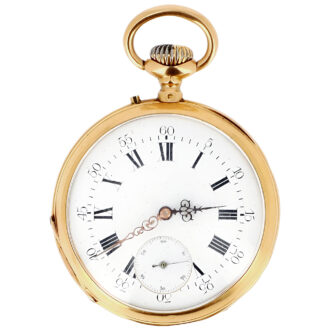
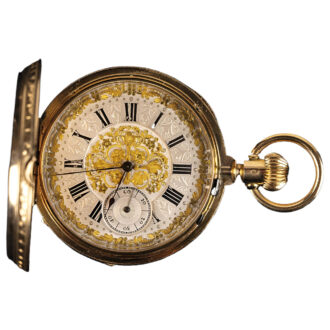
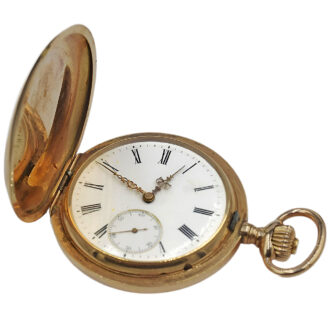
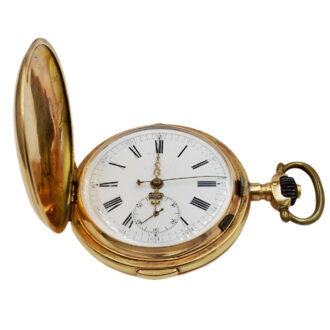
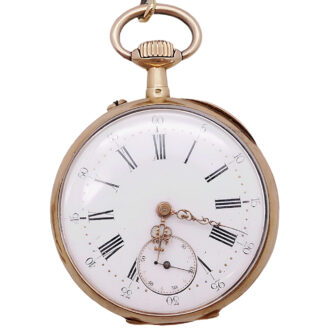
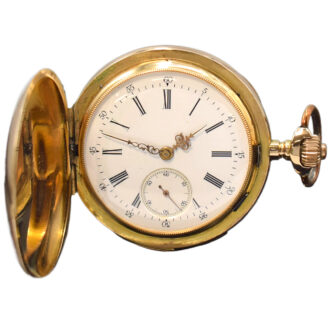
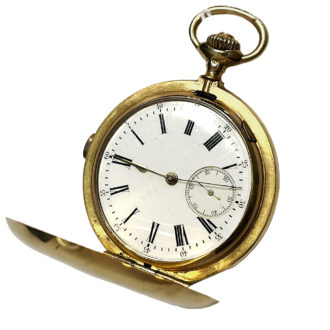
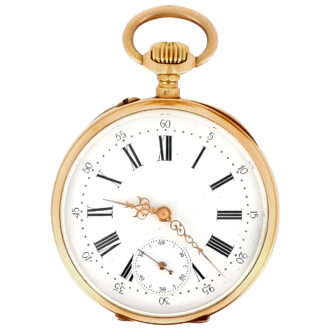
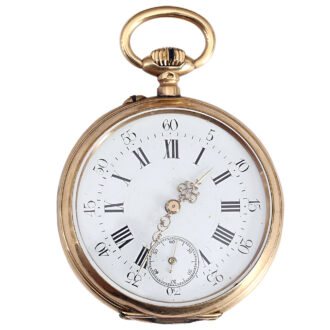
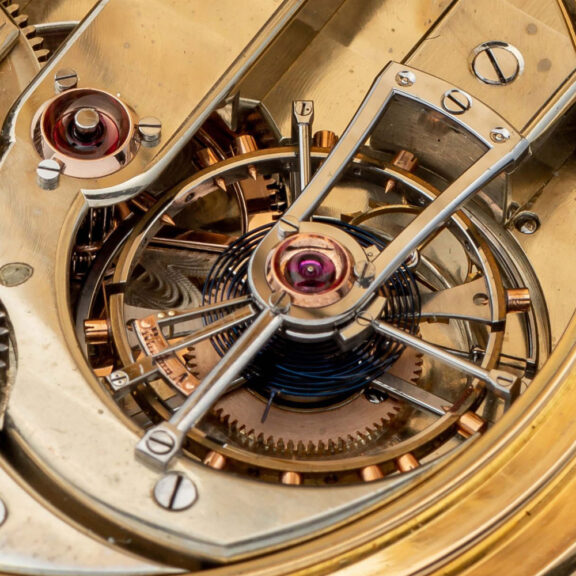
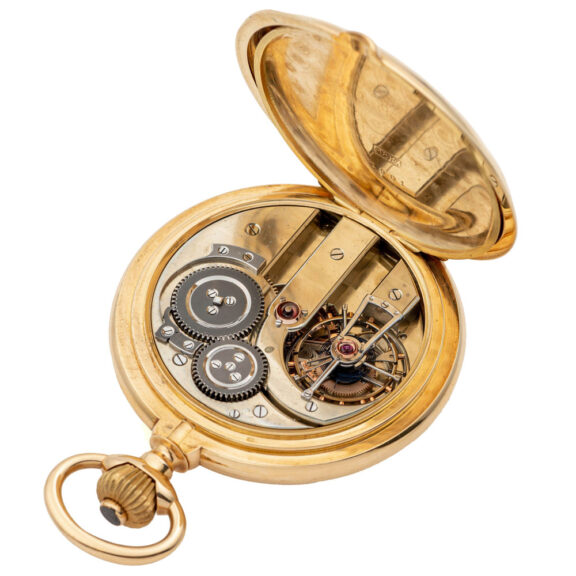
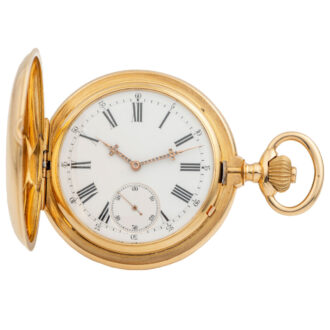
A Swiss 18 carat yellow gold hunting cased keyless dress watch, circa 1900. A massive pocket chronometer; the cover and case back are polished. Inside the cover, a tintype (or melainotype or ferrotype) portrait of a lady. White enamel dial with radial Roman numerals, diamond set gold crucifix type hands, subsidiary seconds at 6 and a one minute tourbillon regulator. A rhodium plated movement, Pellaton type calibre, curved center bridge, going barrel, gold train of wheels, gold screwed chaton on the central wheel, three arm equidistant Pellaton carriage with Earnshaw type spring detent escapement, cut bimetallic compensated balance with gold poising screws and blued steel hairspring with Phillips terminal curve and amplitude control device, gold screwed chaton end stone, polished steel index regulator with gold scale plate.
–
Diameter: 56 mm
–
Weight: 161 g
–
Signed: No Name
–
According to the current owner, the watch is the personal watch of the tourbillon maker Albert Pellaton-Favre (1832-1914), and the portrait on the tintype is that of his wife, Louise-Joséphine Favre-Bulle (1837-1900).
–
Tintype:
A tintype, also known as a melainotype or ferrotype, is a photographic technique developed in 1852 by Adolphe-Alexandre Martin (1824-1896) in Paris, professor of physics at Sainte-Barbe College and member of the French Society of Photography from 1855 to 1896. It’s made by creating a direct positive on a thin sheet of metal coated with a dark lacquer or enamel and used as the support for the photographic emulsion. Tintypes enjoyed their widest use during the 1860’s and 1870’s, but lesser use of the medium persisted into the early 20th century and it has been revived as a novelty and fine art form in the 21st.
–
Albert Pellaton-Favre:
La Chaux-du-Milieu (Vallée de la Brévine), November 17, 1832 – Le Locle, September 9, 1914.
A native of the Neuchâtel mountains, Frédéric-Albert Pellaton used the surname of Pellaton-Favre, adding his wife’s name to his own, as was the regional custom.
Born on November 17, 1832, and baptised on December 8 of the same year, he was the son of Henri-Sylvain Pellaton (1807-1884), a farmer and wheelwright from Travers (Val-de-Travers), and Adèle-Uranie Pellaton (1811-1882), who were both married in La Chaux-du-Milieu (Vallée de la Brévine) on May 19, 1832.
–
His wife, Louise-Joséphine Favre-Bulle (1837-1900), was the daughter of Ami-Louis Favre-Bulle (1815-before 1873) and Joséphine Dubois (1815-before 1883). The Pellaton-Favre couple married in Le Locle on July 10, 1857, and had ten children, including eight sons.
–
Albert Pellaton-Favre is recognised as one of the leading manufacturers of pocket chronometers with tourbillon regulators in the last third of the 19th and early 20th centuries. He made at least 82 of them, all with detent escapements, whose success was highlighted by the Neuchâtel and Geneva astronomical observatories thanks to the Bulletins de marche they obtained.
–
In 1905, he was awarded the first prize in the timing contest at the Neuchâtel Observatory (pocket chronometer section). It is said that he made the tourbillon and escapement for Paul Ditisheim’s chronometer, which won first place at the Kew Observatory contest in 1903. He made other pieces for Ulysse Nardin of Le Locle and Golay Fils & Stahl of Geneva, including a tourbillon that won second prize in the 1907 chronometry competition. From 1890, he was a member of the Commission of the Le Locle Horological School, in which he was very active.
–
Albert Pellaton-Favre died in Le Locle on September 9, 1914, at the age of 81. On September 10, 1932, an intimate ceremony to commemorate the hundredth anniversary of the watchmaker’s birth was organised by his descendants in Le Locle; there were 115 of them.
–
The horological dynasty founded by Albert Pellaton-Favre is perpetuated through his son Jämes-César Pellaton (1873-1954). An eminent pedagogue, he taught between 1903 and 1939 at the Horological School (Technicum neuchâtelois) in Le Locle. Between 1910 and 1950, he was one of the most renowned makers of tourbillon carriages in Switzerland, delivering pieces to the most prestigious manufactures, such as Patek Philippe and Girard-Perregaux. He also published a remarkable Cours d’échappements (1921), a treatise on horology which has been reprinted many times and translated into several languages. In 1943, the Neuchâtel government awarded him the degree of Doctor Honoris Causa.
Share this page: