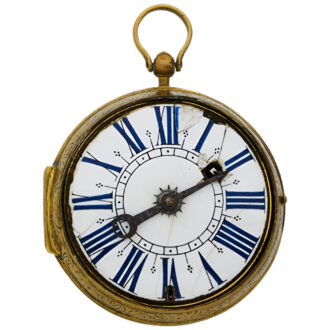
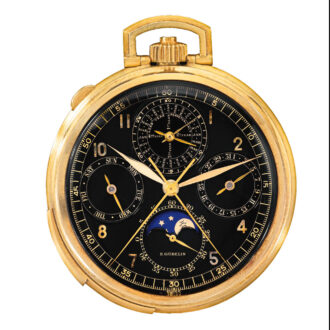
Swiss 21 Carat gold and enamel single-handed pocket watch Circa 1685
- Kenmerk
- TA1809
- Diameter
- 39 mm
- Estimate
- € 25.000 - 50.000
- Price sold
- € 103.350
Gold and enamel open faced verge watch
–
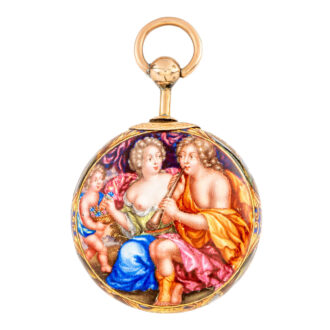
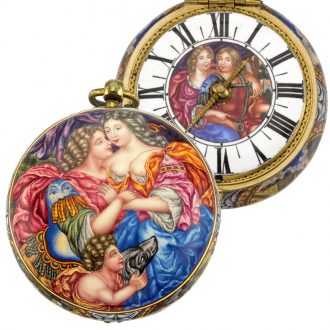
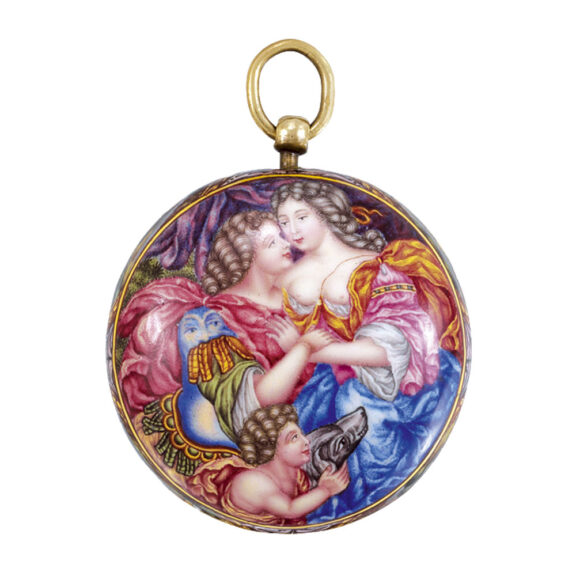
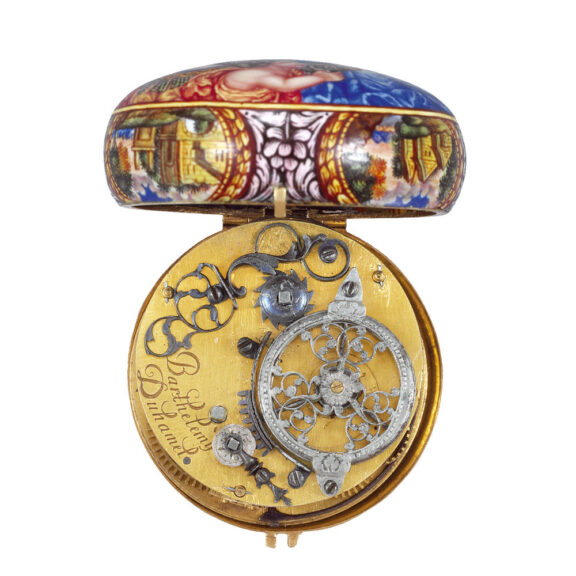
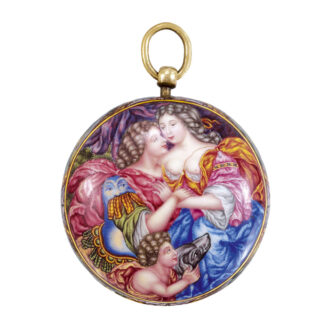
A very fine and rare Swiss 21 Carat gold and enamel single-handed verge pendant watch with an early hairspring, circa 1685. Venus and Adonis by Barthelemy Duhamel. Case with incurved edges, an engraved split bezel, the back with a painted enamel scene depicting Venus pleading with Adonis not to go hunting, further a dog and cupid, the band with four vignettes painted with rural scenes, castle ruins and an alpine scene, on the inside a turreted building in the foreground with large trees overshadowing it and mountainous background, small pendant, loose ring. The enamel is almost certainly by Pierre Huaud.
–
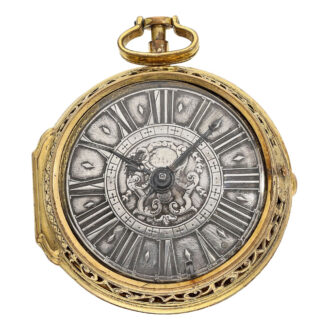
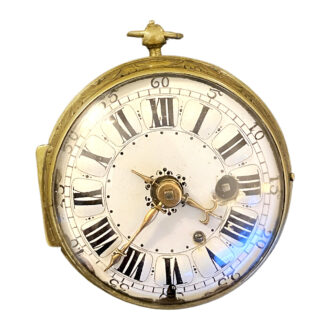
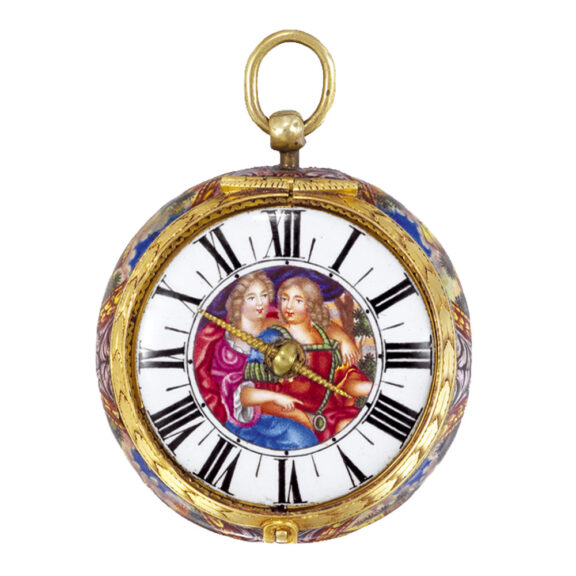
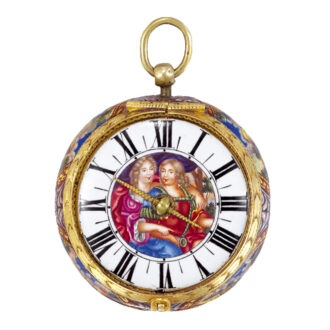
White enamel dial with large radial Roman hours and half-hour indexes, inner quarter hour ring, a finely polychrome enamel scene in the centre depicting Venus attempting to entice Adonis while he appears unmoved and impatient for the hunt, gilt unicorn hand with a tail. A hinged full plate gilt brass movement, divided and engraved Egyptian pillars, fusee and chain, short three wheel train with seven leaf pinions, verge escapement, steel balance, short balance spring, Thuret index regulator, pierced and engraved silver cock with three equidistant foliate grilles, finely chased foliate blued steel click and spring set up, rack and pinion regulator with silver scale plate. Movement signed.
–
Diameter: 39 mm
–
Signed: Barthelemy Duhamel Geneva
–
Barthelemy Duhamel (1662-1705) was a son of Pierre, apprenticed to Abraham Bobinet in 1675 and Pierre Urbain Dufour in 1679. He worked with Philippe Decombe in 1688.
–
Pierre Huaud I (Le Pere), Geneva, 1612-1680. Born in Chatellerault, France, son of French goldsmith Jean Huaud, a refugee in Geneva in 1630 at the age of 18, indicating that he may well have begun his training under his father or another French goldsmith. Some sources suggest that this may have been in Blois and that his subsequent full apprenticeship under Legère was required in order to be received as Master in Geneva. Apprenticed to Laurent Legère in the same year, a companion in 1634 and Master in 1636. Married in 1643 to Françoise Mussard and amongst their children, three sons who became enamellers – Pierre II (1647-1698), Jean-Pierre (1655-1725) and Ami (1657-1724). In 1671, Pierre I and his three sons were made ‘bourgeois’ of the city of Geneva.
–
Venus and Adonis. According to the legend, Adonis was born from the incestuous union of Myrrha and her father Cinyras, King of Paphos in Cyprus. The gods transformed Myrrha into a myrrh tree and in due course, Adonis was born when the tree’s trunk was split open by a wild boar. Venus was struck by the beauty of the child Adonis and put him in the care of Persephone, the queen of the underworld. But Persephone loved the youth and refused to give him back to Venus. Jupiter was called on to pass judgment and ruled that Adonis was to remain one-third of the year with each goddess, in turn, spending the rest of the time as he pleased. Adonis died as he was born, being attacked by a wild boar while hunting. Venus, overcome with despair, fashioned a flower from the blood of his wounds – the red anemone, which blooms briefly each year and then dies. Similar scenes to those on the band are illustrated in Emailmalerei auf Genfer Taschenuhren vom 17. bis zum Beginnenden 19. Jahrhundert, by Hans Boech, 1982.
Signed: Barthelemy Duhamel
Share this page: