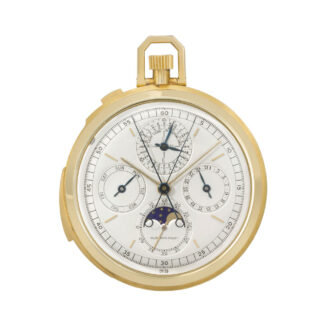
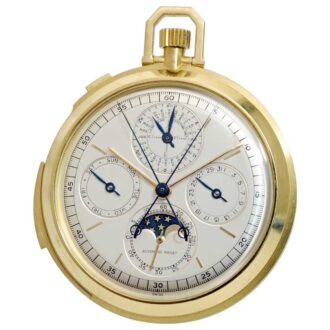
Swiss important pocket watch with nine complications Circa 1972
- Kenmerk
- TA1517
- Diameter
- 50 mm
- Estimate
- € 85.000 - 150.000
- Price sold
- € 108.150
Gold astronomical dress watch
–
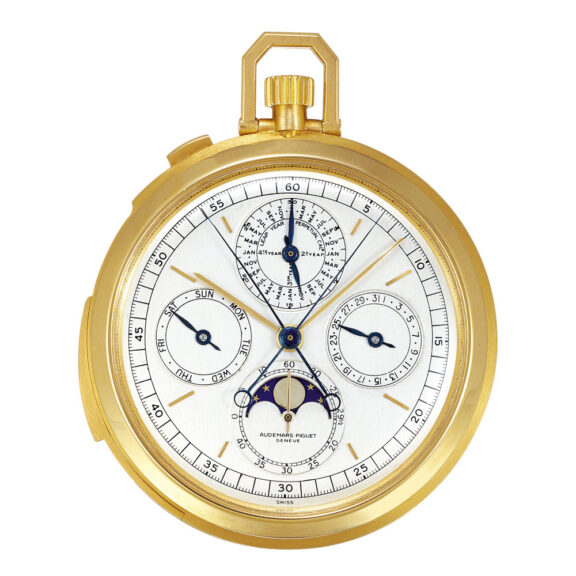
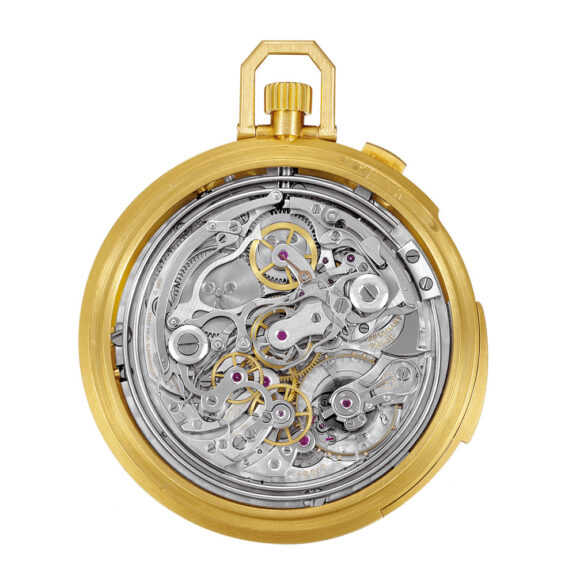
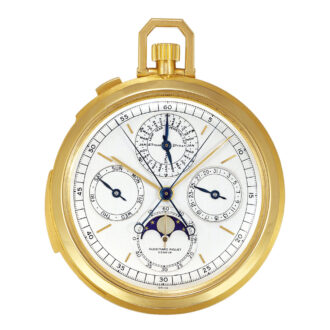
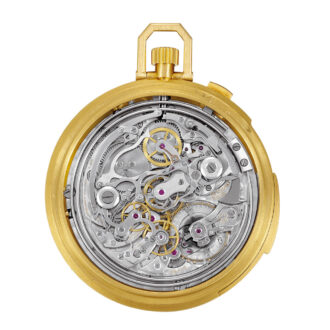
A very fine and important Swiss, 18 Carat yellow gold watch with 9 Complications, circa 1972. Astronomical, keyless, slim, minute-repeating dress watch with perpetual calendar, phases and age of the moon, split-seconds chronograph and progressive 30 minute register. A variée case polished and brushed with inclined bezels. Brushed silver dial with applied yellow gold baton indexes, outer minute/second track and fifth second timing scale, subsidiary dials for days of the week, months, leap year cycle with outer 30 minute register, date, seconds/lunar age with inner moon phase aperture. Gold baton hands. A rhodium-plated movement, Geneva striping and oeil-de-perdrix decoration, 36 jewels, straight-line lever escapement, cut bimetallic compensation balance adjusted to heat, cold, isochronism and five positions, Breguet balance spring, swan neck micrometre regulator, repeating on gongs activated by a slide on the band, split-seconds chronograph with visible work, start/stop winding crown, split-seconds with push-piece in the band. Dial, case and movement signed.
–
Diameter: 50 mm
–
Signed: Audemars Piguet Genève
–
For a triple complication, the movement of this watch is extremely thin and is certainly among the slimmest made at the time. Similar triple complication dress watches are illustrated in Audemars Piguet, by G. L. Brunner, Chr. Pfeiffer-Belli, and M. K. Wehrli. Audemars Piguet, Le Brassus and Geneva The firm was founded in 1875 by two watchmakers, Jules Audemars and Edward Piguet, aged 24 and 22, under the name Audemars Piguet, Manufacture d’Horlogerie. Jules Audemars was born in Le Brassus in 1851, where he was trained by master watchmakers of the area. After his apprenticeship, Audemars began work as a repasseur. In 1874, he moved to Gimel and opened a small business next to his workshop. However, it did not achieve the success he had hoped for, probably due to the recession which was then beginning. Eighteen months later he decided to return to Le Brassus, hoping to find a situation more in keeping with his exceptional watchmaking skill. Edward Auguste Piguet, born two years after Jules Audemars, received a similar education. Edward completed his formation as a repasseur in the workshops of Charles Capt. The two met in 1875 in Le Brassus. For a time, the two watchmakers worked closely together without legally officializing their partnership. In 1880, they opened a branch in Geneva, where commercial possibilities were the greatest. The Audemars, Piguet & Cie name was finally registered at the Bern, Office technique de l’Edition et de la Publicité on December 6, 1882, as producing movements and watch cases. Audemars Piguet & Cie is presented as manufacture active all year long, with 10 male employees. Due to his exceptional technical abilities, Jules Audemars was the technical manager of the manufacture. He patented several inventions in Switzerland and in the USA, and travelled extensively, particularly to America, where the potential for trade fascinated him. Edward Piguet was the financial specialist of the firm. The two men managed the company together until 1918 when Jules Audemars died at the age of 67. Piguet died the following year. The name Audemars Piguet was to become synonymous with watches of exceptional quality, superb complications and incredibly thin movements. The list of their accomplishments is impressive, to say the least. They manufactured many of the world’s most complicated watches, the majority of which were sold to other manufacturers, who in turn sold them as their own watches. Famous examples are the Universal-Uhr of Uhrenfabrik Union and the so-called gross piece which was sold as the Astronomical Watch by Smith & Son Ltd, of London both of which were the most complicated watches in the world when they were sold, 1899 and 1914 respectively. From here they went on to produce the world’s smallest five-minute repeating watch (7”’), in 1915, the first wristwatches with perpetual calendar and moon phases in 1924, a pocket watch with a movement 1.32 mm thick in 1925, the thinnest lady’s watch in 1960, the thinnest automatic watch, 2.24 mm in 1967, followed three years later by an automatic jump-hour watch with a thickness of 3.05 mm. 1978, 1989 and 1990 saw the size of automatic watches with perpetual calendar reduced from to 3.95 mm to 3,75 mm. The finest example of Audemars Piguet’s quest for thinness came in 1986 with the launching of an automatic watch with Tourbillion regulator. Its overall thickness of 4.8 mm was achieved by setting jewels into the case back and utilizing it as a plate. In 1972 the launch of the Royal Oak marked a turning point in the way watchmakers looked at luxury. Designed by Gerald Genta, the Royal Oak has become one of the most instantly recognizable watches in history, and the Flagship model in the Audemars Piguet portfolio. It has been produced in steel, gold, platinum, tantalize, and combinations thereof time. It has been set with gems of every description and has housed some of the firm’s most complicated movements. During the Quartz Revolution of the 1970s this watch, more than any other, was responsible for Audemars Piguet’s success. The launch of the Offshore saw a watch that was of a size thought to be unwearable: the gold version with bracelet weighs over 500 grams. The resilient Royal Oak once again proved the critics wrong. The 2003 Basel Fair introduced the Royal Oak T3, which dwarfs the Offshore. The last ten years have seen the launch of a wristwatch with carillon and Grande and Petite Sonnerie, as well as the Cabinet Watches which are among the most complicated wristwatches in the world. There is also the John Scheffer minute repeater which is destined to become another of Audemars Piguet’s style icons.
Share this page: