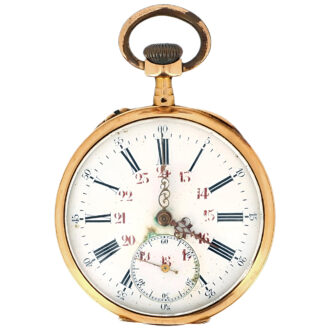
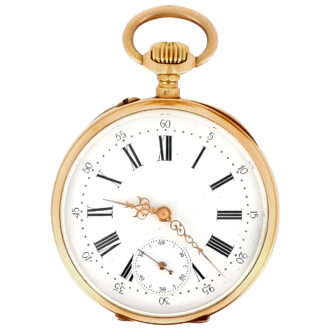
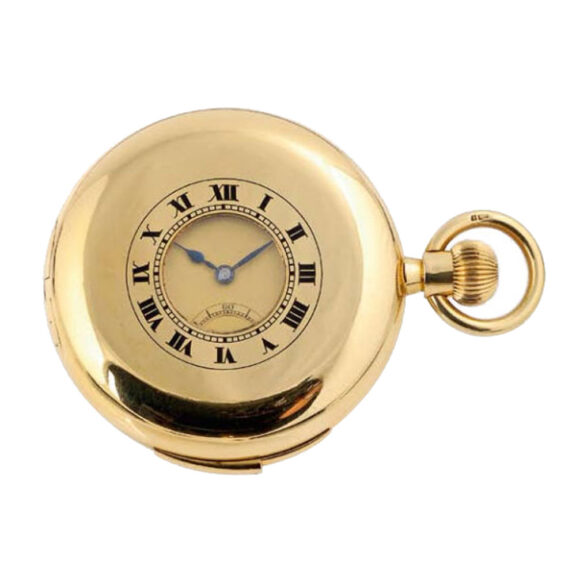
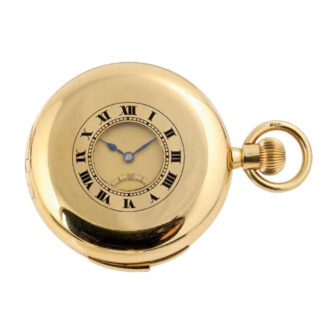
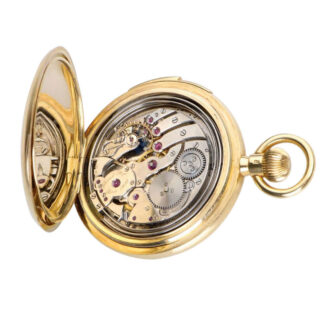
Swiss gold five minute repeating pocket watch Circa 1911
- Kenmerk
- PD0024
- Diameter
- 59 mm
- Estimate
- € 60.000 - 120.000
- Price sold
- -
Gold half hunter watch with Whittington carillon strike
–
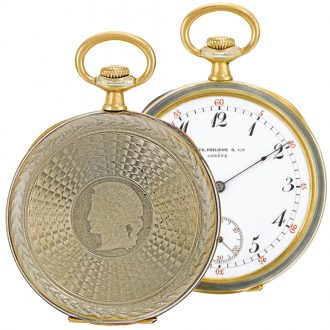
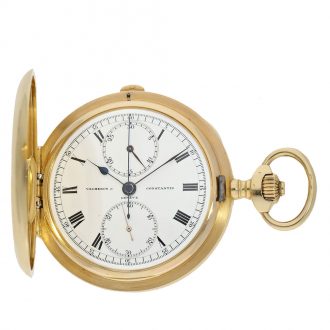
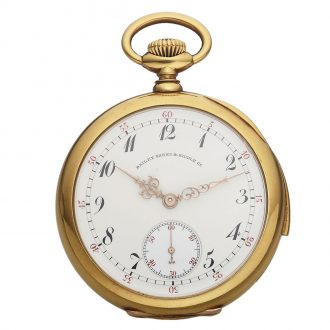
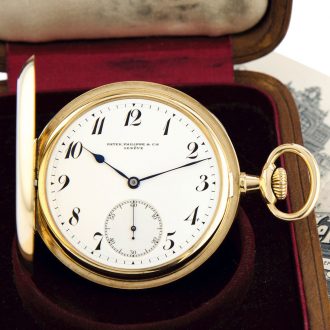
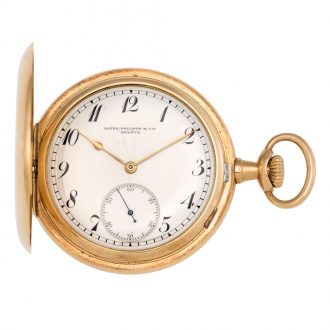
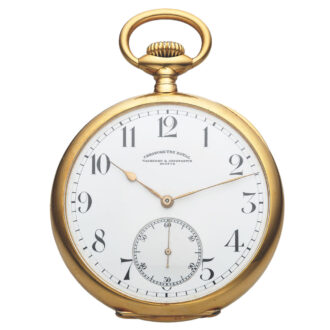
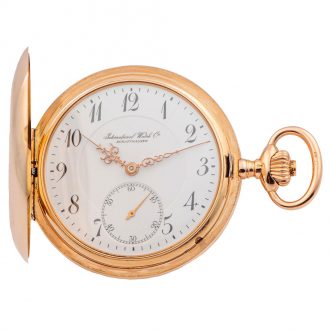
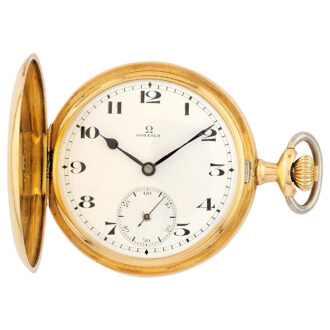
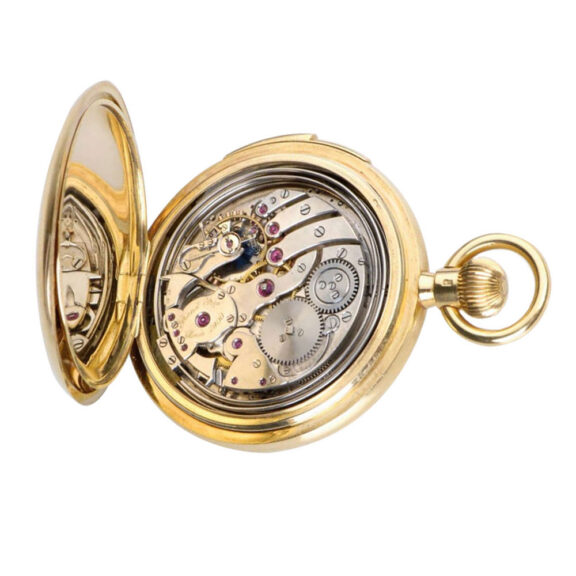
A museum like Swiss 18 carat gold half hunting cased five minute repeating pocket watch with Whittington carillon strike, circa 1911. The smooth case with a dedication engraving on the reverse: Francis Everard Leyland Walke Rotherham, a family crest with the motto Dieu Vous Garde (God keeps you in English), a gold cuvette and maker punch mark GS, a slide for the repeating mechanism in the band. Gilt gilt dial with radial Roman hour numerals, sunk auxiliary seconds and blued double spade hands. The nickel plated bridge movement with a lever escapement, ground and polished screws, five hammers, five gongs, a gold screw compensation balance, blued balance spring, an index spring fine adjusting device, and a ruby endstone on the balance, lever and escape wheel.
–
Diameters: 58.5 mm
–
Weight: 175 g
–
Signed: Paul Ditisheim
–
This watch was presented at the Swiss National Exhibition in Bern in 1914 and was one of the most expensive watches offered.
Mentioned as No. 59 in the catalogue: “Montre à répétition des heures, quarts et minutes, sonnant sur 5 timbres (carillon Whittington). Boîtier à savonnette. Diamètre 58,5 millimètres. Prix Net Francs 3750,-.”
–
Whittington chimes or St. Mary’s, are a family of clock chime melodies associated with the St Mary-le-Bow church in London, which is related to the historical figure of Whittington by legend. Whittington is usually the secondary chime selection for most chiming clocks, the first being the Westminster. It is also one of two clock chime melodies with multiple variations, the other being the Ave Maria chimes.
Dick Whittington and his cat is the English folklore surrounding the real life Richard Whittington (circa 1354-1423), a wealthy merchant and later Lord Mayor of London. The legend describes his rise from a poverty stricken childhood with the fortune he made through the sale of his cat to a rat infested country. Although the real Whittington was actually of high birth and likely did not own a cat, he did become a merchant and politician, and was remembered for his public projects and charitable investments.
Another element in the legend is that Dick attempted to flee his service as a scullion one night, heading towards home, but was dissuaded by the sound of the bells of the St Mary-le-Bow church in London, which promised he would be mayor of London one day. Since the pre Victorian era, the story has been a favourite subject of British pantomime, especially during the Christmas season.
Signed: Paul Ditisheim
Share this page: