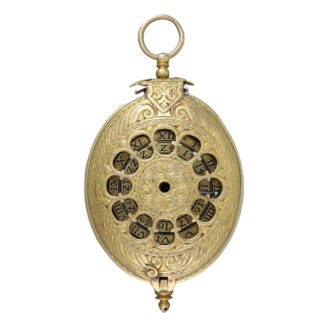
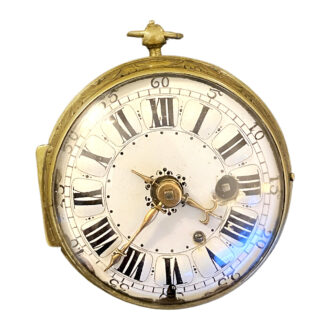
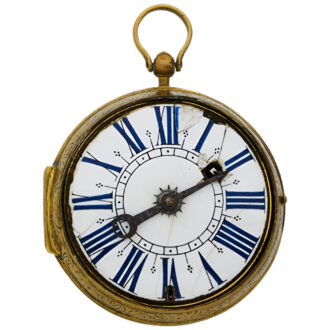
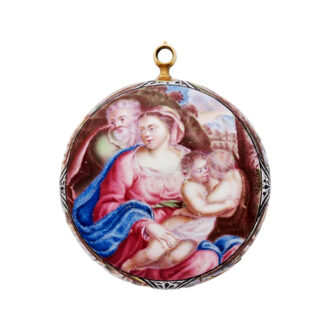
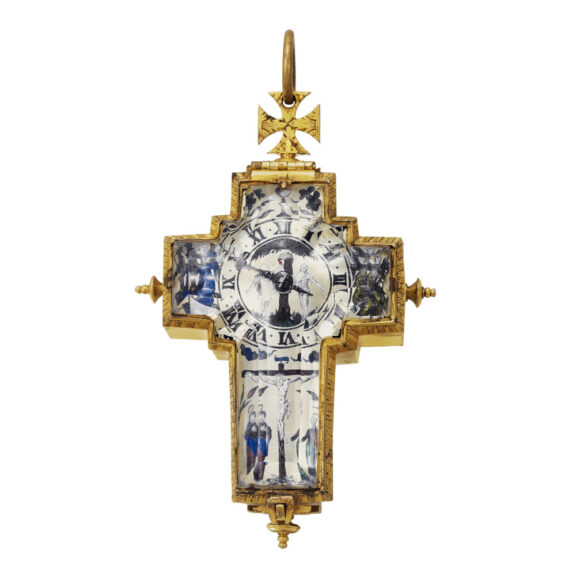
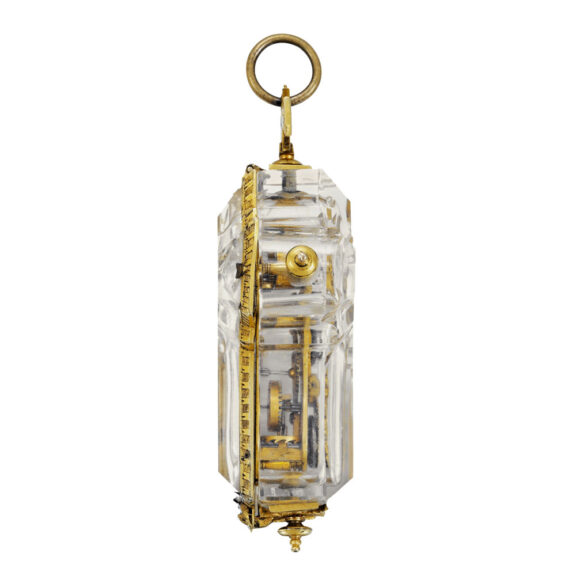
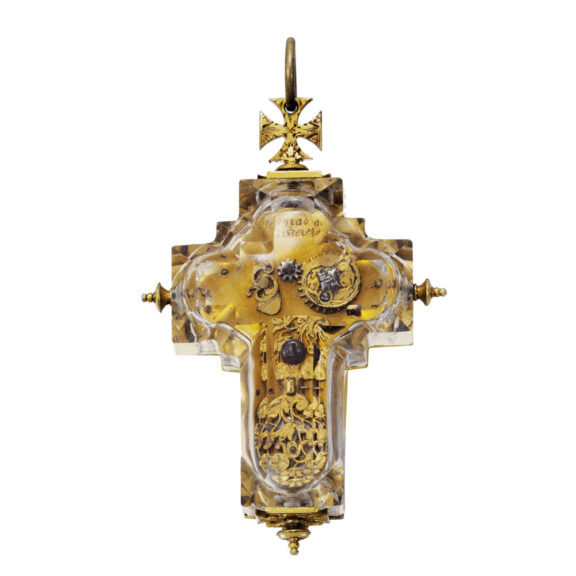
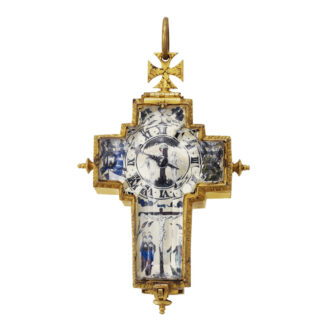
German gilt brass and rock crystal cruciform watch Circa 1610
- Kenmerk
- TA1731
- Diameter
- 79 mm
- Estimate
- € 30.000 - 60.000
- Price sold
- € 46.800
Rock crystal verge form watch
–
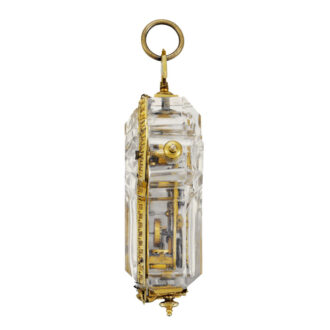
A fine and exceptional German, rock crystal and gilt brass, cruciform, pre-balance spring single-hand pendant watch, circa 1610. With stack freed and polychrome champlevé enamel silver dial. A case in the shape of a Patriarchal cross, of two pieces of gilt brass-mounted carved rock crystal hinged at the top, turned side finials, small lower finial with engraved Maltese cross base, engraved Maltese cross pendant with a loose ring. Silver champlevé dial, chapter ring with radial Roman numerals and dot half-hour divisions, the centre decorated with a depiction of the temptation of Eve, with Adam and Eve flanking the apple tree, the outer border decorated with angels, flowers and the crucifixion below, all in red, blue, white and green translucent and painted enamels. Steel tulip hand.
–
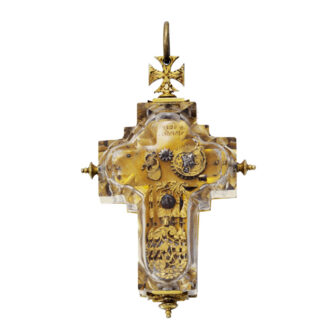
A hinged, gilt brass full plate movement, turned vase pillars, fixed going barrel with engraved border, verge escapement, incomplete stack freed, steel circular foliot without balance spring, elongated cock asymmetrically pierced and with floral engraving, secured by a pin, provision for hog’s bristle regulator. Movement signed. Property of an American Family.
–
Dimensions: 79 x 51 mm
–
Signed: Conrad Kraiserer Augsburg
–
The case is oxidized, movement Slightly spotted. The dial has some luminous material reapplied, original later bezel, hand partially replaced.
–
The Stackfreed was designed to equalize the varying force of the mainspring. This was necessary because the rate of the foliot’s oscillation depends directly on the force with which the escape wheel acts upon it. In a watch, the force transmitted to the escape wheel when the watch is fully wound is about twice that of when it is nearly run down. The need for an equalizing device was realized early on in the development of horology and the stack freed was a crude but relatively effective method of achieving this. It was only made for a relatively short period before being superseded by the fusee. In a 26-hour watch, the action of the stack freed spring causes constant high friction for the first 12 hours after winding, a slowly diminishing friction for the next 6 hours and a rapidly diminishing friction for the next 6 hours and no friction during the last 1 or 2 hours. This action agrees roughly with the variation in force of a coiled spring. The stack freed is only found in watches made in Germany and continued to be used there into the 17th century even after the introduction of the fusee.
–
The Kreizer family was a veritable dynasty of watchmakers, with at least four individuals apparently bearing the same Christian name. Some uncertainty exists as to whether Conrad III and IV were not in fact the same person, but certainly one of the Kreizer’s occupied the position of a clockmaker to the Knights of the Grand Cross of Malta and indeed several watches (including the present lot) signed by Kreizer use their characteristic cross as the form for the pendant. The Metropolitan Museum of Art has a cruciform watch by him.
–
The History of the Crucifix-Form Watches are around 1580, the styles of watch cases began to diversify and develop markedly in terms of sophistication and variety and the first crucifix shaped watches appeared at about this time, being one of the first major departures in case style from the circular form, they were a natural progression of the visual religious arts of the time into the art of horology. At the time, these watches would have been amongst the most expensive objects that money could buy, so it is certain that the earliest crucifix watches would only have been commissioned or presented to Popes, Cardinals and Bishops although the ownership of such watches was multi-denominational. Prior to about 1600, the cases of most watches including the crucifix type were of solid metal, either gilded brass or silver engraved with a design, usually and quite naturally, The Crucifixion. The shapes of the crucifix watch cases did however differ and included the standard cross shape, the patriarchal cross and the Maltese cross along with multiple small stylistic variations. The majority of the surviving crucifix watches date from the first quarter of the 17th century when the inclusion of the lapidary’s art became an integral part of watchmaking, thus, the crucifix watch is, on the whole, to be found with a rock crystal case which added to the watch’s beauty as a pendant. Most of the dials of crucifix watches are engraved silver and brass and interestingly, about thirty to forty per cent of surviving examples have secular decoration such as foliage, animals and townscapes. This shows that the cruciform watch was also to be found worn in the upper echelons of more general society where people wanted to show their piety yet not display any particular religious allegiance. Famously, some watches were made for the Knights Hospitaller (Knights of Malta) in the shape of their insignia of the Maltese cross. The most exceptional crucifix watches had enamelled silver dials, almost always champleve and finely executed with both translucent and opaque colours, these pieces were at the very pinnacle of princely objects, owned only by royalty and clergy affiliated to royal households. Mechanically, the shape of the crucifix watch obviously restricted the space and design layout of the movement, most of which have a linear wheel train with the going barrel or fussee at the upper end and the escapement towards the base. The fashion for crucifix watches lasted until about 1675 and in fact, almost all crucifix watches were made before the use of the balance spring in watches. Crucifix watches have interest for the collector on several levels, historically, decoratively and technically and give insight into early horology and its associated crafts.
Signed: Conrad Kraiserer Augsburg
Share this page: