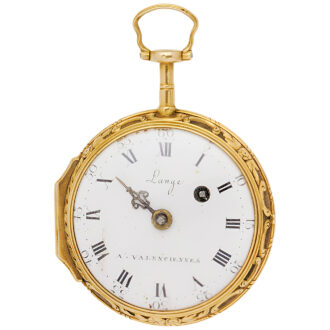
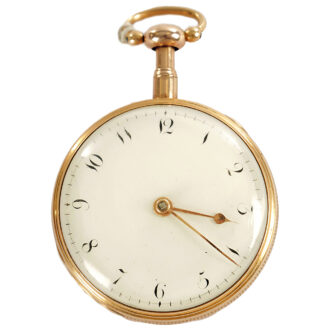
Magnificent English oval watch for the Oriental market Circa 1800
- Kenmerk
- TA2971
- Diameter
- 96 mm
- Estimate
- € 75.000 - 150.000
- Price sold
- € 190.800
Gold oval shaped verge pocket watch
–
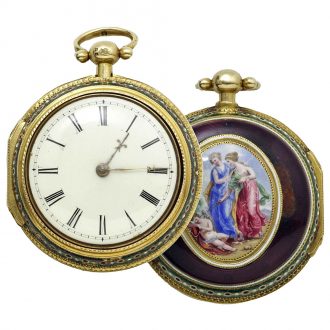
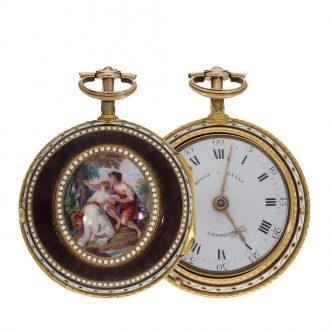
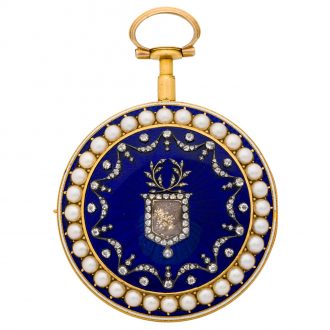
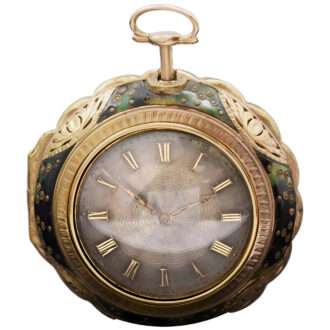
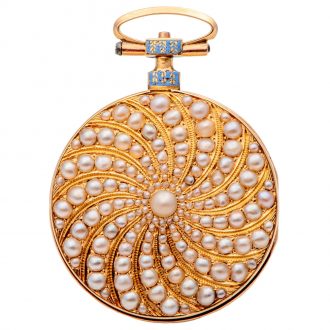
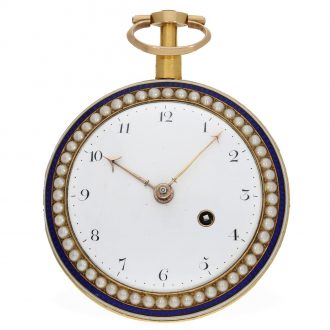
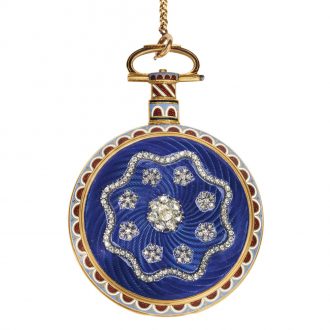
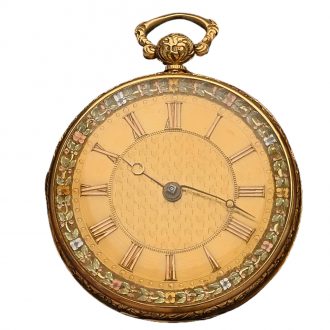
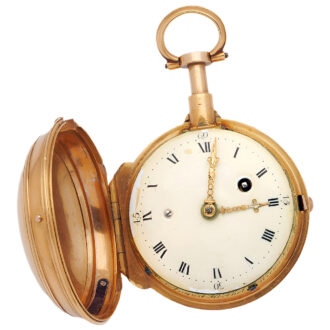
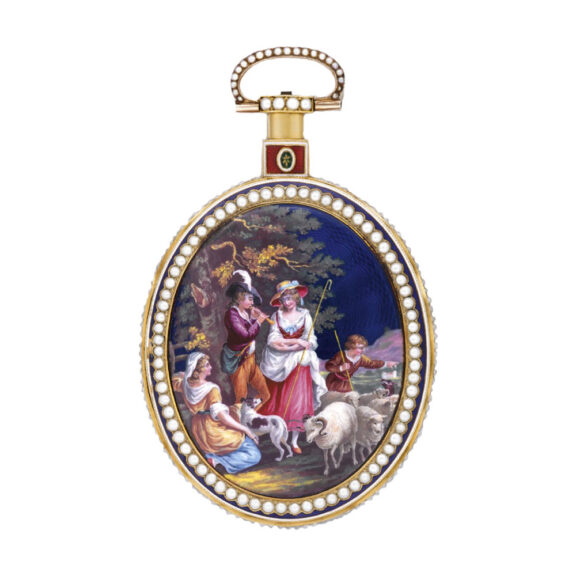
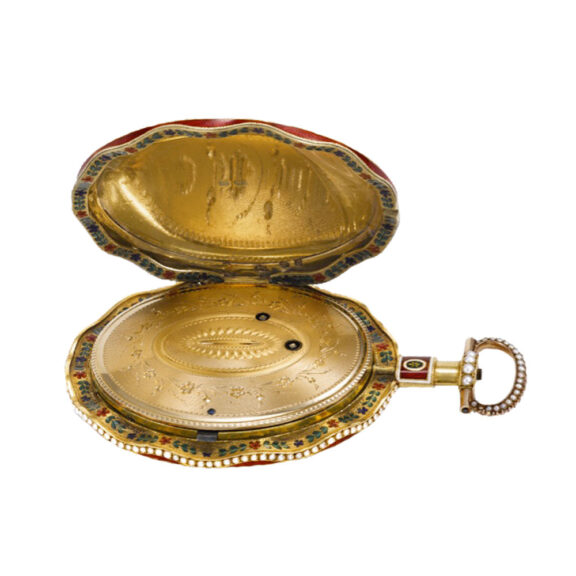
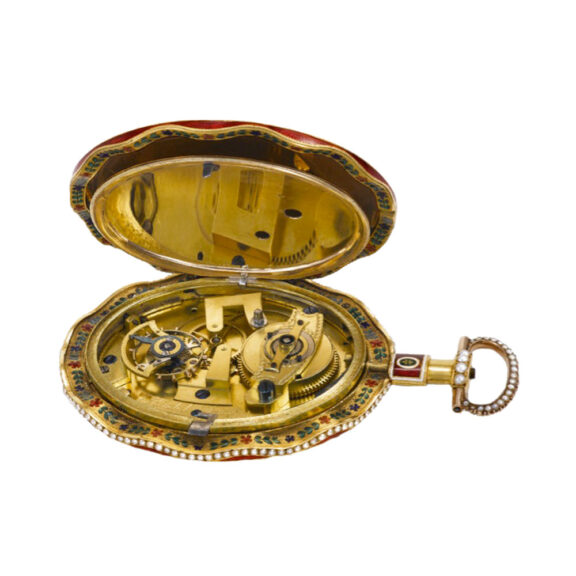
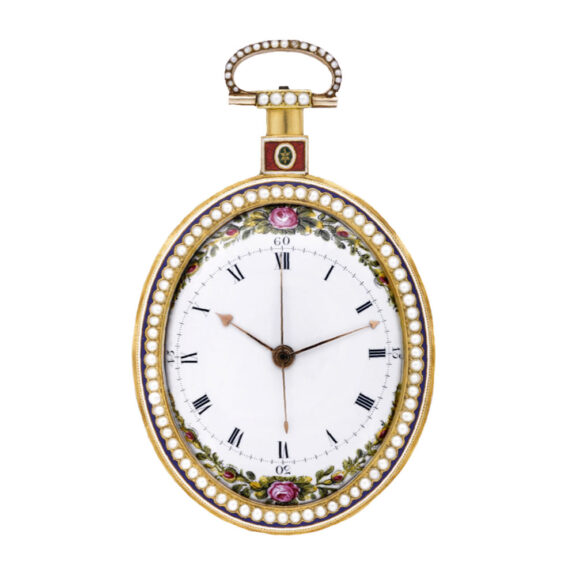
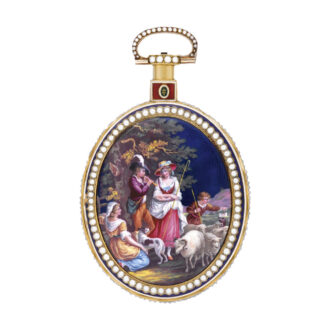
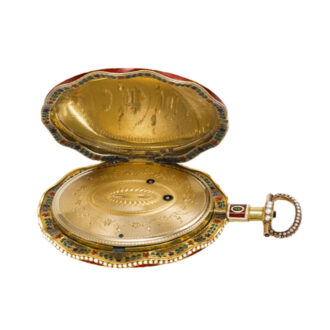
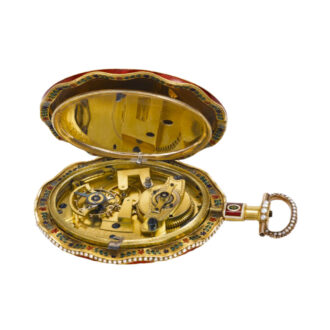
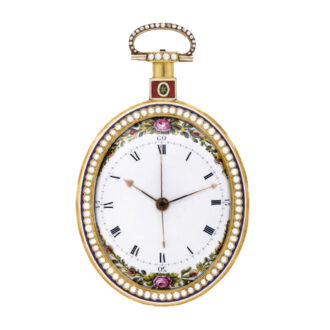
Magnificent and rare English large oval shaped 18 carat gold, enamel and pearl set open faced centre seconds verge pocket watch made for the Oriental market, circa 1800. The polychrome enamel scene on the case back has been painted in an unusual and distinctive palette after an engraving by A. Conte of the painting Evening by William Hamilton, the enamelling possibly by Jean Abraham Lissignol. The spring loaded back cover with a scalloped inside edge, which is decorated with foliage in translucent green, red and blue champlevé enamel, the inner edge of the front cover is formed in the same manner and decorated to match, both bezels are set with pearls on a translucent dark blue enamel ground, the band and bow are pearl set too, the pendant enamelled, the gold engine-turned and engraved cuvette is hinged to the movement ring.
–
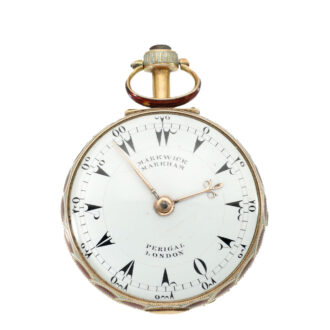
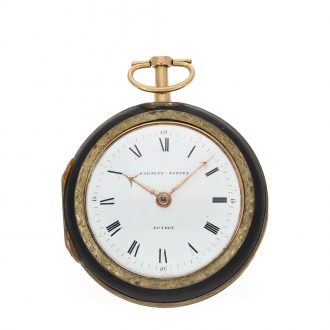
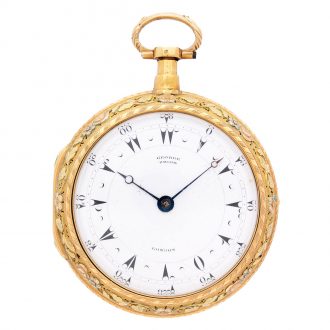
White enamel dial with Roman hours, outer minute and fifth second divisions, Arabic 15 minute numerals, the top and bottom borders decorated with very finely painted enamel roses and foliage, gold heart hands. An oval movement, gilt brass bridge calibre, 10 jewels, going barrel, lateral lever escapement with club tooth steel escape wheel, cut bi metallic compensation balance, blued steel Breguet balance spring.
Signed on the movement, the inside of the back cover is stamped with the maker’s mark GR.
–
Dimensions: 96 x 60 mm
–
Signed: John Kenebel London
–
The case is slightly chipped.
–
This piece was in the Lord Sandberg collection prior to 2001, a very similar watch is in the collection of the Patek Philippe Museum.
–
John Kenebel (also Knobel, Kenable or Kenabel), Frith Street, Soho, London is not recorded in any of the standard lists of watchmakers’ names which is unsurprising on account of the fact that watches bearing his signature are rare and he was technically a jeweller as is stated in his will: “This is the last will and testament of Mr Jean Louis Knobel at times called John Kenebel of Frith Street in the parish of St. Anne, Soho…..Jeweller…..”. The bequests to his sister in Nyon and others in his will would point to him having been born in Switzerland. Most, if not all of his known work is clearly made for export to the Chinese Market. Kenebel died in July 1810.
Antonio Conte (1780-1837) was a printmaker and a stipple engraver from Milan, Italy.
William Hamilton painted a sequence of paintings, depicting the four parts of the day. This watch is superbly executed and decorated. It is among the best examples made for the Oriental market. Due to the artistic value of the object, a later owner, during the second half of the 19th century, must have decided to improve the timekeeping of the watch by changing the original lever escapement to a more advanced type, so well executed as to leave no visible signs of the conversion.
William Hamilton (1751–1801) was an English painter and illustrator. Hamilton was born in Chelsea, London, but travelled and worked in Italy with Antonio Zucchi for several years. He trained first as an architectural draftsman but soon moved to theatrical portraits and scenes from plays. Hamilton became an associate member of the Royal Academy in 1784 and was made a full member in 1789.
Jean Abraham Lissignol was a Swiss painter, revolutionary and one of the finest enamellers of his time. He was born in Geneva on May 7th, 1749 and died in Plainpalais on June 28th, 1819. He was the pupil of Jean-Marc Roux and later became his partner. Specialized in snuff boxes and watch cases, he worked for Jaquet-Droz & Leschot, the Rochat Brothers and John Rich.
Signed: John Kenebel London
Share this page: