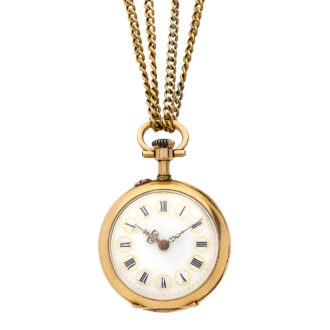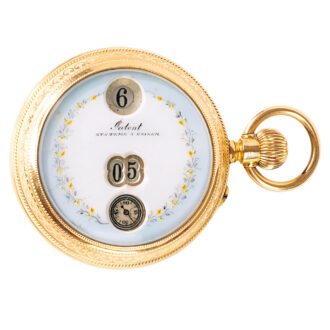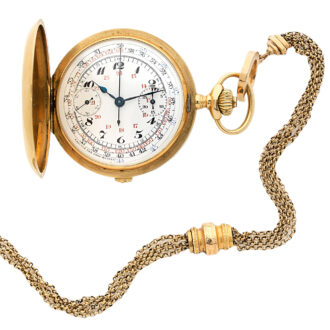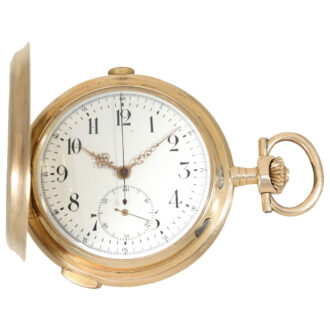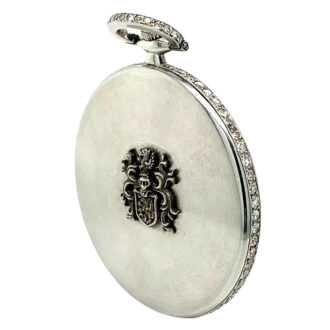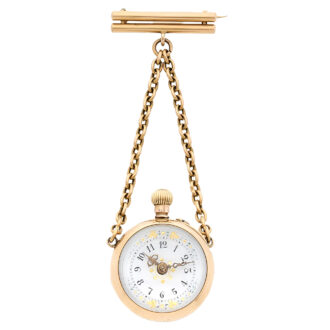
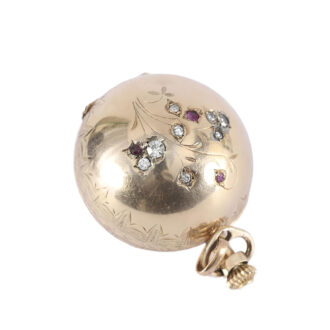
Swiss gold and gem set Boule de Genève watch Circa 1900
- Kenmerk
- AL3590
- Diameter
- 20 mm
- Estimate
- € 1.000 - 2.000
- Price sold
- -
Gold, ruby and diamond set spherical pendant watch
–
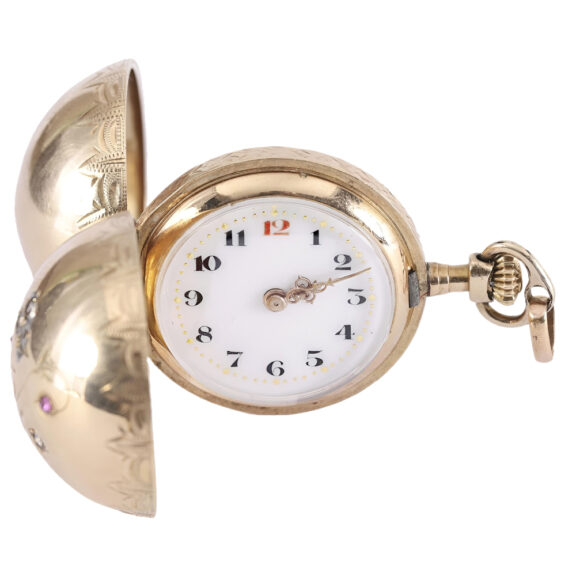
A fine Swiss 14 carat yellow gold, ruby and diamond set spherical pendant watch, Boule de Genève, made by J.F. Boutte in Geneva, circa 1900. It has a hand wound mechanical movement with lever escapement and 10 ruby jewelled bearings, protected beneath a solid gold inner dust cover signed Qty Boutte and marked 10 Rubis. The white enamel dial shows black Arabic numerals for the hours with a distinctive red 12 o’clock marker, an outer minute track with gold dot indicators, and ornate hands.
–
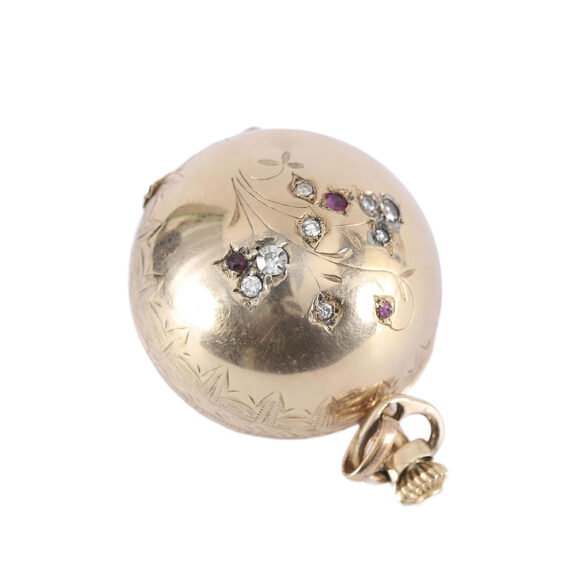
The timepiece is housed in a spherical case made of two hinged hemispheres that open at the equator. The exterior is decorated with an engraved floral spray set with rubies and diamonds, and it has a fluted winding crown and a suspension loop.
–
Diameter: 20 mm
–
Weight: 10 g
–
Signed: Qty Boutte
–
A Boule de Genève (Geneva ball) is a type of pendant watch in the shape of a small ball or sphere originating from Geneva, Switzerland. The dial is usually at the bottom of the sphere facing the floor, at the opposite side of the jump ring on the upper part of the sphere. Although there are examples with a front view face. Usually, they were Arabic numeral dials, sometimes Roman and from the 1950s different types of hour markers were also used. This ‘objet de vertu’ frequently came with a matching brooch, chain or chatelaine.
–
The term Boule de Genève is generic, it doesn’t mean that a given watch was necessarily made in the city or Canton of Geneva. Geneva balls were crafted in different sizes, styles, materials and decorative techniques, such as gold, silver, other metals, guilloché enamel, enamel, cloisonné, adorned with diamonds, pearls, etc. They were intended as an accessory mainly for women.
–
The first Boules de Genève date from the 1860s, marketed by firms such as Patek Philippe from 1866. They featured the winding mechanism invented by Marius Lecoultre (1847-1915) of Geneva and patented in Switzerland in 1889 (the Swiss patent office was not created until 1888). Winding by rotating the hemisphere containing the dial and time-setting by pressing the protruding, cylindrical-shaped button at one side of the orb while turning the hemisphere clockwise or counterclockwise. These watches have no key or crown. Lecoultre’s winding system was also used in some ring watches and wristwatches of the time.
–
In the 1878 Paris Exposition Universelle, Patek Philippe devoted a showcase to these ball-form timepieces. Years later they sold pieces to royalty such as Sultan Hussein Kamel of Egypt in 1887 and Empress Teresa of Brazil in 1888.
–
Qty Boutte stands for Quality Boutte, a high grade trademark and quality stamp used by Swiss watchmaker Jean-François Boutte, based in Geneva. Active in the late 19th and early 20th centuries, the firm specialized in finely finished miniature timepieces and luxury jewellery watches for an elite international market. The inscription Qty on the dust cover served as a commercial guarantee of superior mechanical craftsmanship, complementing the complex miniaturized engineering required for specialized objects like the Boule de Genève.
Signed: Qty Boutte
Share this page: