Swiss gold chronograph pocket chronometer with register Circa 1911
- Kenmerk
- AA0354
- Diameter
- 50 mm
- Estimate
- € 7.000 - 14.000
- Price sold
- -
Gold chronograph with register by Vacheron & Constantin
–
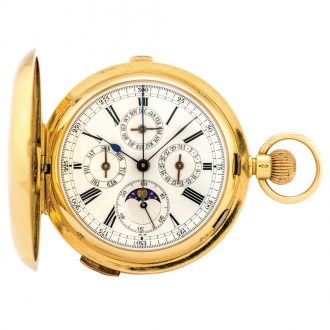
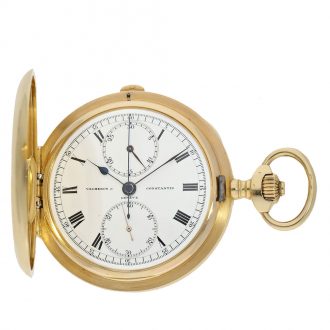
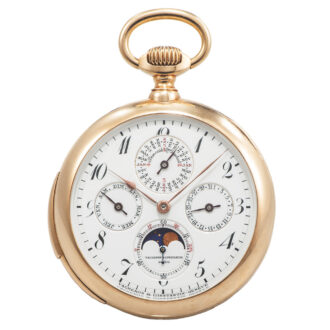
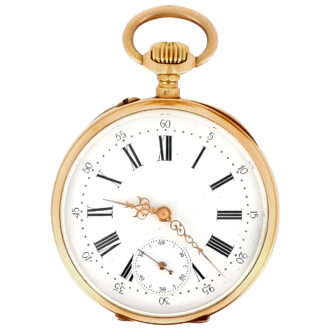
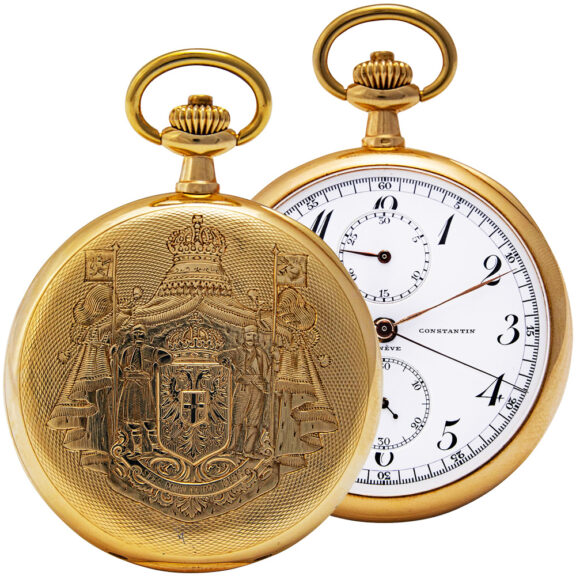
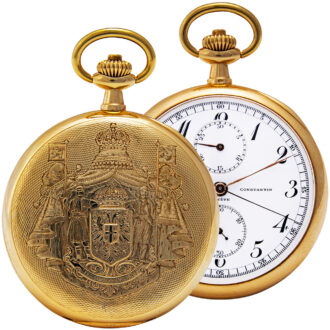
A historically important and extremely rare, Swiss keyless-winding pocket chronometer with chronograph and 30-minute counter, circa 1911. This watch was completed in 1911 and sold on March 3, 1911, to H. H. Peter I Karadordevic, King of Serbia (1903-1918), then King of Serbs, Croats and Slovenes (1918-1921).
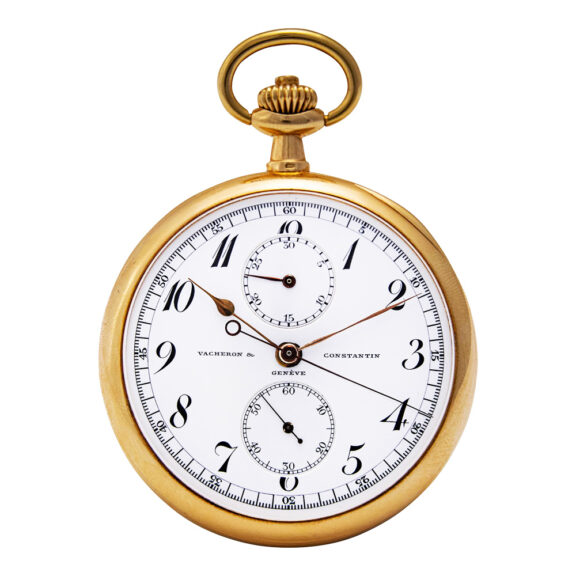
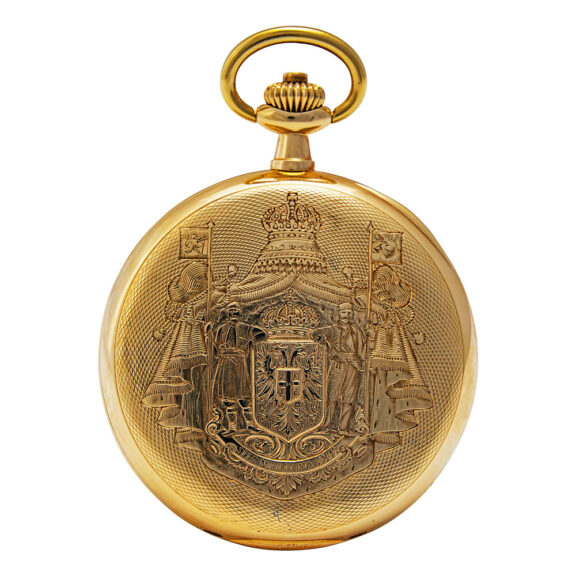
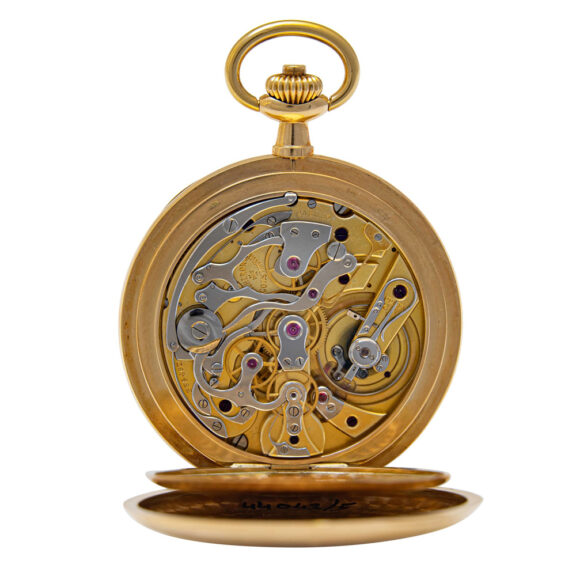
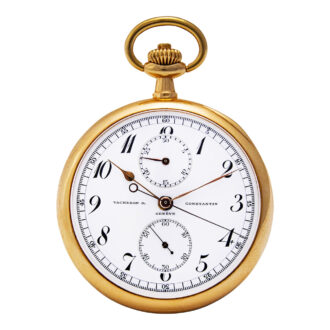
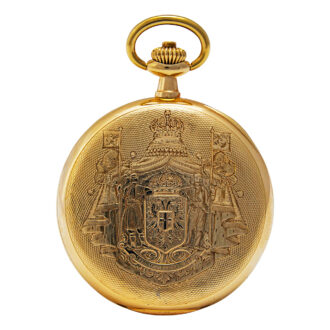
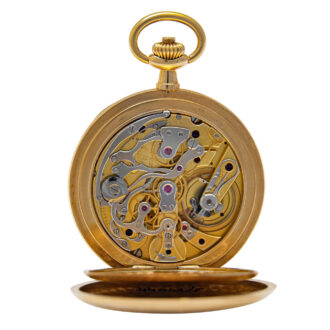
18K yellow gold round-shaped case, cover engraved in taille-douce (fine cut) with the coat-of-arms of Peter I Karadordevic, King of Serbia (1903-1918), and the motto Spes mihi prima deus (My Hope is God First of All). Enamel dial with Breguet-style radial hours, outer minutes/seconds track with Arabic five minutes/seconds numerals, subsidiary dial for the seconds, 30-minute counter, centre chronograph hand, and gold pear hands. Top class movement, lever escapement, large balance, fine adjusting device, wolf’s toothing. Dial, case and movement signed.
Accompanied by the Extract from the Archives, dated November 10, 1994, that mentioned that this watch was made in 1911 and sold in 1911.
–
Diameter: 50 mm
–
Signed: Vacheron & Constantin, Genève
–
Peter I Karadordevic
Belgrade, Principality of Serbia, July 11, 1844 – Topchider, Belgrade, August 16, 1921, Peter reigned as the last King of Serbia (1903-1918) and the first King of Serbs, Croats and Slovenes (1918-1921). Peter was the son of Alexander (Aleksandar) Karadordevic (1806-1885), Prince of Serbia (1842-1858), and Persida Nenadovic (1813-1873), Princess consort of Serbia. He was forced into exile with his father in 1858 in Geneva and Paris. The Obrenovic reigned over Serbia from 1815 to 1842 and 1858 to 1903. They were the rival of the Karadordevic dynasty. Peter was raised in France; he served in the French Army (Foreign Legion) during the Franco-Prussian War of 1870-1871 and then joined the Bosnian insurrection against the Ottomans in 1875. In 1883, he married Zorka of Montenegro (1864-1890), Ljubica Petrovic-Njegoš, Princess of Montenegro, daughter of Nikola I Petrovic-Njegoš (1841-1921), Prince of Montenegro (1860-1910), then King of Montenegro (1910-1918). She gave birth to his five children.
–
In 1903, after the revolution, which ended the Obrenovic dynasty, he was appointed King of Serbia on June 11, 1903, and was approved by the National Assembly of Serbia on June 15. As king, he advocated a constitutional setup for the country and was famous for his libertarian politics. Peter proved an able and conscientious ruler and restored dignity to the court of Belgrade. He reformed the constitution, the army and the school system and fostered improved methods of agriculture. Peter was the supreme commander of the Serbian army in the Balkan wars (1912-1913). Because of his age, on June 24, 1914, he proclaimed his son, Alexander (1888-1934), heir apparent to the throne, as regent of the Kingdom of Serbia. In the First World War, he and his army retreated across the Principality of Albania. Since Peter was the king of Serbia during a period of great Serbian military success, he was remembered by Serbian people as “King Peter the Liberator” and also known as “Old King”.
Alexander became King of Serbs, Croats and Slovenes (1921-1929), then King of Yugoslavia (1929-1934).
Signed: Vacheron & Constantin Genève
Share this page: