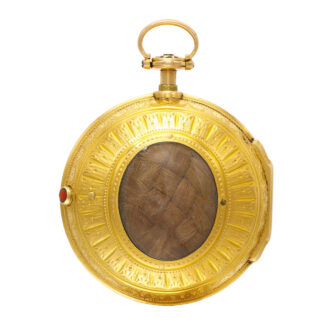
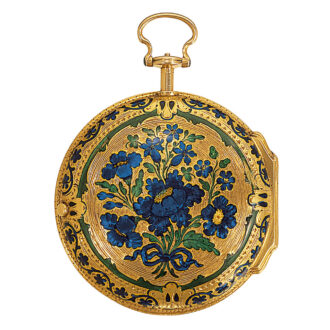
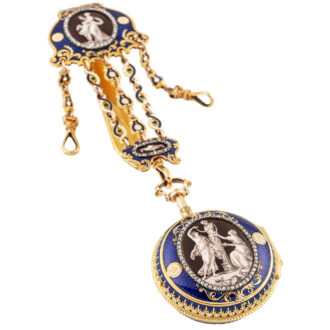
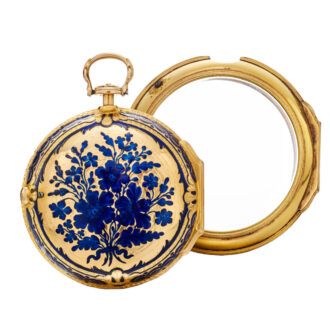
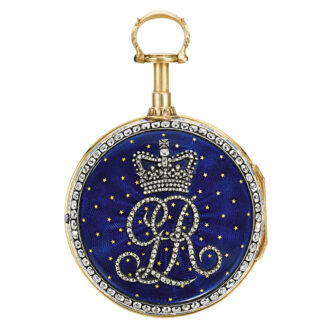
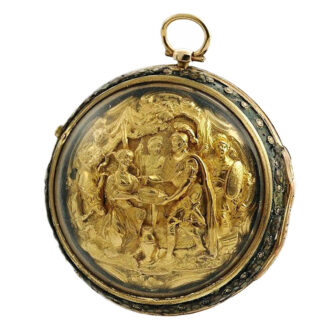
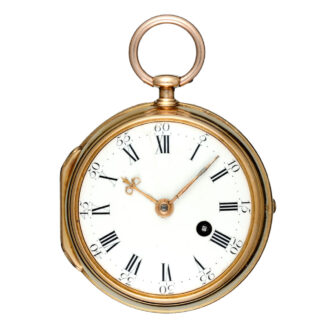
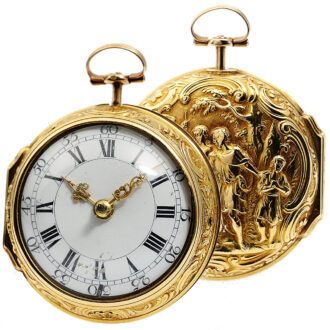
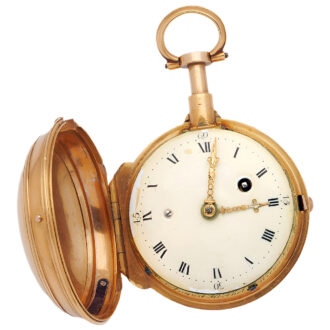
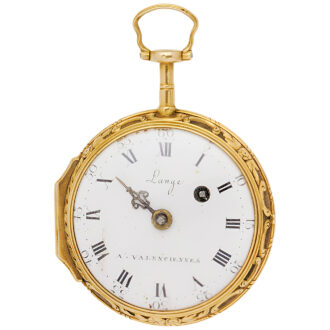
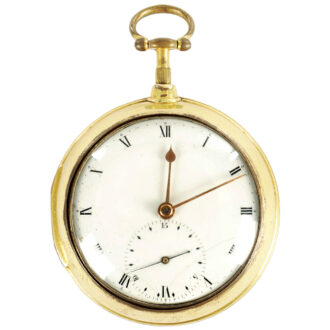
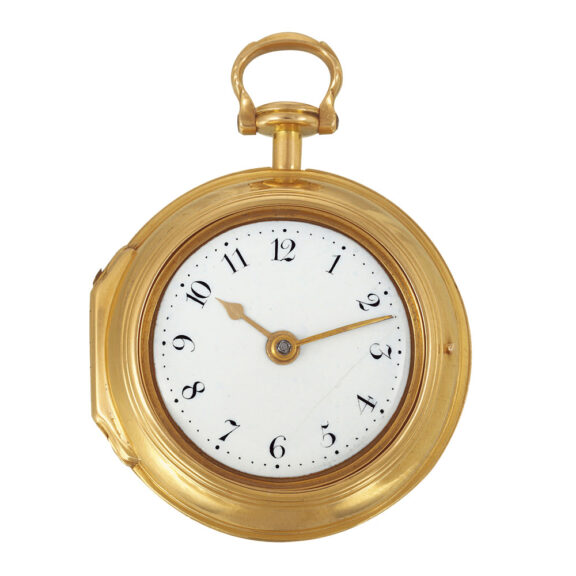
English gold pair cased miniature pendant watch Circa 1768
- Kenmerk
- TA1460
- Diameter
- 30 mm
- Estimate
- € 3.500 - 6.000
- Price sold
- € 4.100
Gold miniature verge pendant watch
–
A very fine and very rare English, miniature, 18 Carat gold pair cased pendant watch, circa 1768. Outer case by John Wright master mark, polished, extended rims. Inner case with a curved in edge, winding aperture at the back. White enamel dial, radial Arabic numerals, outer dot minute divisions. Gold spade hands. A hinged, frosted gilt full plate movement with turned tapered cylindrical pillars, fusee and chain, verge escapement, brass balance with flat balance spring, single footed cock pierced and engraved with foliage and a mask, silver regulation disc. Movement signed, both cases with London hallmarks for 1768 and the master mark IW.
–
Diameter: 30 mm
–
Signed: John Ellicott London
–
This watch was probably updated at the end of the 18th Century.
John Ellicott 1706-1772
The elder John Ellicott was apprenticed to John Waters in 1687. Free of the Clockmakers Company in 1696, he taught at least four apprentices. Elected to the Court of Assistants in 1726, he served as Warden from 1731 until his death in 1733. He resided in the parish of All Hallows, London Wall. Ellicott was an excellent craftsman; one movement known by him, dating from shortly after 1700, is for a very thin watch measuring only 1/5 inch between the plates. Another watch by Ellicott has a very early example of a centre seconds hand. He often concealed his name under the cock and balance. The most eminent member of the family, however, was his son, also named John Ellicott, born in 1706. The second Ellicott set up shop around 1728 in Sweeting’s Alley, near the Royal Exchange. Ellicott’s production was distinguished by excellent workmanship. He paid great attention to the cylinder escapement and did much to promote its use. He appears to have adopted it only two or three years after its improvement by Graham. From 1760 he signed his watches Ellicott and later John Ellicott & Son. Ellicott designed several public clocks, among them that of the London Hospital, and was appointed Clockmaker to the King. He died in 1772 and was succeeded by his eldest son Edward, who had been in partnership with him since about 1760. Edward Ellicott died in his home in Great Queen Street in 1791.
Share this page: