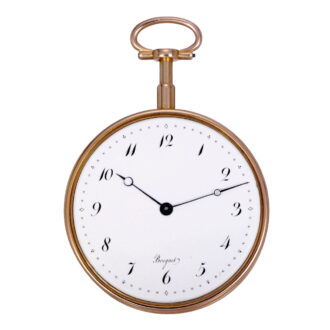
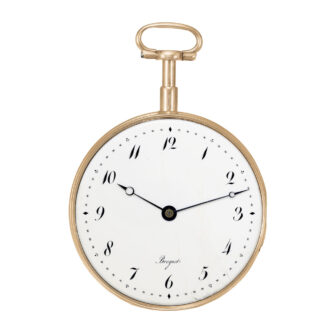
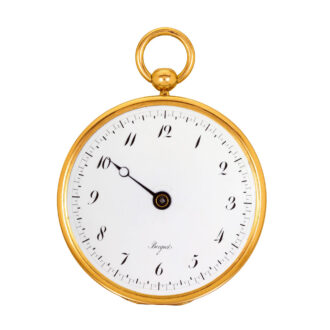
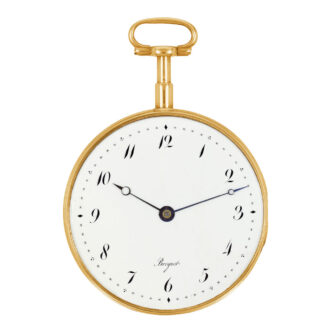
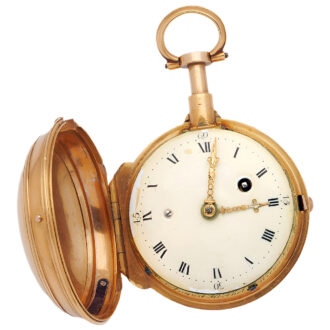
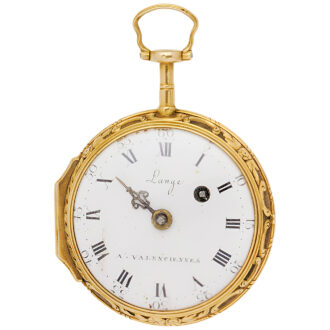
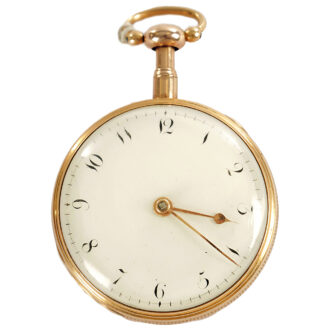
French gold, enamel and stone set pocket watch Circa 1799
- Kenmerk
- TD0131
- Diameter
- 54 mm
- Estimate
- € 15.000 - 30.000
- Price sold
- -
Gold open faced verge pocket watch
–
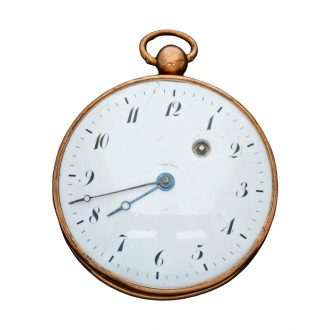
An exquisite French 18 Carat gold, enamel and stone-set open faced verge pocket watch, circa 1799.
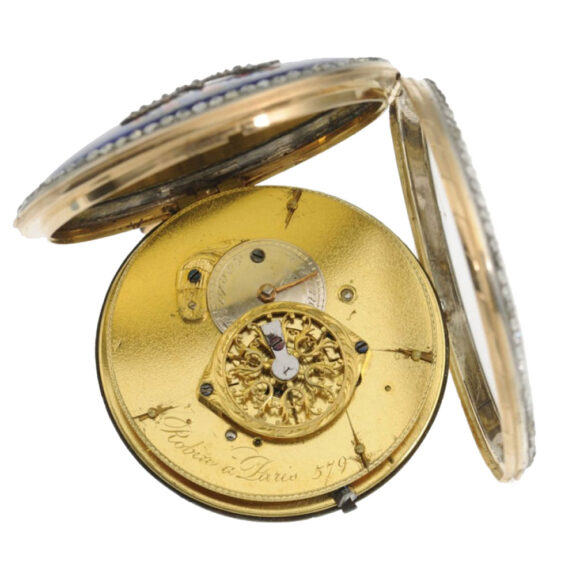
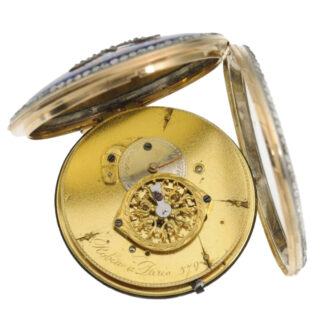
Fine full plate movement, verge escapement, chain and fusee, three-arm brass balance.
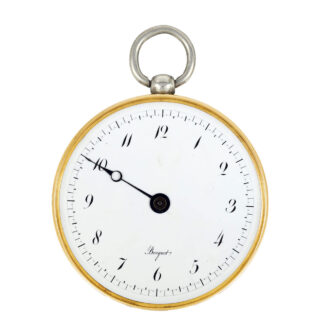
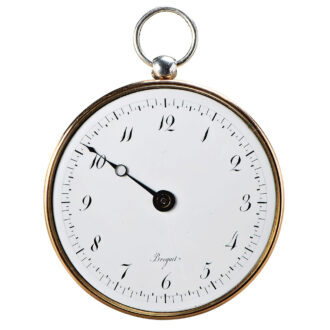
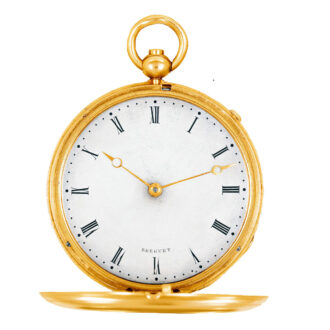
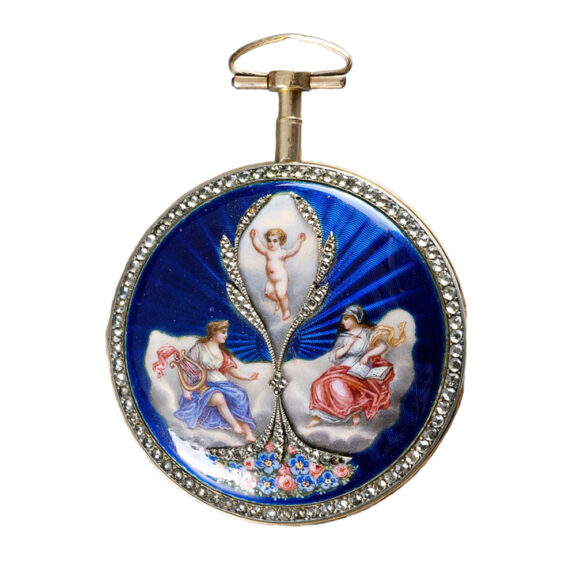
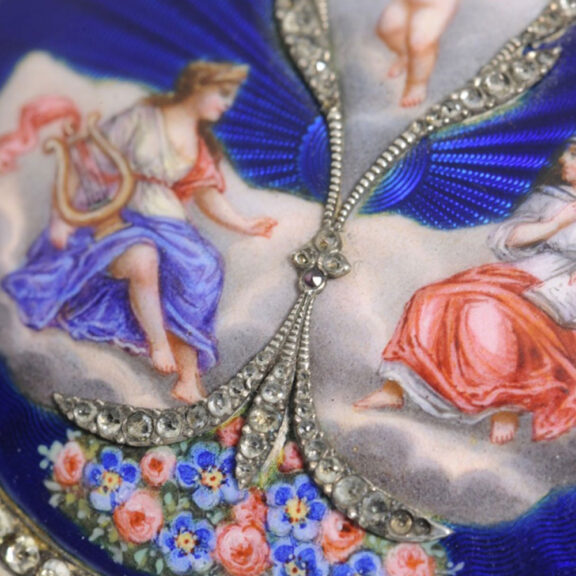
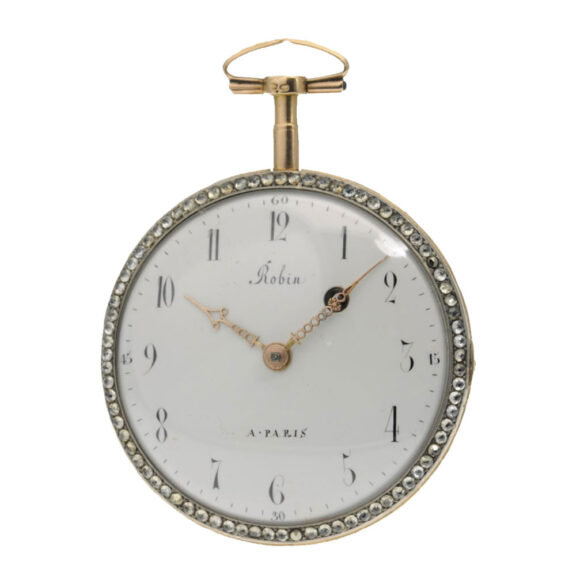
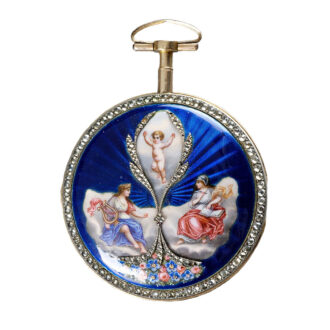
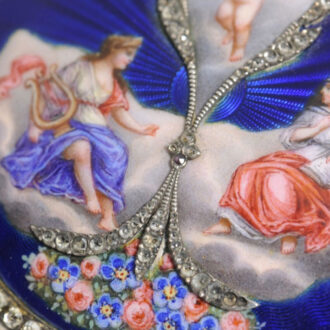
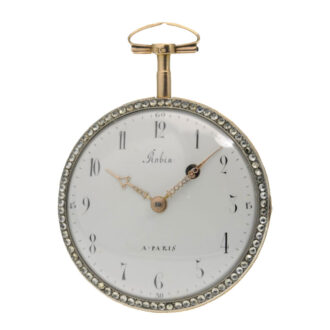
White enamel dial with Arabic hours, outer minute divisions and Arabic quarter hour numerals. The case back is decorated with three polychrome opaque enamel figures on a translucent cobalt blue ground with an engine-turned pattern; the lower part shows two muses on the left, Terpsichore, the muse of dance and chorus, her attribute is the lyre, on the right is the beautiful voiced Calliope, the muse of eloquence and epic poetry, philosophy and science, she is usually seen with a writing tablet and a pen, in the upper part and between the two figures above is a stone studded flower with a central putto, with the embossed crown of a count and initials X. F.
Comes with its original leather-covered presentation box signed by H.J. Linton.
–
Diameter: 54 mm
–
Weight: 98 g
–
Signed: Robin à Paris
–
Robert Robin (1741-1799) was a talented and inventive clock and watchmaker who counted among his clientele the French Royal Family. He became Marchand-Horloger Privilégié du Roi on 22 October 1763 and resigned on 13 September 1765 in favour of Jean-Pierre Courtois. In 1778 the Académie des Sciences approved two of his inventions, one being an astronomical clock representing a meridian drawn on a pyramid, which the Menus Plaisirs acquired that year for Louis XIV for 30,000 livres. During the same period, he perfected his famous mantel clocks with astronomical indications and compensated pendulums, one of the first owners being the Marquis de Courtanvaux. Robin applied these principles to regulators; the Duc d’Aumont possessed an early model of this kind. He was equally interested in watches, using a special escapement that bears his name from 1786 onwards and in monumental clocks, supplying the Grand Commun at Versailles (1782), the Menus Plaisirs and the Petit Trianon (1785). Many members of Parisian high society were clients of Robin, including the maréchaux Ducs of Duras and Richelieu and the Marquis de Sérent, tutor to the dukes of Angoulême and Berry. In 1794, Robin was appointed Horloger de la République. After the French Revolution, he was given the task of making an inventory of the Royal clocks, including the 23 that belonged to Marie Antoinette.
Signed: Robin à Paris
Share this page: