Swiss gold mandolin made for the Oriental market Circa 1820
- Kenmerk
- TA4887
- Diameter
- -
- Estimate
- € 1.000.000 - 2.000.000
- Price sold
- -
Gold quarter repeating musical automaton watch
–
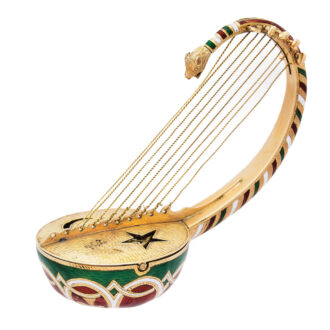
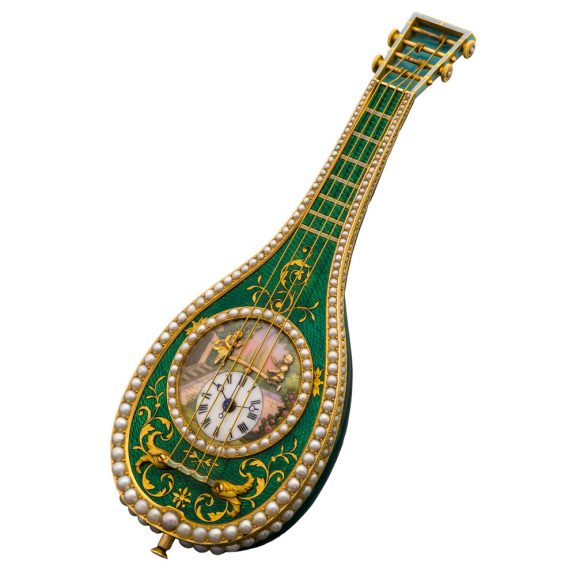
This magnificent and extremely rare 18K gold watch, made around 1820 for the Oriental market, takes the form of a Neapolitan mandolin. It has a quarter repeater and a musical automaton that plays every hour or on demand.
–
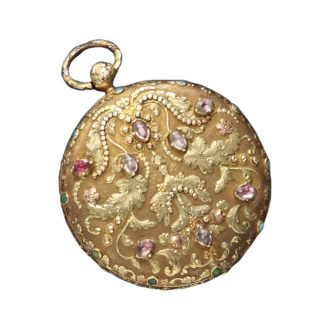
The body is covered in translucent green enamel over an engine-turned ground, with gold leaves on the soundboard. The pearl-framed sound hole holds the watch dial and the automaton scene. The back is made of six ribs in the same green enamel over a geometric pattern. The neck has light blue enamel frets, knurled gold tuning pegs and a row of finely graduated split pearls, and the strings are twisted gold rope. Graduated half pearls line the edge, where a small button sets off the quarter repeater.
–
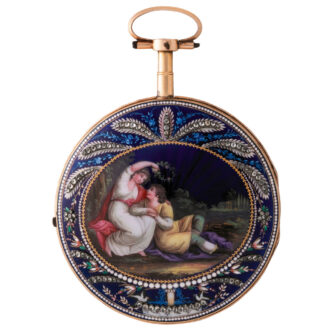
When the lid is opened, it reveals a polished gold cuvette with flowers in translucent imperial blue enamel. On its side is the lever to switch the music on or off.
–
The gold cuvette holds the movement, and the plates around it are engraved with ribbons and flowers in royal blue champlevé enamel.
–
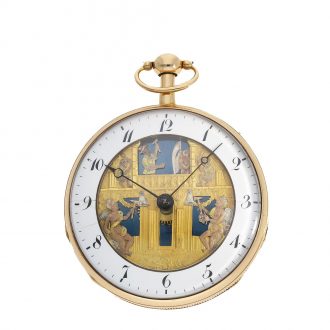
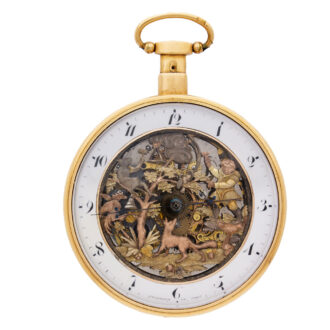
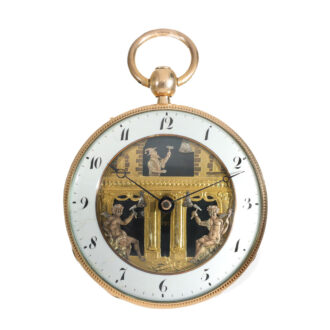
The enamel dial shows a painted park with roses in the foreground. Two children in multicoloured gold play on a moving seesaw above an off-centre chapter ring with Roman numerals. The hands are blued steel, in Breguet style, with a counterbalanced centre hand.
–
The frosted gilt movement has two trains, a cylinder escapement and a plain three-arm balance with a flat blued steel balance spring. Pressing the pendant makes the watch strike the quarters on two gongs. The music comes from 21 tuned steel blades, plucked from both sides of a pinned disc. A small lever on the edge of the cuvette, under the cover, turns the music on or off. The movement is stamped “PM” for Piguet & Meylan and is numbered in several places.
–
Dimensions: 128 x 50 mm
–
Signed: Piguet & Meylan Geneva
–
Piguet & Meylan made this magnificent fantasy watch in Geneva around 1820. It is one of only four known. Two others are in Geneva, in the Patek Philippe Museum and in the Hans Wilsdorf Foundation Collection of Rolex. In his 1944 book on the Wilsdorf collection, Alfred Chapuis (1880–1958) identifies the tune as the popular song “Ach, du lieber Augustin”
–
These watches are unusually large. Besides telling the time, they play music and have moving figures. Unlike most fantasy watches, they do not hide the watch: it is their main feature, just as in a classic watch.
–
The large size left room for especially rich decoration. This piece combines polychrome champlevé enamel, translucent enamel over guilloché, natural pearls, gold paillons and fine engraving. The automaton shows two children on a seesaw, gently beating time to the music.
–
The choice and placement of the enamel colours suggest that this mandolin was made especially for the Chinese Emperor and his court. Most of Piguet & Meylan’s finest watches and objects were made for them.
–
The mandolin belongs to the lute family, from which it took its rounded, bowl-shaped back. Small mandolins were already played in Italy in the 17th century, but the Neapolitan form we know today was developed in Naples in the mid-18th century. Its sweet tone made it hugely popular in Italy, especially around Naples, and it soon became fashionable in England as well.
–
The mandolin is often dismissed as a folk instrument, but that does it an injustice. Vivaldi wrote solo concertos for it, and it appears in works by Beethoven, Pergolesi, Verdi, Mahler and Stravinsky, and in Mozart’s opera Don Giovanni.
–
The instrument also suited the spirit of its time. In France, Geneva-born Jean-Jacques Rousseau, and in Germany, the Sturm und Drang movement, were preparing the way for Romanticism, a reaction against the strict classicism of the 18th century.
–
In Geneva, goldsmiths and watchmakers were inspired by what the mandolin stood for and by its graceful shape. They made it in miniature, creating tiny masterpieces in gold, rich with multicoloured enamel and natural pearls. These fantasy jewels became messengers of love, worn discreetly on the breast of a loved one.
–
Some Geneva watchmakers were also goldsmiths and specialised in this kind of work. Among them were Piguet & Capt, Rémond, and the Achard, Esquivillon and Bordier families. They made precious jewels in unusual shapes, such as musical instruments, fruit, flowers, lucky animals, flasks and everyday objects, for the most refined buyers in Europe and beyond.
–
The rounded body of the mandolin was ideal for hiding small treasures: a vinaigrette (a tiny box for scented salts), a secret watch, or a miniature musical movement. In such a movement, small pins pluck steel blades to make music, so the jewel copied not only the shape of the mandolin but also its sweet sound.
Signed: Piguet & Meylan Geneva
Share this page: