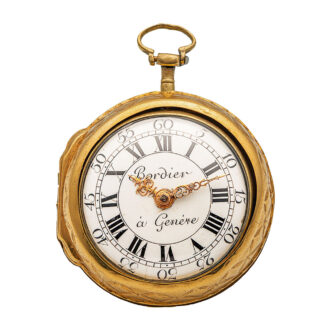
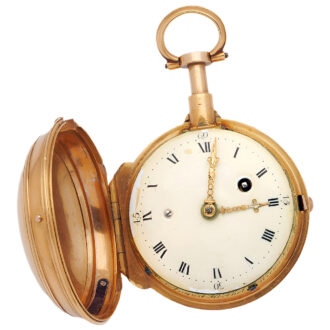
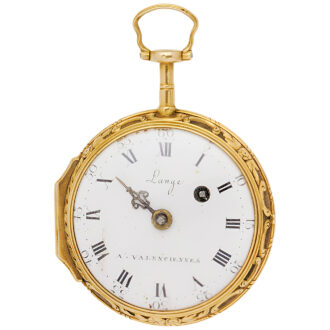
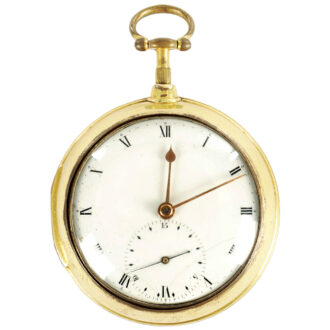
Swiss miniature pair-cased verge pocket watch Circa 1760
- Kenmerk
- AD9504
- Diameter
- 38 mm
- Estimate
- € 1.000 - 2.000
- Price sold
- -
Copper-gilt open faced pocket watch by Virginio Girard & De Montanrouge
–
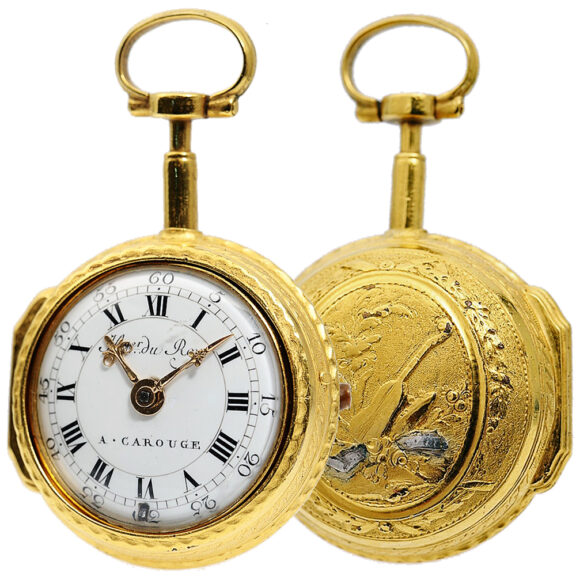
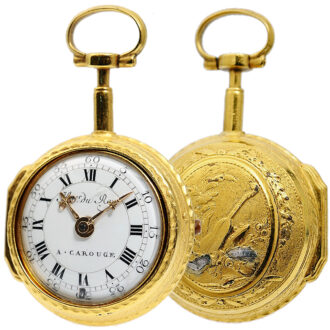
A Geneva miniature pair-cased verge pocket watch, circa 1760.
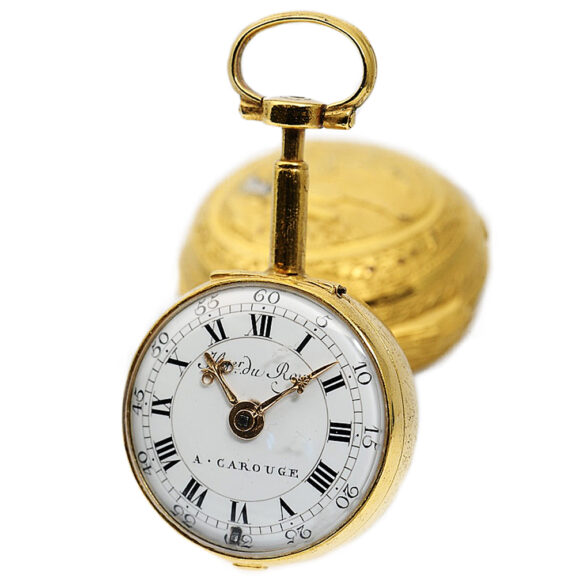
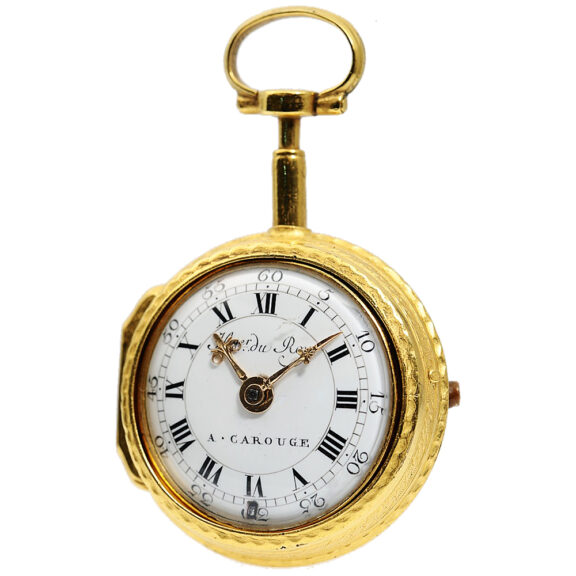
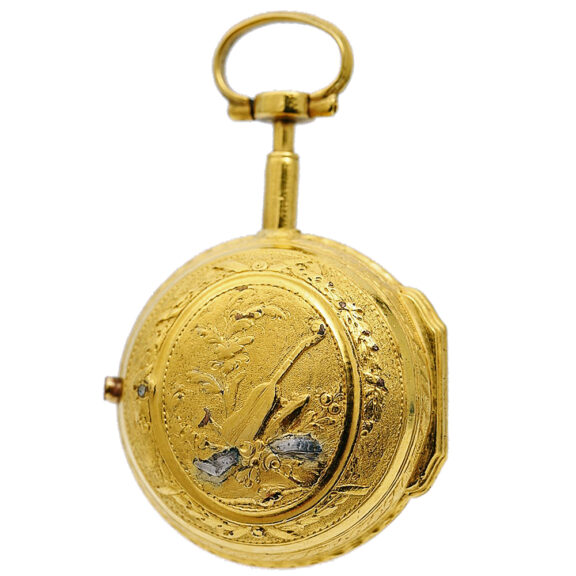
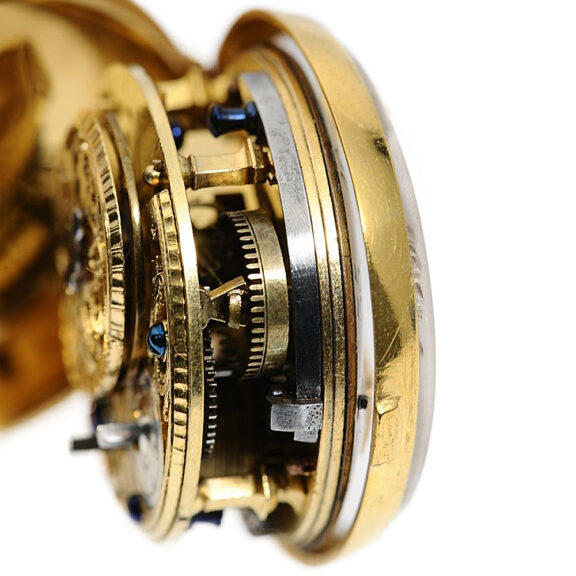
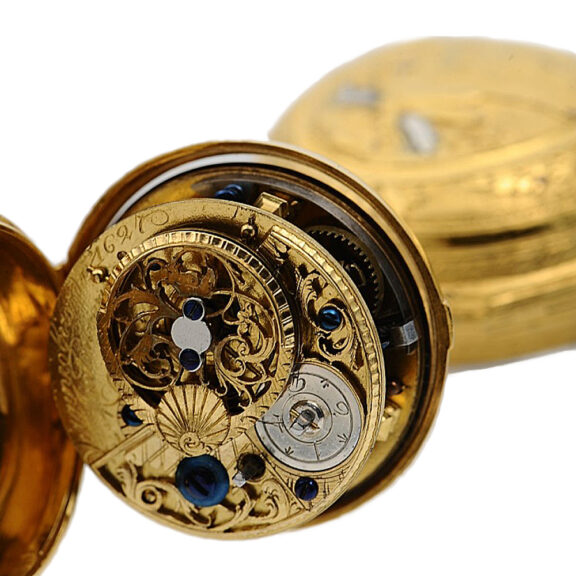
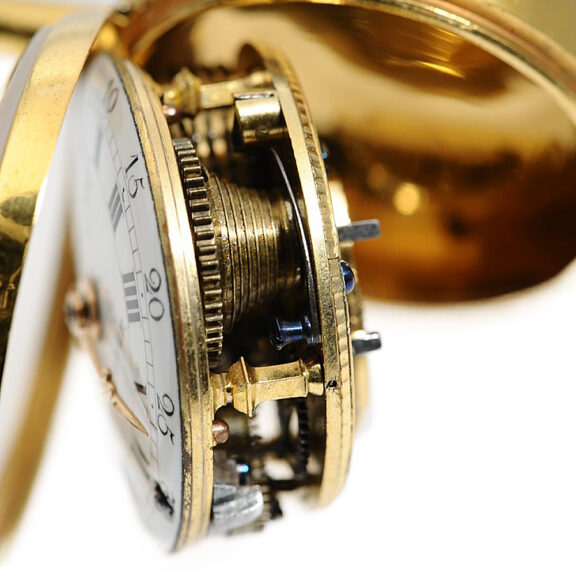
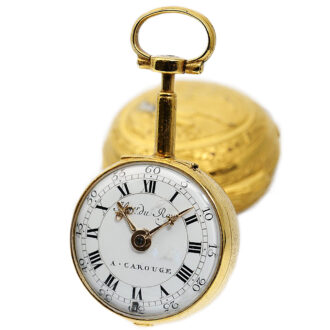
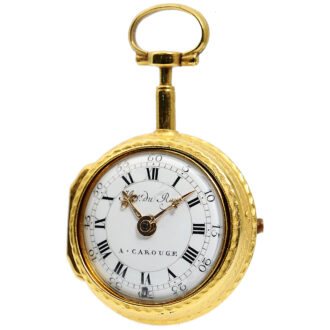
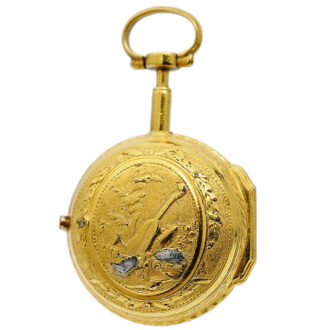
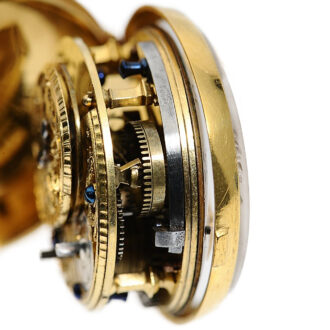
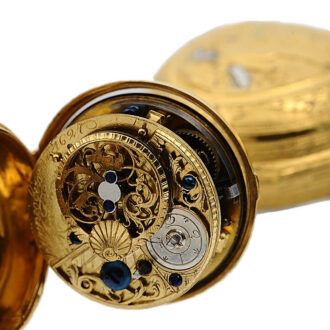
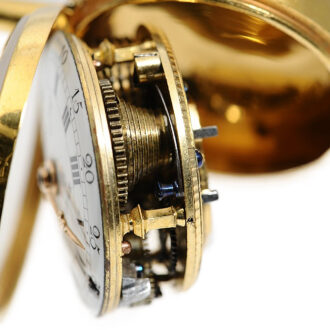
Two cases: an outer case – copper, gilt, florally engraved, à goutte, ornamented with musical instruments and garlands on the backside, large lateral hinge: and an inner case – gilt, polished. Signed enamel dial with radial Roman hours, and Poker & Beetle hands. Full plate movement, keywind, fire gilt, applied floral decorations, signed, chain/fusee, square baluster pillars, three-arm brass balance, pierced and engraved balance cock with shell.
–
Diameter: 38 mm
–
Weight: 57 g
–
Signed: Horloger du Roy à Carouge
–
The company Virginio, Girard & De Montanrouge was founded in Carouge near Geneva before November 7th, 1783. In the Turin archives, the company was already mentioned at the main financial office. One of the company owners was Joseph Antoine de Montanrouge and father of François Sébastien de Montanrouge. The “Fabrique royale d’Horlogerie” was located at 20 rue Vautier (view this location). Dominique Virginio came from Venice but was also one of the firms and probably financially involved.
The city of Carouge was built from scratch by the Sardinian monarchy (House of Savoy) in the last quarter of the 18th century to compete with the neighbouring city of Geneva. In 1754, there were 24 houses, 1772 767 inhabitants, and 20 years later there were already 4,672 inhabitants. At that time, the population of Carouge was mixed. In 1786, the population consisted of 51% French, 26.3% Savoy and Piedmontese, 7.8% German, 6.5% Geneva and 5.5% other Swiss. In 1792 Carouge became French. In 1816, the Treaty of Turin assigned the city of Carouge to the canton of Geneva and thus to the Swiss Confederation.
The history of the city makes it clear why the company could use the title “Horloger du Roy” because Carouge then belonged to the Kingdom of Sardinia. The company currently employs around 150 people. The watch glasses were made by a Jewish gentleman who came from London and founded a factory in 1785. Carouge was a refuge for Jews and also has a Jewish cemetery, similar to the town of Hégenheim in Frankeich (see also Ditisheim). Watchmaking in the Geneva area was a prime example of the rapidly growing industrialization of Carouge. Various residents of Carouge also worked in the Geneva watchmaking facility and travelled to Saint-Gervais in Geneva every day to work. The craft of watchmaking encompasses numerous professions such as making springs, watch cases, polishing, jewellery, and silversmithing.
Signed: Horloger du Roy
Share this page: