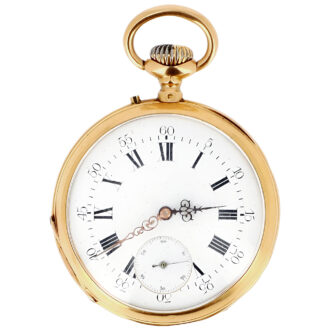
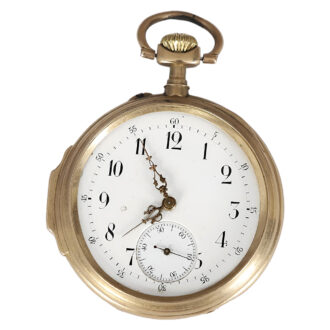
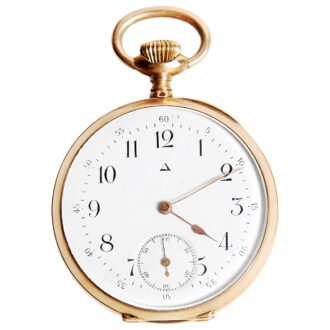
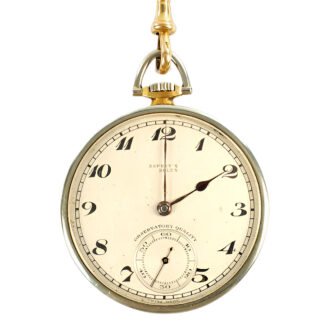
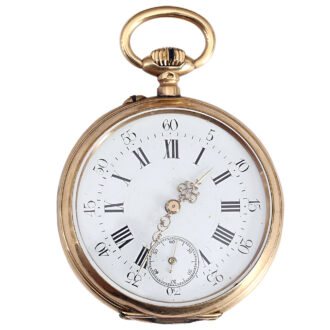
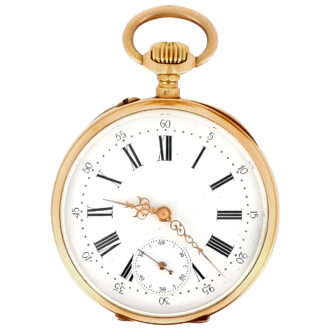
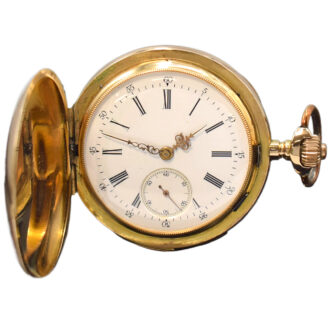
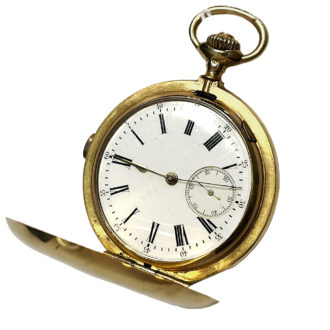
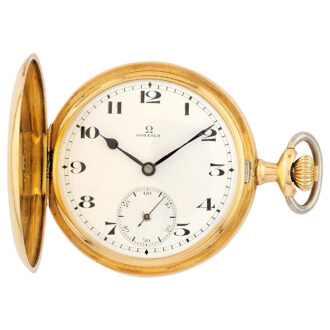
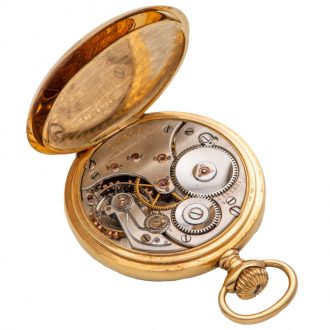
Rare Swiss 18 carat gold Observatory chronometer Circa 1900
- Kenmerk
- TA5294
- Diameter
- 51 mm
- Estimate
- € 3.500 - 7.000
- Price sold
- € 4.500
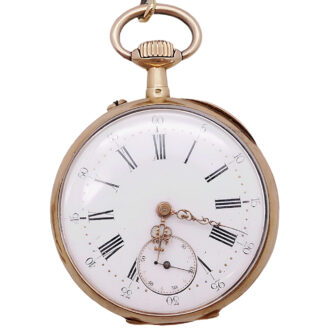
Gold open faced keyless lever pocket watch
–
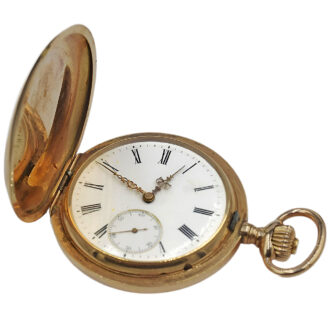
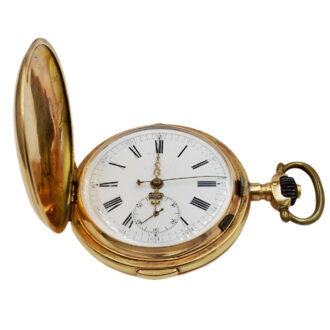
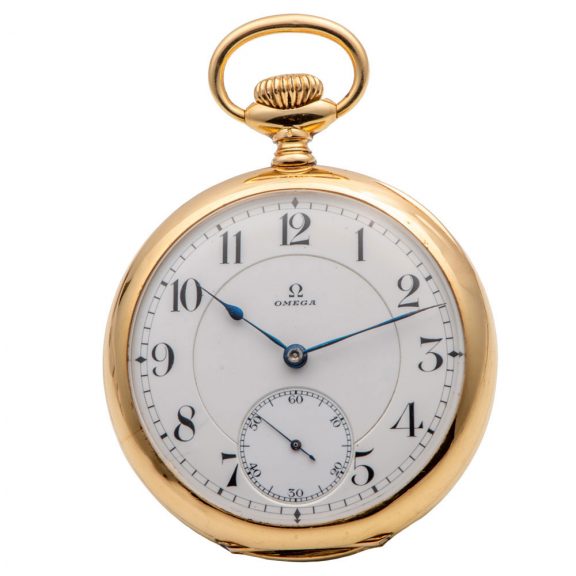
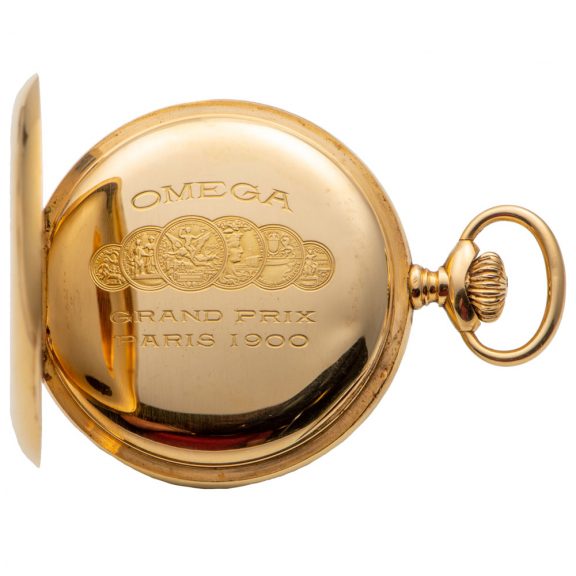
A rare Swiss 18 carat yellow gold open faced keyless pocket chronometer made by Omega in Bienne, circa 1900. A polished, plain case. The Chronomètre DDR model, accompanied by a First Class Bulletin de Marche from the Astronomical Observatory of Neuchâtel (1911, 1912 and 1913). White enamel dial with Arabic hour numerals, an outer minute track, subsidiary seconds at 6 o’clock and blued steel spade hands.
–
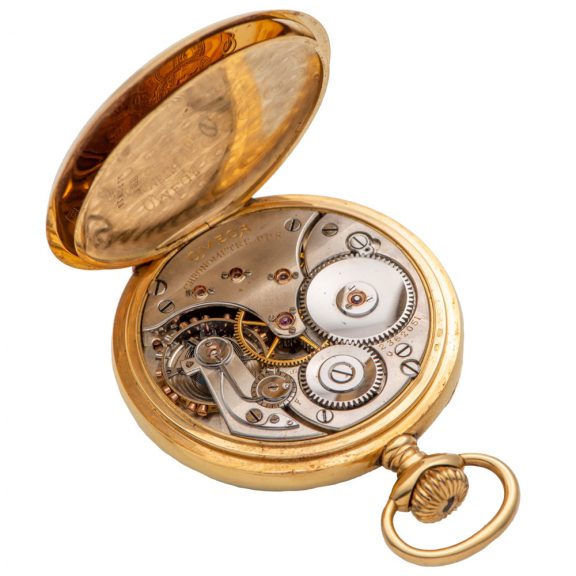
A nickelled movement, Grade DDR, 23 jewels, going barrel with safety pinion, gold screwed chatons, straight line lever escapement, cut bimetallic compensated brass Guillaume balance with gold and platinum poising screws and blued steel hairspring with terminal curve, diamond end stone, an index regulator with swan neck spring and precision regulating device for fast/slow by means of an eccentric snail, adjusted by the Omega precision regulator Werner A. Dubois in Bienne/Biel. The dial, case and movement are signed.
–
Diameter: 51 mm
–
Weight: 110 g
–
Signed: Ω Omega Bienne
–
Omega Observatory precision calibrations:
-Grade D: 16 or 17 jewels, available as chronomètre, from size 13 to 20 with a Bulletin de marche issued by the Bureau or the Observatory in Bienne, Neuchatel or Geneva; adjusted to variations of less than a minute per month, in five positions and under extreme temperatures.
-Grade D: very fine finished, 18, 19 and 20.
-Grade DR: extra-fine finish, 19 and 20, with 19 jewels, balance screws in gold.
-Grade DDR: appeared in 1905, 19 and 20, intended for official chronometers and observatories, made in silvered nickel, with 23 jewels (incl. 2 diamonds), all parts polished and/or gold finished.
–
In Switzerland, as early as the middle of the 19th century, scientists and watchmaking industrialists cooperated in chronometric tests. The Geneva and Neuchâtel observatories, for example, hosted precision competitions, the conditions of which would evolve with time and technological advances. In the course of the 20th century, these tests took place over a period of forty-five days and included ten separate tests to time the movement in five different positions and at two different temperatures. These tests quickly exceed their function as simple certification tests and become a real competition ground for the best watch manufacturers in Switzerland and Europe.
–
In Geneva, the names of H.R. Ekegrén, B. Haas, Patek Philippe, Vacheron Constantin, etc., are regularly found there, and in Neuchâtel, those of Longines, Omega, Peseux, Ulysse Nardin, Zenith, etc., are also present. This theatre gives rise to movements specially designed for these annual events, which have today become legendary calibres. Some watchmakers specialise in adjusting these movements; they are the precision timers, the aristocrats of the profession. Precision movements are manufactured with much smaller mechanical tolerances than standard watch movements and often take as long to make and adjust as movements for watches with horological complications.
–
Guillaume Balance
The Guillaume balance is a compensated bimetallic balance, made of anibal an alloy of steel, nickel and brass, after the works of Dr Charles-Edouard Guillaume 1861-1938, with which the middle temperature error is practically eliminated. The middle temperature error, or Dent’s anomaly, is the difference between the rate of a chronometer at the mean temperature and the average of the rates at extreme temperatures. This type of balance was used by the horological manufactories since 1904.
Signed: Ω Omega Bienne
Share this page: