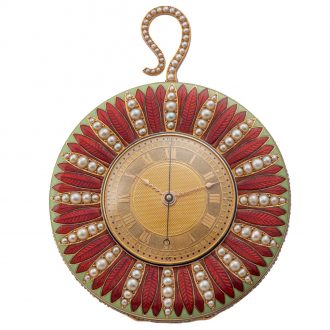
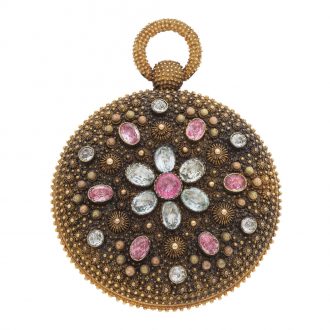
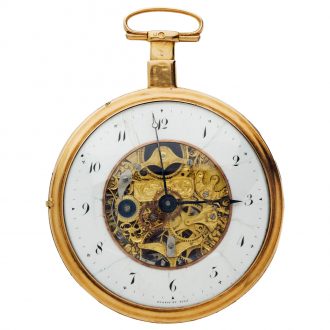
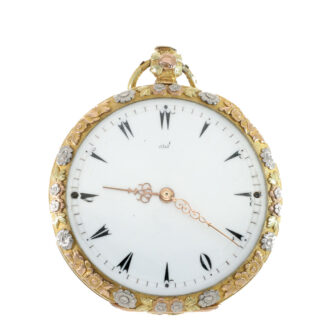
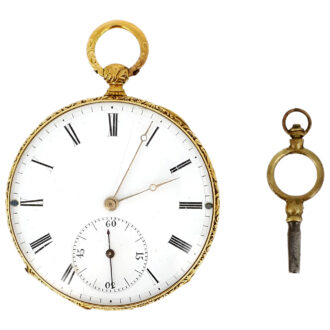
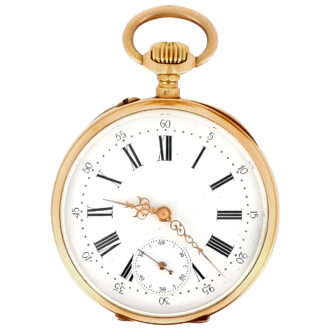
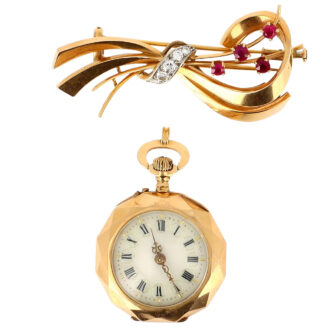
Swiss rose form two train musical automaton watch Circa 1820
- Kenmerk
- AS1913
- Diameter
- 49 mm
- Estimate
- € 150.000 - 300.000
- Price sold
- € 246.500
Gold and enamel automaton watch with centre seconds
–
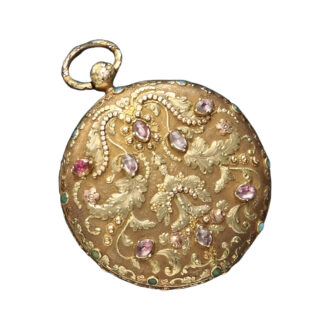
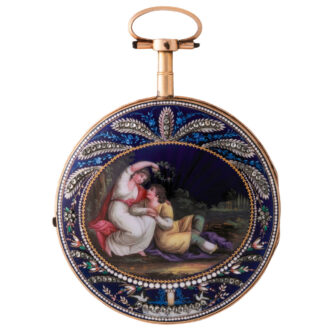
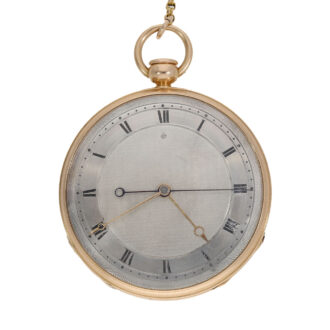
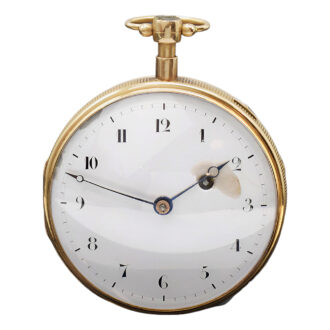
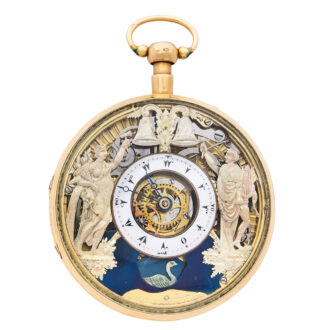
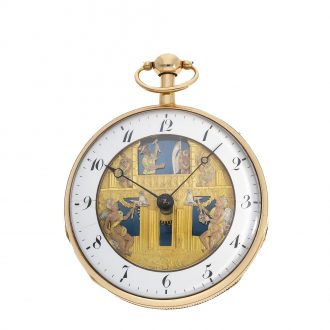
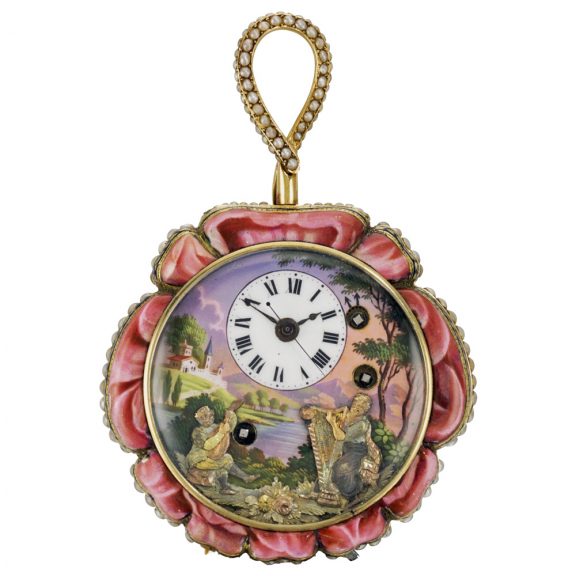
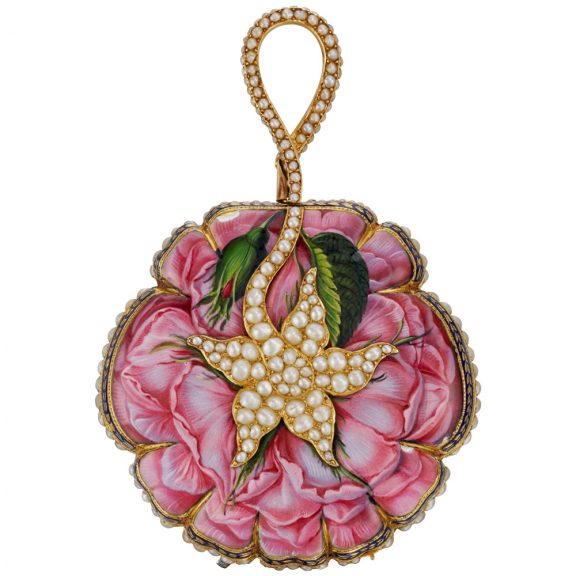
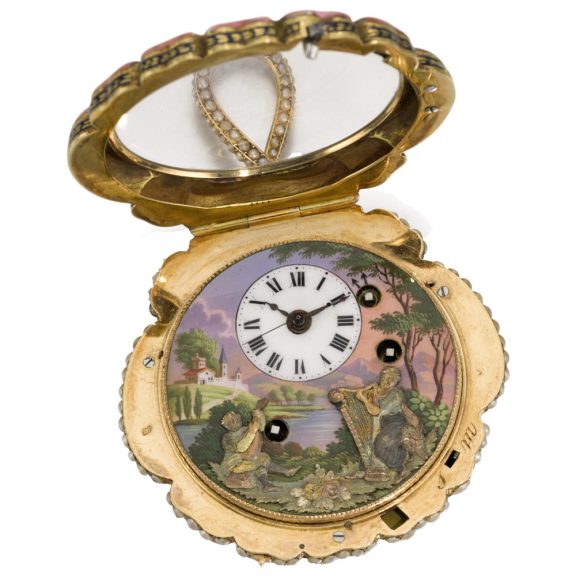
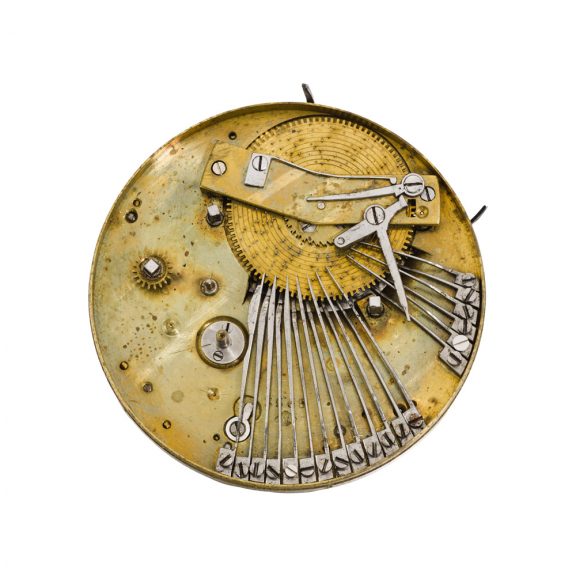
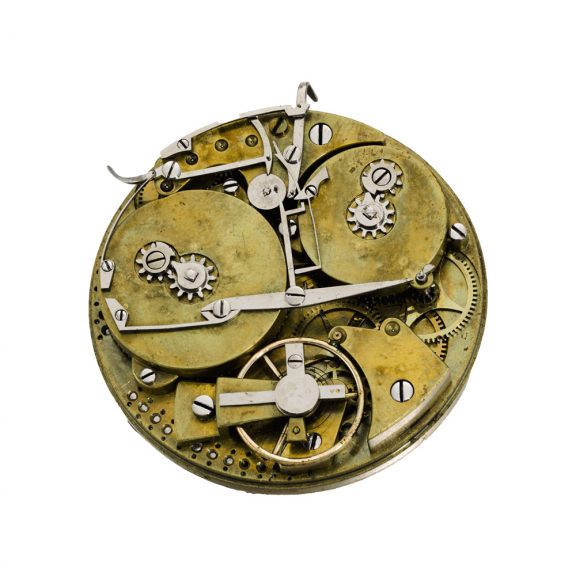
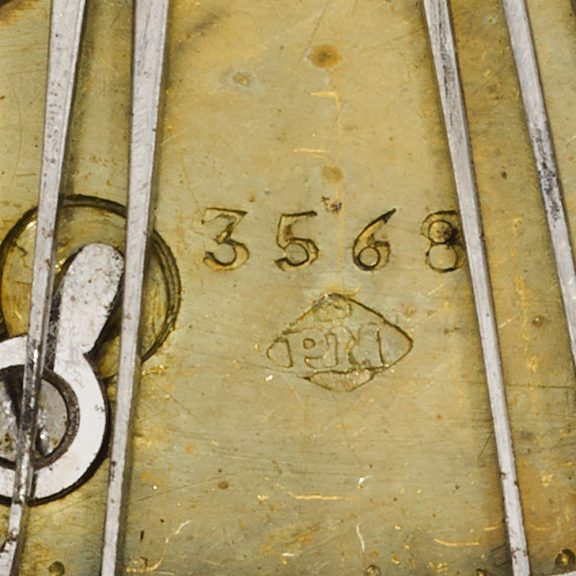
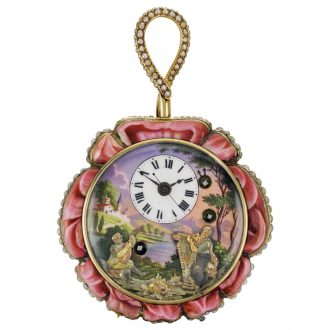
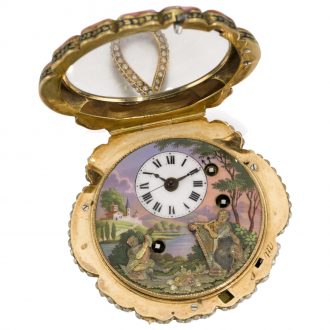
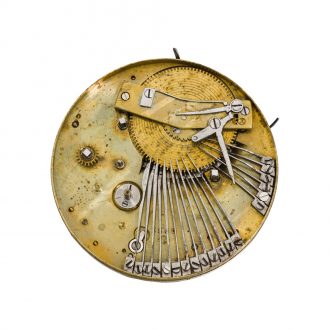
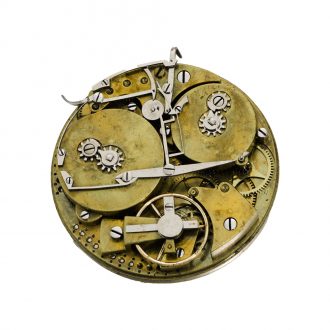
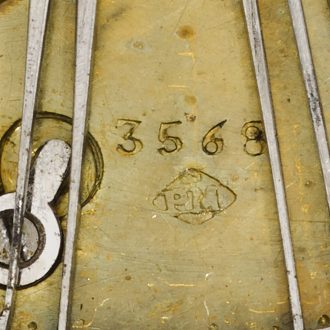
An exquisite Swiss gold and enamel rose-shaped two-train musical automaton watch, titled THE ROSE, featuring centre seconds and playing on the hour and on-demand, crafted for the Chinese market by Piguet & Meylan, circa 1820. This beautiful watch features a gilded movement with a cylinder escapement and hanging barrels for the timekeeping and music mechanisms. It plays music on demand or hourly through a pinned disc with 19 tuned teeth. The movement is stamped with PM for Piguet Meylan and is numbered 3568 on the top plate beneath. The dial includes a small off-set white enamel time display with black Roman numerals, an outer minute ring, and central seconds. It is surrounded by a polychrome enamel painted lakeside scene, depicting a varicoloured gold gentleman and a lady in the foreground, playing a lute and harp with moving arms. There are three apertures for winding the time, music mechanisms, and setting the time. The dial plate is numbered 3568 on the reverse.
–
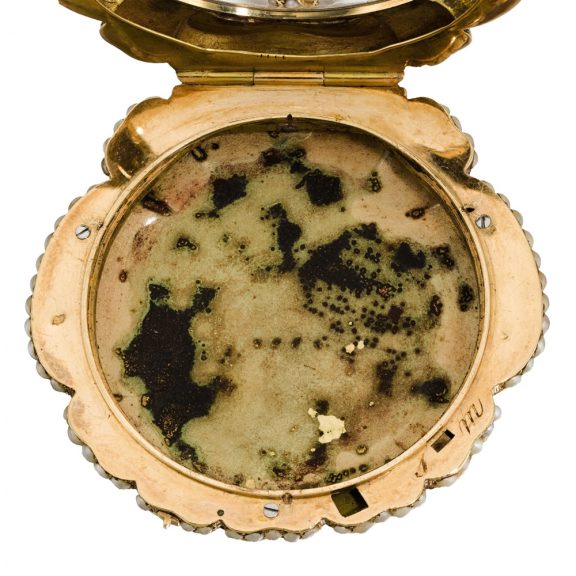
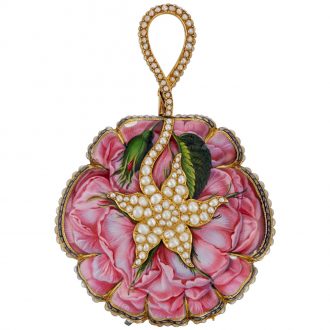
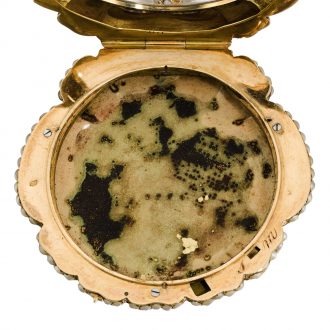
The gold case is designed in the shape of a pink rose flower, with a rosebud and leaf emerging from a gold and pearl-set sepal and stem, which also form the watch’s bow. The bezel is similarly decorated with enamel, and the band is pearl-set with a gold geometric pattern enhanced with dark blue enamel. A lever beneath the bezel allows for silence or music mode, and the inside back is numbered 3568.
–
Width: 48.5 mm
–
Signed: Piguet & Meylan
–
The movement is currently not functioning, and the music is not playing. The dial seems to be in good condition. There is a chip on the edge of the case back to the left of the pendant, and the bezel shows some discolouration, likely indicating repairs. The back may have signs of restoration, and the band has been restored. Under the bezel, there is a scratch that appears to be marked with the name Melleret, Geneve.
–
Piguet & Meylan are celebrated for their exquisite watches crafted for the Chinese market. These timepieces are distinguished by their intricate decorative finishes, with the company employing some of the finest enamel painters to adorn their creations. The watch in question exemplifies the firm’s finest work, featuring lavish case decoration and innovative, complex mechanisms for its musical and automaton displays. Piguet & Meylan’s creations are part of many prestigious collections worldwide, including the Patek Philippe Museum in Geneva, the Metropolitan Museum of Art in New York, and the Sandoz Collection.
–
A pair of similar musical automata rose-form watches by Piguet & Meylan, bearing consecutive numbers to this watch (nos. 3569 & 3570), are housed in the Patek Philippe Museum.
–
Piguet & Meylan was established in 1811 by Daniel Isaac Piguet (1775–1841) and Philippe-Samuel Meylan (1772–1845), and their partnership continued until 1828. Daniel Isaac Piguet, originally from Chenit in the Vallée de Joux, relocated to Geneva, where he became a Burgher in 1812, a year after forming the partnership with Philippe-Samuel Meylan. Their enterprise focused on the production of watches, jewellery, and various mechanisms. Piguet was known for creating intricate watches featuring carillons and clock mechanisms. Philippe-Samuel Meylan, born in Bas-du-Chenit, is noted for innovating the use of sonorous metal ‘tongues’ for musical movement combs in watches and other small items. The firm is credited with significant advancements in the development of miniature and ultra-thin movements for watches, music boxes, and sophisticated automata, as well as the invention of the sur-plateau musical movement. Their automata, which include singing birds, barking dogs, and magicians capable of ‘answering’ questions, are regarded as some of the finest ever created.
Signed: Piguet & Meylan
Share this page: