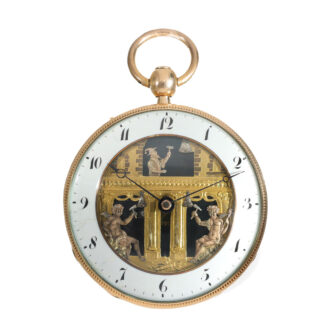
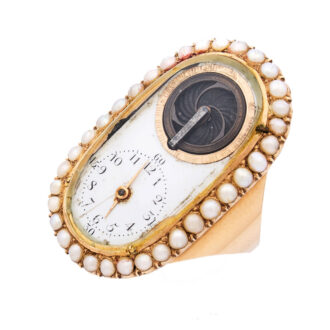
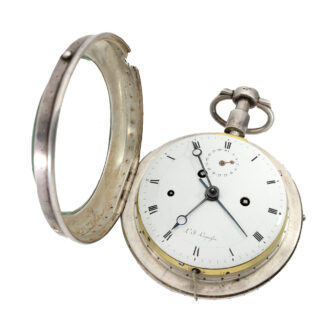
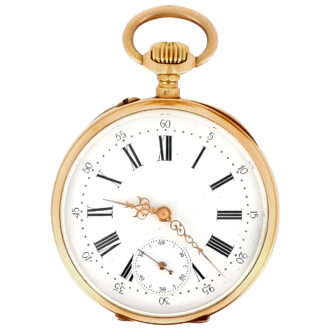
Swiss/French silver and gold cylinder pocket watch Circa 1815
- Kenmerk
- AA0241
- Diameter
- 63 mm
- Estimate
- € 15.000 - 25.000
- Price sold
- -
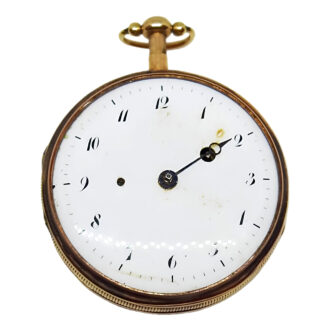
Breguet type souscription watch probably by Louis Decombaz
–
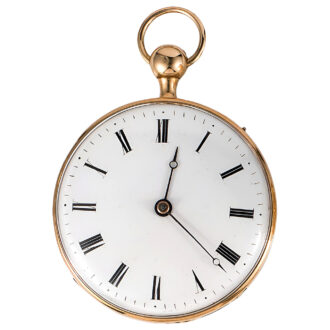
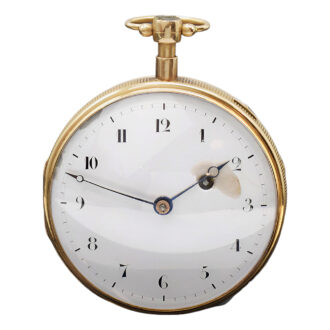
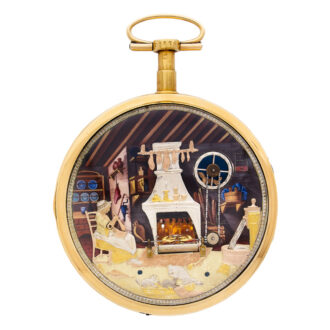
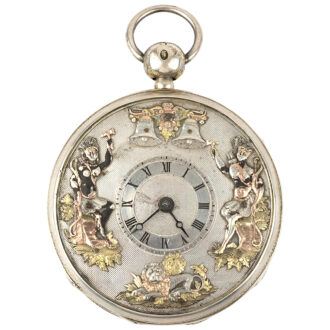
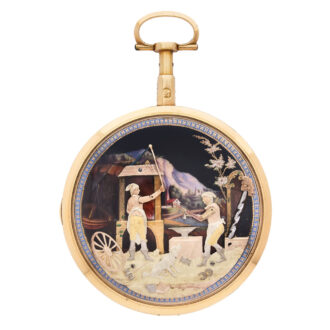
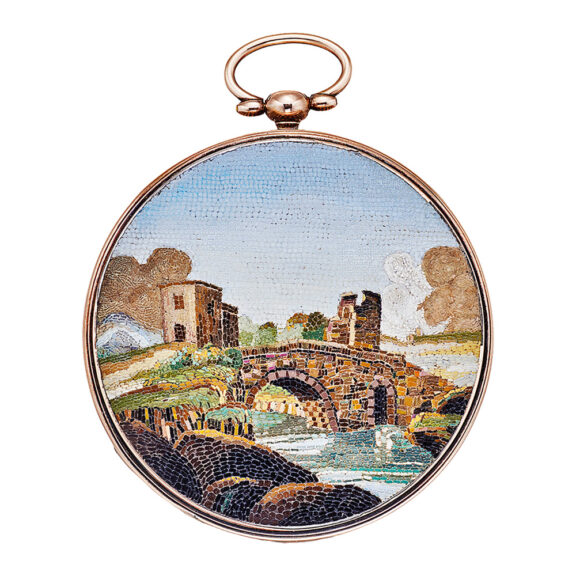
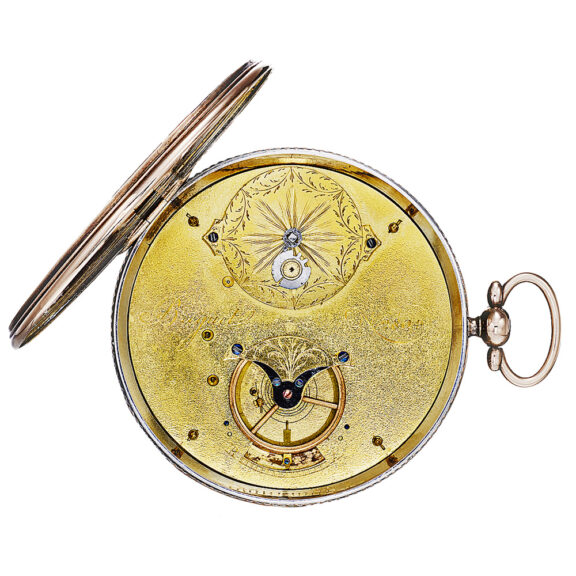
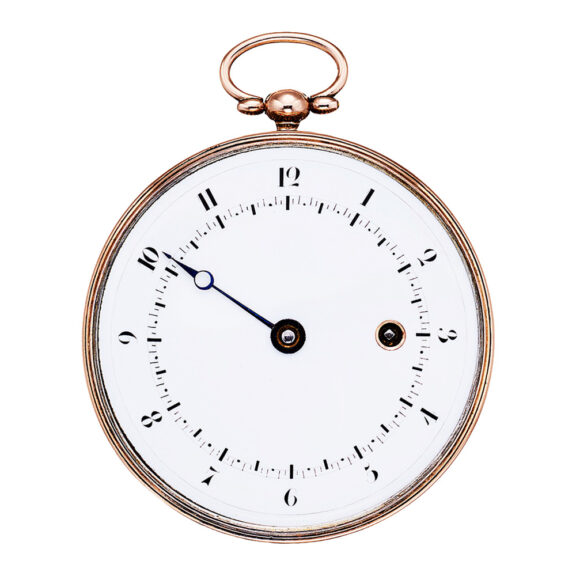
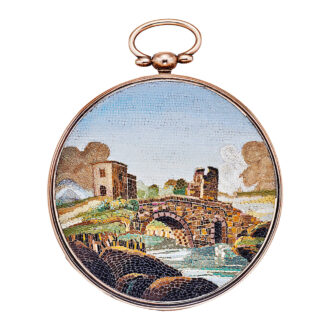
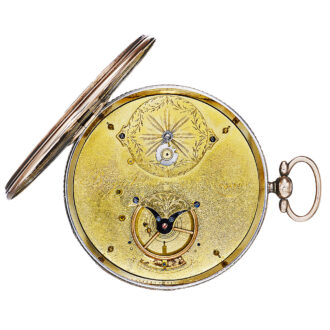
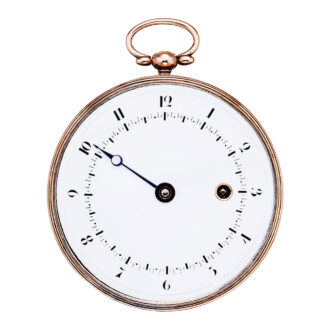
A Swiss/French silver and rose gold open faced key wound one handed souscription type pocket watch, circa 1810-1820. The round shaped case with a fluted band and a polychrome micro mosaic on the hinged back showing an ancient fortified bridge with a tower and other structures over a river, the Ponte Mammolo (Mammolo Bridge) on the Aniene River, a tributary of the Tiber. A white enamel dial with Arabic hours, an inner minute track, a secret signature below the 12 Breguet No. 2804 and one blued Breguet hand. The signed, gilded brass movement with a cylinder escapement, brass wheel, going barrel, monometallic balance and blued steel flat hairspring engraved 683 and 5 with an etching needle.
–
Diameter: 63 mm
–
Weight: 165 g
–
Signed: Breguet
–
The caliber of this watch is not made by Breguet, but most likely by his business partner, Louis Decombaz, in Geneva. The dial was probably supplied by Breguet, hence the matching secret signature.
This timepiece is one of only two souscription watches known to date with micro mosaic decoration. The watch is in all probability the subject of an order for the Italian market and/or intended for a member of a patrician family of the Roman nobility, as the art of micro mosaic flourished in Rome at the end of the 18th century.
The attribution to the workshop of Decombaz results from a watch (in a private collection) with a similar souscription-like movement signed by him. Although the name Louis Decombaz has fallen into oblivion today, it is important to know that he was the preferred contact of Abraham-Louis Breguet in Geneva at the beginning of the 19th century and that it was he who made watches with complicated mechanisms for the Parisian master. Decombaz was one of the best Geneva watchmakers of his time.
–
Breguet’s Souscription watches
Usually made in silver with gold rims being the only decoration, the souscription watches were of a large diameter, allowing the enamel dial to be divided so that both hours and minutes could be read from a single hand. The movements had a single plate, the spring barrel mounted in the center, and the wheels elegantly positioned and retained by bridges. The single hand was driven directly off the barrel arbour, eliminating the motion work and the inherent friction. The ruby cylinder escapement was fitted with a parachute (shock protector) and a compensation curb to assist in correcting temperature errors. Features that were the norm for all of Breguet’s first class watches.
To further reduce the selling price, Breguet decided to produce these watches in small series of 12 to 20 examples at a time, with the buyers paying 25% in advance and the remaining amount on completion, hence the term “de souscription” (by subscription).
The success of these watches enabled Breguet to reestablish his business, which had been badly affected by the French Revolution and his exile in Switzerland, and largely finance his research into other areas of horology.
–
Giuseppe Corleone Vasi, born August 27, 1710 on Sicily and died April 16, 1782 in Rome, was an Italian engraver and architect.
–
Micro mosaics consist of tiny pieces of glass, fragments of coloured enamel or small hard stones, assembled on a very small area, often just a few square centimetres. Micro mosaics flourished from the late 18th to early 19th centuries.
The first documented exhibition of micro mosaics was held in 1775 by Giacomo Raffaelli (1753-1836) in his private studio in Piazza di Spagna. Raffaelli came from a family of workshop mosaicists. Many innovations are credited to him, although some were probably developed a little earlier. Most significant was the invention of the ‘smalti filati’. These are narrow, thin glass rods that are stretched and cut vertically, creating very fine, small mosaic stones. Raffaelli primarily produced micromosaics depicting views of ancient Rome, which were purchased by the wealthy European nobility as small travel souvenirs. This repertoire of images proved to be extremely successful commercially and continued to be produced for a long time. In 1820, there were more than twenty workshops in Rome.
Antonio Aguatti (?-1846), another scion of a dynasty of successful Italian mosaic artists, further refined this imagery. He achieved greater naturalness in his work by increasing the variety of shapes in the tesserae, including curves and curves. These changes allowed him to make his work look like it was painted with brushstrokes. In 1834, he was appointed professor at the Studio Vaticano del Mosaico.
–
Ponte Mammolo
Giuseppe Vasi started his book (1754) covering the monuments along the River Tiber in Italy with three etchings showing the bridges which crossed the Aniene, a tributary coming from Subiaco and Tivoli, and joining the Tiber north of the Ponte Milvio. Via Tiburtina, the road leading to Tivoli crosses the Aniene twice. Vasi chose to show the Ponte Mammolo, the bridge nearest to Rome, although the Ponte Lucano, another bridge, offered a more evocative view because of a nearby ancient mausoleum. He showed the latter in a small etching on the book’s opening page.
Signed: Breguet
Share this page: