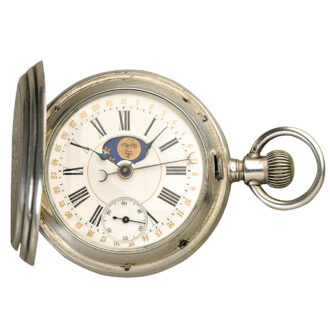
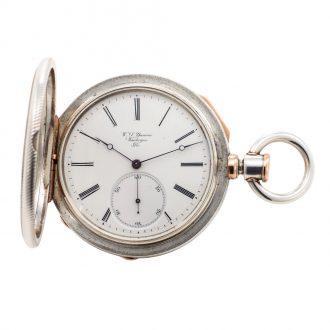
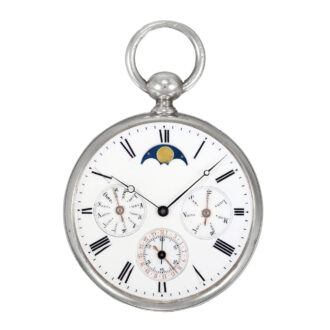
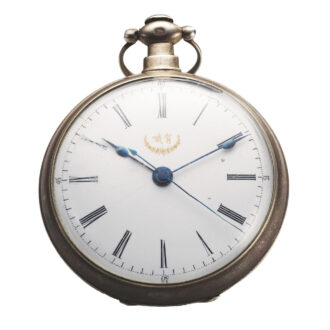
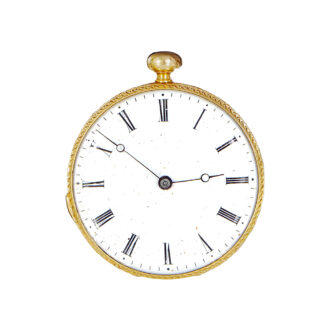
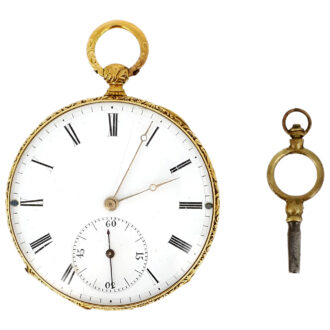
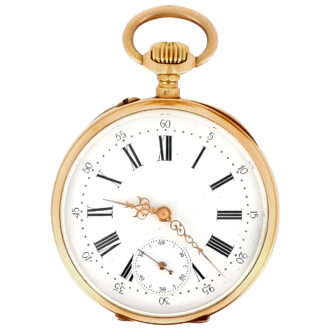
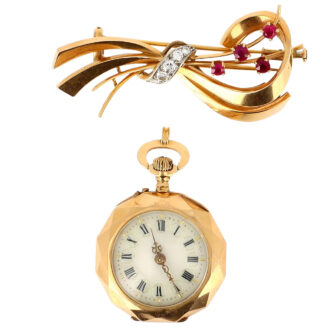
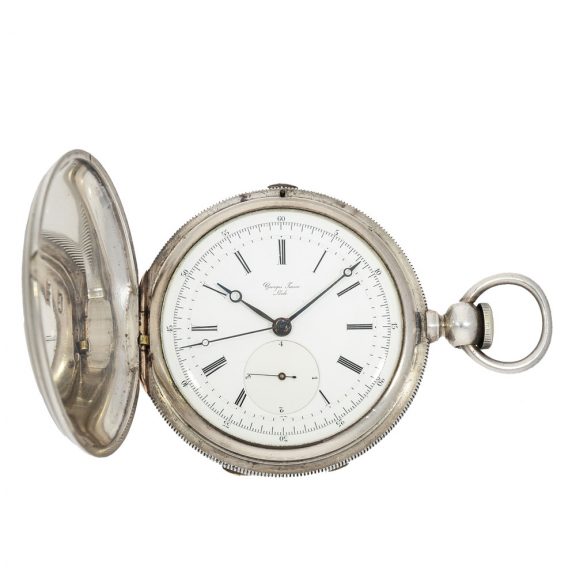
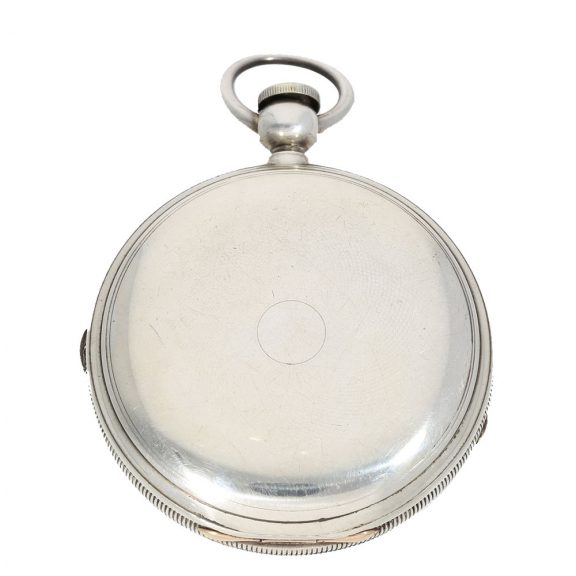
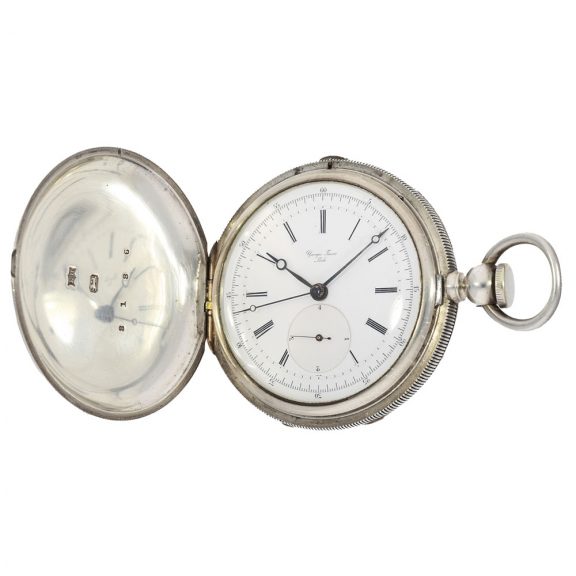
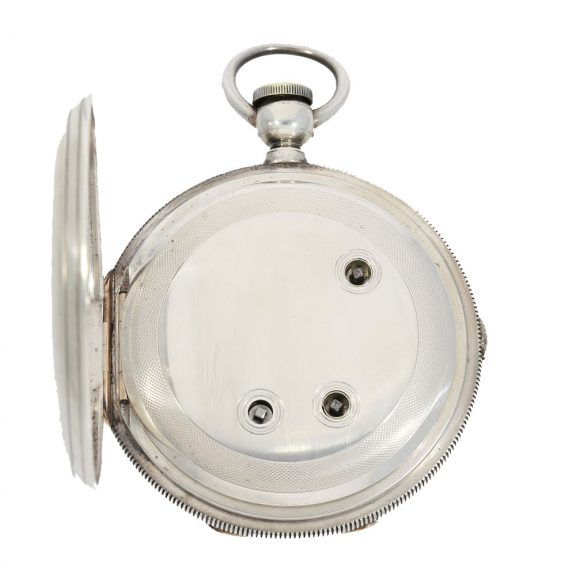
Swiss silver watch with diablotine and seconde morte Circa 1865
- Kenmerk
- HC2021
- Diameter
- 56 mm
- Estimate
- € 800 - 1.600
- Price sold
- € 1.200
Silver precision watch with seconde morte
–
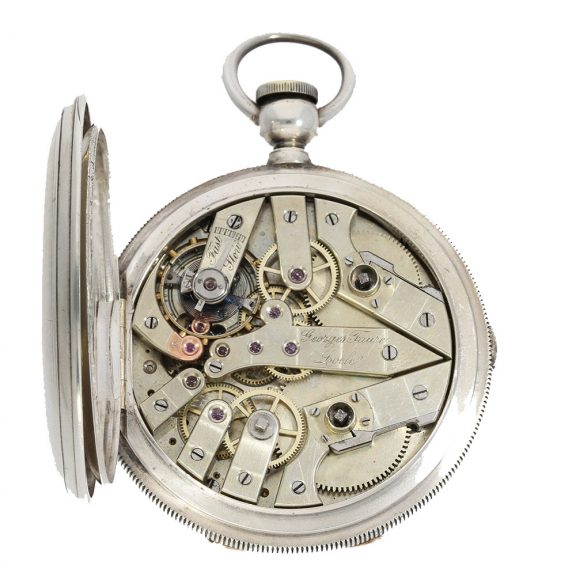
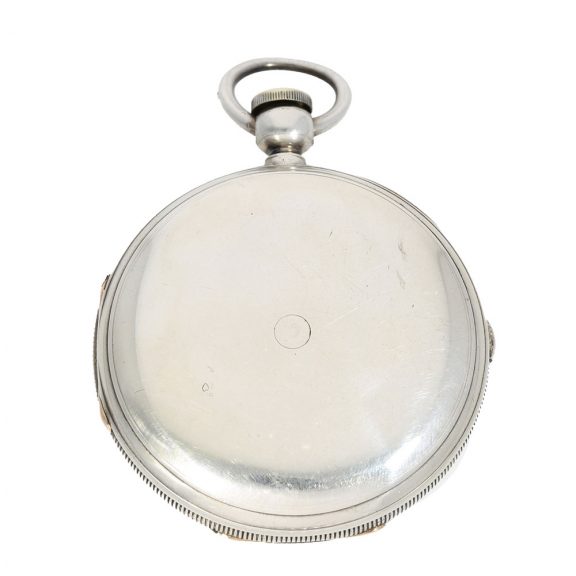
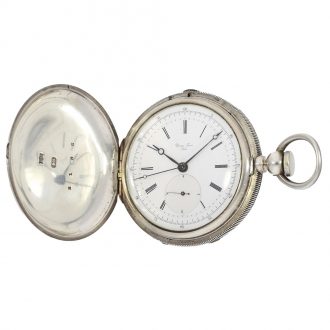
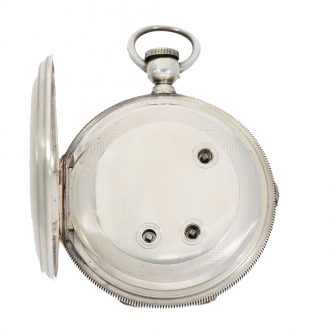
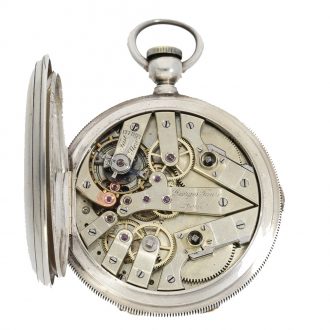
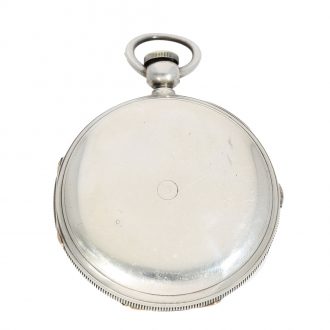
An early precision watch with independent center seconds and a diablotine made by Georges Favre in Le Locle, Switzerland, circa 1865. The numbered case of this watch, crafted from silver, features gold hinges and maker’s mark EH. The fine white enamel dial has Roman hour numerals, an outer minute track, fifth of a second divisions, outermost Arabic five minute numerals, a subsidiary ¼th of a second dial at 6 o’clock and blued Breguet hands. The high quality movement is equipped with a lever escapement, two barrels, seconde morte, bridges with fine Geneva striping decoration, an escape wheel, an anker with gold chatons, a compensation balance wheel with blued Breguet spring and fine adjustment.
The dial and movement are signed.
–
Diameter: 56 mm
–
Weight: 143 g
–
Signed: George Favre Locle
–
Favre-Bulle-Jacot
In 1865, Georges Emile Favre-Bulle-Jacot founded the “Fabrique des Billodes” in Le Locle on a property called Billodes. He initially manufactured precision pocket watches signed with his name. Around 1900, the product range was expanded. Board chronometers, table clocks, precision pendulum clocks and later marine chronometers were also made. From 1903, the Favre-Jacot company regularly and very successfully took part in the competitions of the Neuchâtel Observatory with pocket watches and deck chronometers.
–
The Zenith brand was created when the company was converted into a joint stock company in 1911.
–
EH
The initials EH on the watch case of a George Favre-Jacot watch from around 1865 most likely stand for the case maker Ernest Huot. On many early examples of diablotine watches, the brand name “Billodes” or the initials “GFJ” can be found alongside the EH stamp.
–
The seconde morte, also known as dead-beat seconds, is a complication of a mechanical movement in which the second hand moves every second. This is in contrast to the usual ‘running’ of the second hand. This complication is rare and was seen in the years before the quartz revolution, the 1970s and 1980s, but died a silent death because of the same quartz revolution. The reason for this was that the second hand moves per second in almost the same way as quartz watches, which ultimately also use a frequency of 1Hz. With that, the ‘running’ second hand became the distinction between mechanical and quartz watches. Incidentally, that external similarity only applies to the second hand jumping per second, the underlying mechanism of the dead seconds complication is of course of a completely different order.
–
The feature known as a diablotine is a small subsidiary dial on a chronograph or independent center seconds pocket watch, the hand of which moves in a jumping manner at intervals of 1/4 or 1/5th of a second. The term means ‘little devil’. The diablotine is halted when the chronograph or center seconds is stopped and the fractions of a second can be read.
Signed: George Favre Locle
Share this page: