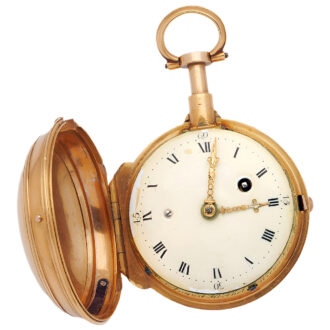
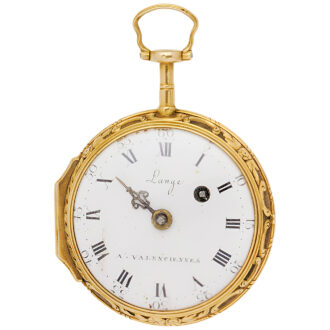
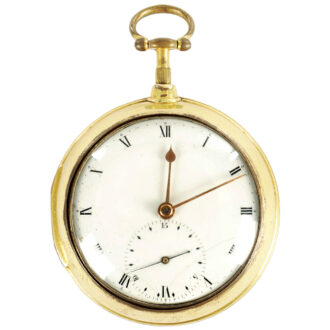
French gold verge made for the Turkisch market Circa 1755
- Kenmerk
- TA3620
- Diameter
- 53 mm
- Estimate
- € 12.500 - 25.000
- Price sold
- -
Gold watch with two meantime dials
–
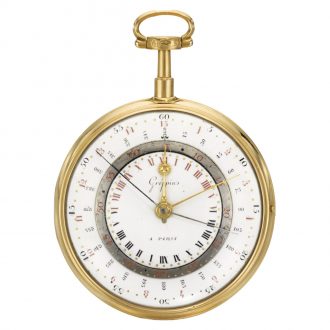
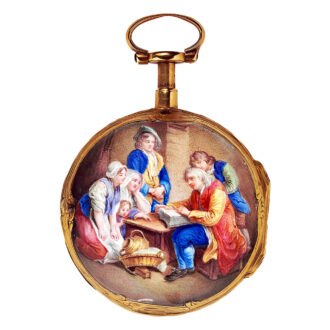
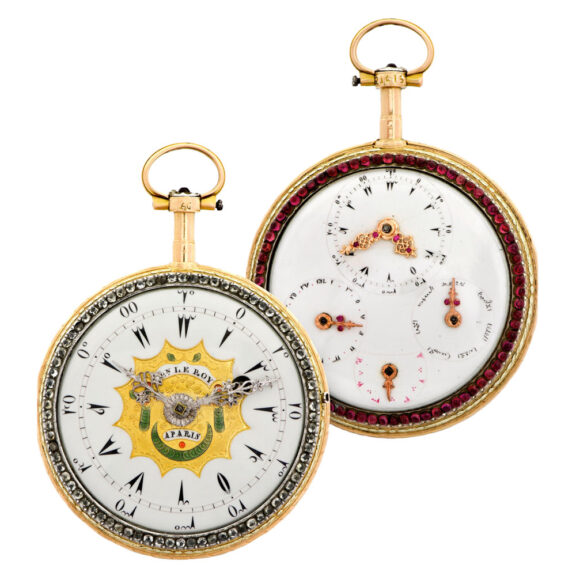
An extremely rare French, Louis XV, 18K gold, rose-cut diamond and emerald-set pocket watch with date and two meantime dials, circa 1755. Made for the Turkish market.
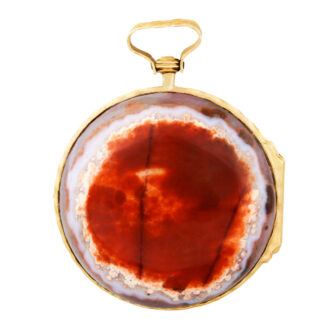
A Louis XV case, glazed on both sides, chased with a repeated laurel leaf pattern, the front bezel set with rose-cut diamonds in silver, the reverse bezel set with round cabochon emeralds in silver, the pendant set with a further emerald. Main dial: very fine enamel and gold, white chapter ring with radial Islamic numerals, outer minute divisions and outermost Islamic five-minute numerals, winding aperture at 2, the gold centre finely chased with flowers and with green translucent enamel crescent moon and swags hanging from the white enamel signature cartouche. Diamond-set pierced silver flower hands.
–
Second dial: white enamel, small meantime dial with radial Islamic numerals, outer minute track and Islamic five-minute numerals, subsidiary dials for the date and days of the week and sector for regulation and ruby-set pierced gold hands. Gilt, full-plate movement, cylindrical pillars, fusee and chain, verge escapement with micrometric potence adjustment, balance mounted beneath the dial, regulation via a hand on the reverse dial. Dial signed.
–
Diameter: 53 mm
–
Signed: Julien Le Roy Paris
–
This watch was made to be exported to Constantinople and the court of the Sultan. Complicated gem-set watches were highly desirable both as a symbol of wealth and sophistication and as mechanical curiosities. This watch is extremely unusual because it features a provision for two independently adjustable time zones long before the adoption of hourly time zones. Several watches are known which were made for the Turkish market that have this feature and it could be that one dial was set to European time and the other to home time although this would have been for pure novelty value rather than any practical use. Before the adoption of time zones, people used local solar time (originally apparent solar time, as shown by a sundial) and, later, meantime. Meantime is the average over a year of apparent solar time; its difference from apparent solar time is the equation of time.
–
Julien Le Roy (1686-1759) Is one of the clockmakers who contributed most to the progress and the reputation of French watch- and clock-making. Born in Tours on August 6, 1686, he came to Paris in 1699 and was received master in 1713. First member, then Director of the Société des Arts, he improved almost all branches of clockmaking, and many important inventions in the realm of time measurement are owed to him. In 1717, Julien Le Roy presented an equation clock to the Royal Academy of Sciences which showed the true time, the place of the sun and its declination. Appointed Clockmaker to the King in 1739, he had his private quarters in the Louvre. His most important discoveries concerned watch mechanisms. The adjustable potency for the verge escape wheel considerably improved the escapement’s functioning, and the steel end-piece (coqueret) which allowed oil to be retained in the balance pivots in order to diminish frictional force, was quickly adopted by other watchmakers. The inventor of dumb repeating watches, 1740 created a new arrangement which allowed the area allotted to the repeating work to be enlarged. This invention, called “à bâte levée”, was also adopted by his fellow clockmakers. In 1755 he invented a small anchor escapement used as a regulator for the repeating train. He contributed to the Encyclopédie by writing several articles on clock-making together with his son Jean-Baptiste, the Academician.
Signed: Julien Le Roy Paris
Share this page: