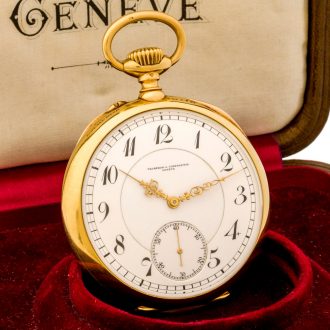
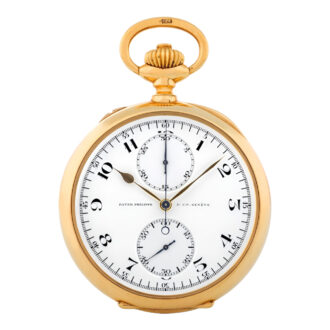
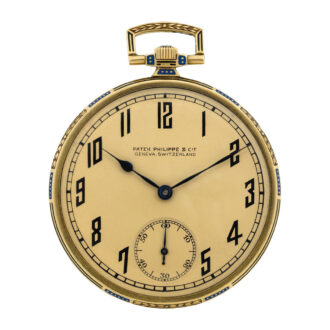
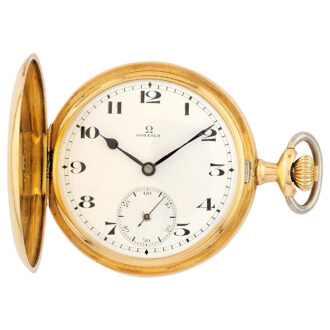
Swiss gold minute repeating perpetual calendar Circa 1928
- Kenmerk
- SA0946
- Diameter
- 45 mm
- Estimate
- € 15.000 - 30.000
- Price sold
- € 55.250
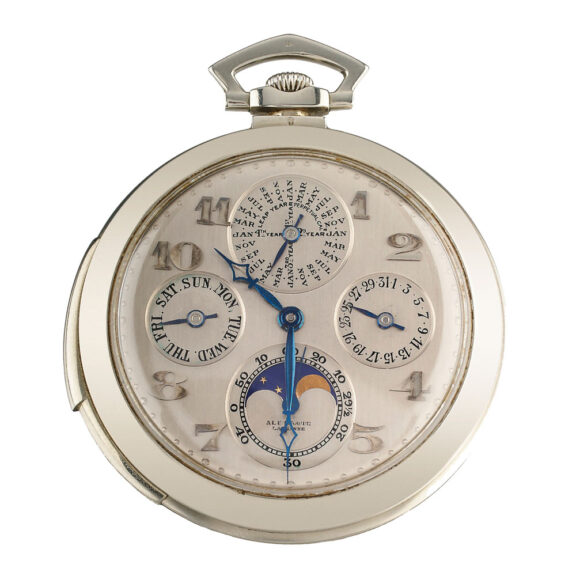
Ultra-slim white gold minute repeating perpetual calendar watch made for the famous pianist Alfred Cortot
–
A fine and rare Swiss ultra-slim white gold open-faced minute repeating perpetual calendar watch made for the famous pianist Alfred Cortot, circa 1928, manual winding nickel-finished lever movement, 29 jewels, two polished hammers repeating on two gongs, cut bimetallic compensation balance.
White gold dial, Breguet numerals, four subsidiary dials for month combined with leap year, day, date, and constant seconds combined with moon-phases, outer minute track, blued steel hands.
18k White gold case, snap-on case back, slide to the band for repeater at 3, case, dial and movement signed.
–
Diameter: 45 mm
–
Signed: Audemars Piguet for A l’Émeraude
–
The boutique A l’Emeraude is a renowned watch and jewellery retailer in Lausanne since 1909. It was founded by Jacques and Aline Schwob and established at the historical place Saint-François since 1919. The boutique has received royal families and prestigious personalities wishing to acquire exquisite timepieces and jewels.
Alfred Denis Cortot (26. September 1877 – 15. June 1962) was a Franco-Swiss pianist and conductor. He is one of the most renowned 20th-century classical musicians, especially valued for his poetic insight in Romantic period piano works, particularly those of Chopin and Schumann. Born in Nyon, Vaud, in the French-speaking part of Switzerland, to a French father and a Swiss mother, Cortot studied at the Paris Conservatoire with Émile Decombes (a student of Frédéric Chopin), and with Louis Diémer, taking a premier Prix in 1896.
In 1902 he conducted the Paris premiere of Wagner’s Götterdämmerung. He formed a concert society to perform Wagner’s Parsifal, Beethoven’s Missa solemnis, Brahms’ German Requiem, and new works by French composers.
In 1905, Cortot formed a trio with Jacques Thibaud and Pablo Casals, which established itself as the leading piano trio of its era. In 1907, he was appointed Professor by Gabriel Fauré at the Conservatoire de Paris, replacing Raoul Pugno.
In 1919 Cortot founded the École Normale de Musique de Paris. His courses in musical interpretation were legendary. As a leading musical figure, Cortot traveled for many international music events. The French government-sponsored two promotional tours to the United States, and one to the new Soviet Russia in 1920. He continued to teach at the Paris Conservatoire until 1923, where his pupils included Yvonne Lefébure, Vlado Perlemuter, Simone Plé-Caussade and Marguerite Monnot.
He conducted several orchestras and was often called upon to provide piano accompaniment for touring artists when in Paris. Involved in music until his health failed, like Franz Liszt in his advanced years he taught master classes in piano. (Excerpts from these classes can be found on CD, and on the DVD “The Art of the Piano.”) He died in Lausanne.
In 1925 he made the world’s first electrical recording of classical music – Chopin impromptus and Schubert’s Litanei for Victor Records.
Signed: Audemars Piguet for A L’Émeraude
Share this page: