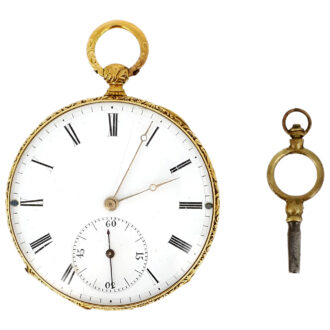
Important English gold watch with tourbillon regulator Circa 1897
- Kenmerk
- TA2948
- Diameter
- 63 mm
- Estimate
- € 75.000 - 150.000
- Price sold
- € 163.800
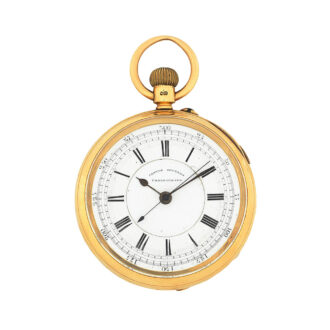
Gold repeater with split-seconds chronograph
–
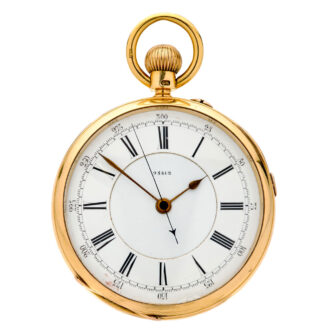
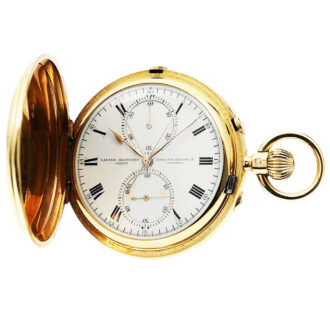
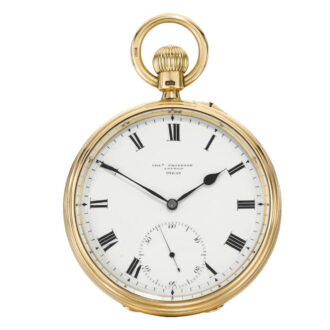
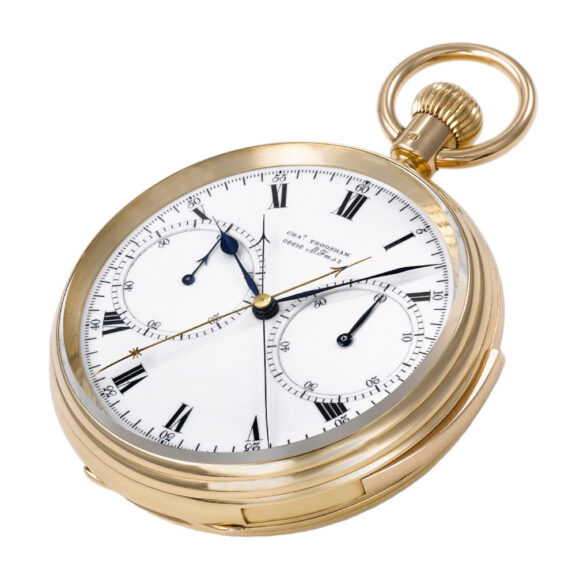
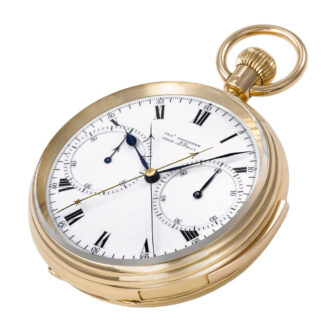
Exceptional and highly important English, 18K gold minute repeating, keyless pocket chronometer, circa 1897. With a one-minute tourbillon regulator, split-seconds chronograph and 60-minute register. Made by Charles Frodsham by appointment to the Queen, 115 New Bond St., late of 84 Strand, London, No. 08616, Ad. Fmsz. The case with London hallmarks for 1897-98, the movement supplied by Nicole Nielsen & Co., entered in stock in 1898, ordered by J. Pierpont Morgan and given to P.M.H. in 1913.
–
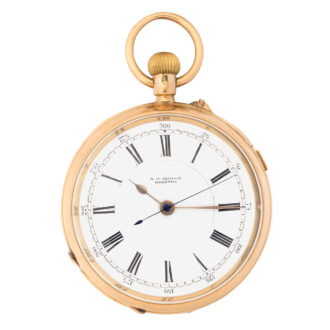
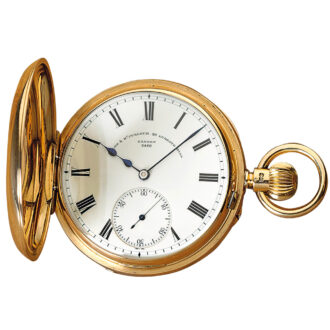
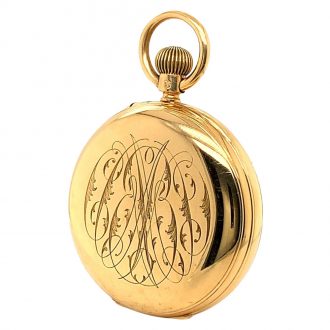
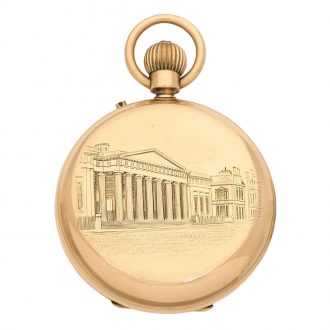
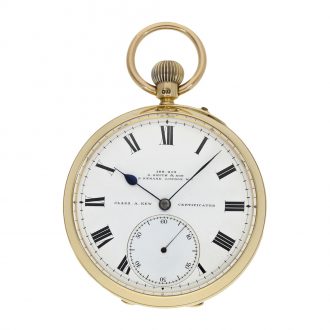
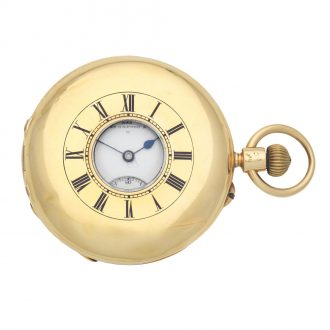
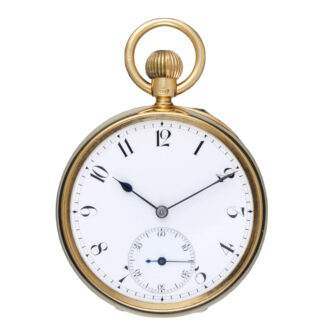
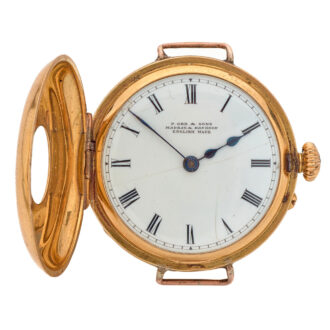
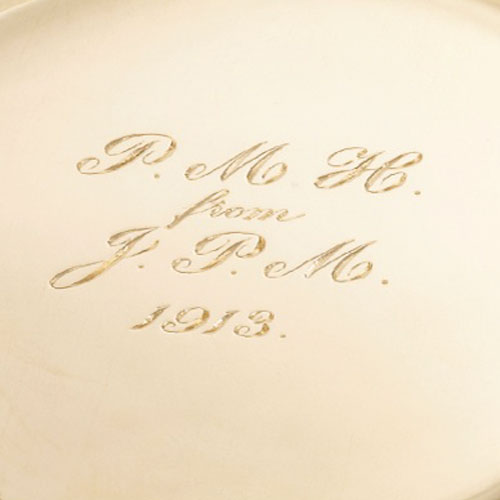
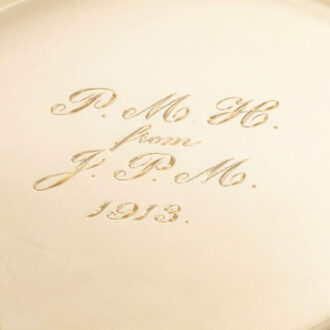
A massive case by Harrison Mill Frodsham, master mark HMF, polished, swivel anti-theft pendant, master mark GJ. Hinged gold cuvette engraved P.M.H. from J.P.M. 1913. Best Venetian tint enamel dial, by master dial maker Willis, radial Roman numerals, outer minute divisions, outermost seconds divided into fifths, subsidiary 60-minute register at 9, subsidiary seconds symmetrically at 3. Blued steel spade hour and minute hands, gold star chronograph hand.
–
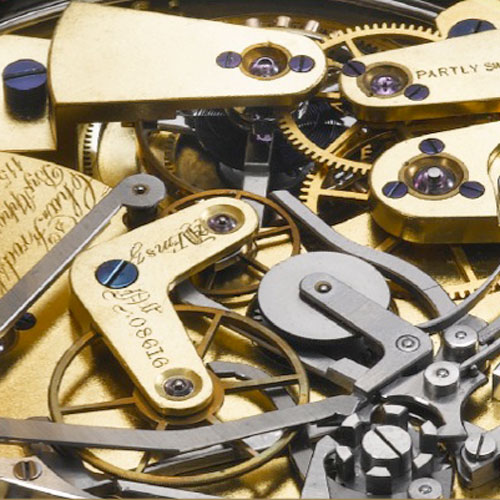
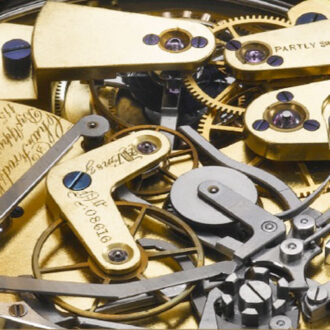
A frosted gilt movement, 3/4-plate, 18 jewels, some in screwed chatons, one-minute equidistant 3-arm steel tourbillon carriage poised with gold screws as in a compensation balance and by friction-fit gold nut set on eccentric post for micrometric adjustment, lateral counterpoised lever escapement, cut-bimetallic compensation balance with gold temperature and meantime adjustment screws, double-over coiled free-sprung Breguet balance spring with inner and outer Phillips terminal curves, Nicole Nielsen chronograph mechanism driven from the toothed carriage, while the register is driven directly from the 2nd wheel, repeating on gongs activated by a slide in the band. Dial and movement signed case punched with H.M. Frodsham mark, movement and case with the same serial number.
–
Thickness: 19 mm
–
Diameter: 63 mm
–
Signed: Charles Frodsham London
–
John Pierpont Morgan (1837-1913) John Pierpont Morgan and his family had a long-standing relationship with the London watchmaker Charles Frodsham, with orders for watches dating back to the 1850s from J.P. Morgan’s father. Without a doubt, the most famous watch associated with one of the period’s most important men in the United States banking history is the Charles Frodsham minute repeating pocket watch with a split-second chronograph and tourbillon within a 63 mm diameter case. A total of 20 watches with these complications were ordered by J.P. Morgan to be presented to corporate partners and important friends. Of the 20 ordered, 12 are known.
–
This example was the first to be ordered with these specifications and differs from other, known, inscribed watches as the order date of 1898, and presentation date of 1913, are so far apart. John Pierpont Morgan and his wife, Frances Tracy Morgan, had 4 children. John Jr (1867-1943), Louisa (1866-1946), Juliet (1870-1952) and Anne (1873-1952).
–
It is interesting to note that his daughter, Juliet Pierpont Morgan, who married William Pierson Hamilton (1869-1950) on April 12, 1894 (great-grandson of Alexander Hamilton) had a son, Pierpont Morgan Hamilton in 1898. William Pierson Hamilton joined the firm J.P. Morgan & Co in 1897, became a full partner in 1900 and retired in 1922.
–
Pierpont Morgan Hamilton (P.M.H.) left Harvard University in 1917 when the United States joined World War 1. After training, he became First Lieutenant in the Signal Officer’s Reserve Corps and again enlisted in the US military during WWII where he received the Medal of Honour, the United States military’s highest decoration.
–
As the first Charles Frodsham minute repeating split-second chronograph pocket watch with a tourbillon to be ordered by J.P. Morgan it is very probable he either intended the watch for himself or more likely for his son-in-law after he joined the family company. Why he never presented the watch until 1913, shortly before his death the same year, and then to his 15-year-old grandson, at present remains a mystery.
–
With no use for such an important watch during his military service it is probable Piermont Hamilton left it in the company of his parents, who divorced in 1923, until purchased from their relative estates shortly after they died in 1950 & 1952 by the famous American collector of important pocket watches, Esmond Bradley Martin, sometime prior to 1956. Alexander Hamilton (1757-1804) was the United States’ first Secretary of the Treasury.
Signed: Charles Frodsham London
Share this page: