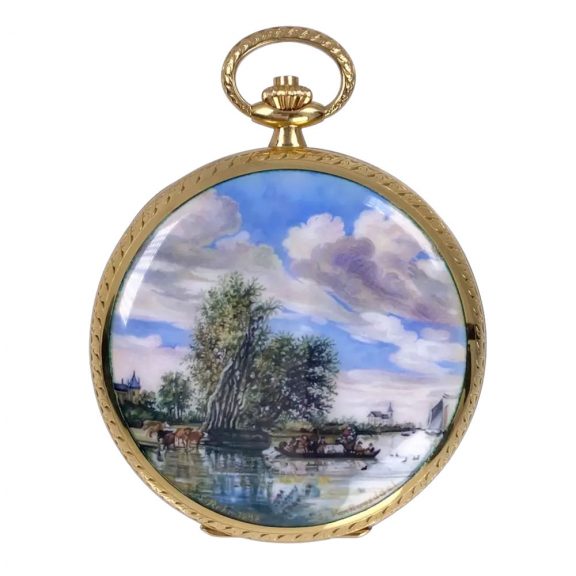
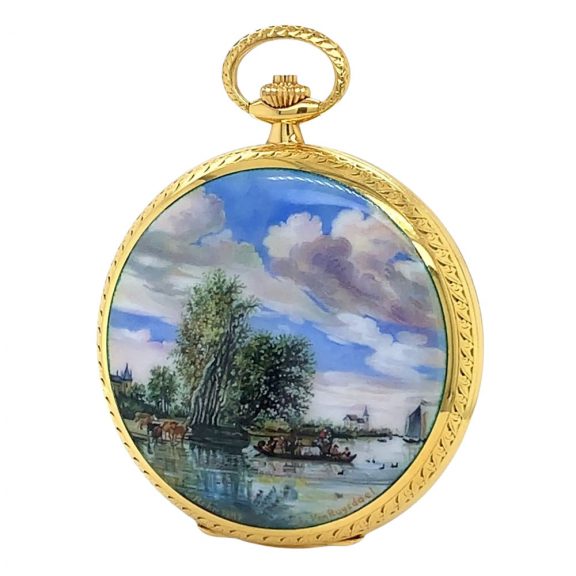
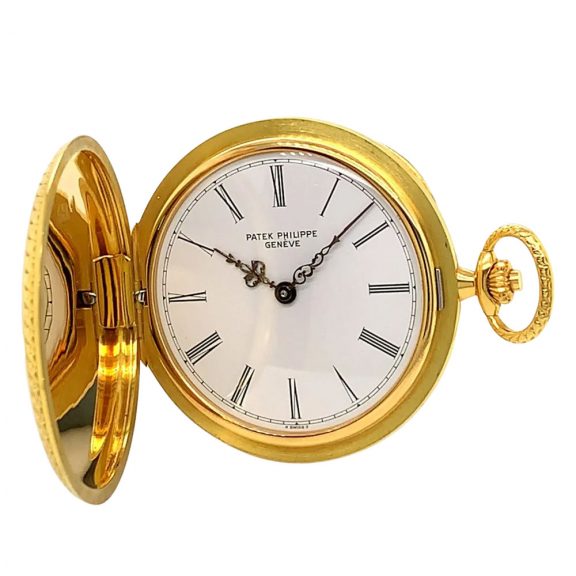
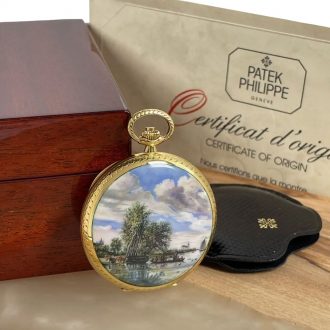
Unique Swiss 18K gold and enamel hunting cased watch Circa 1987



- Kenmerk
- DB0777
- Diameter
- 48 mm
- Estimate
- € 125.000 - 250.000
- Price sold
- € 175.000
Gold and enamel lever watch by Patek Philippe
–
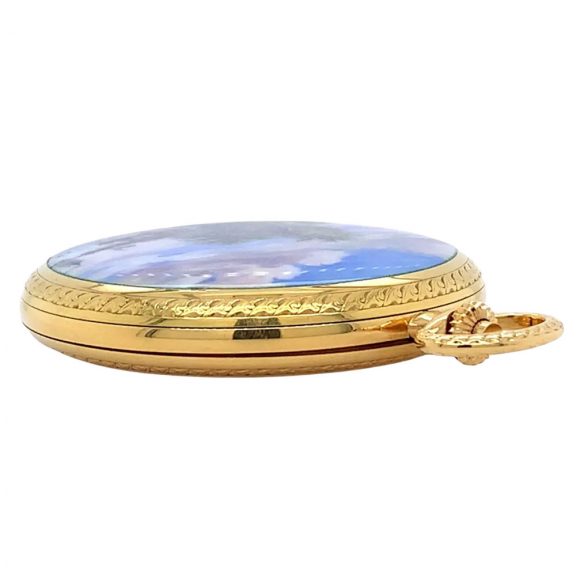
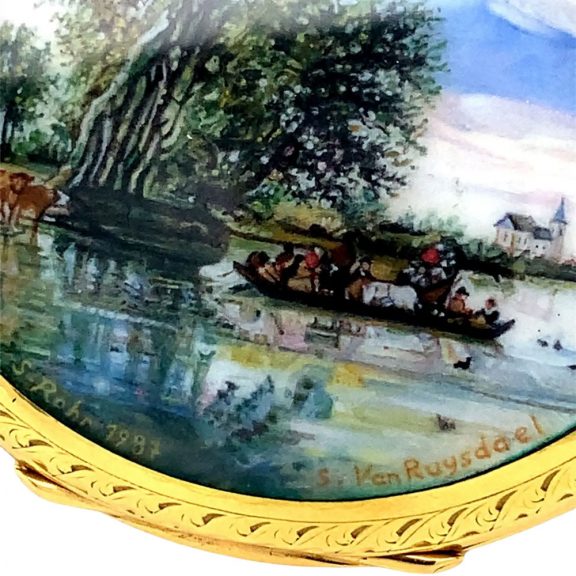
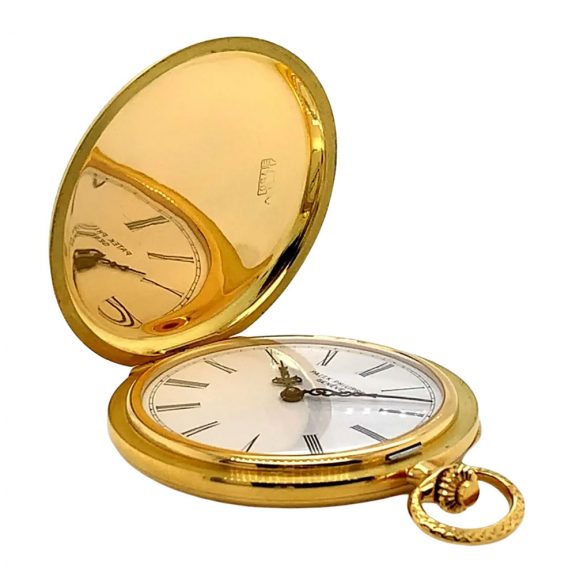
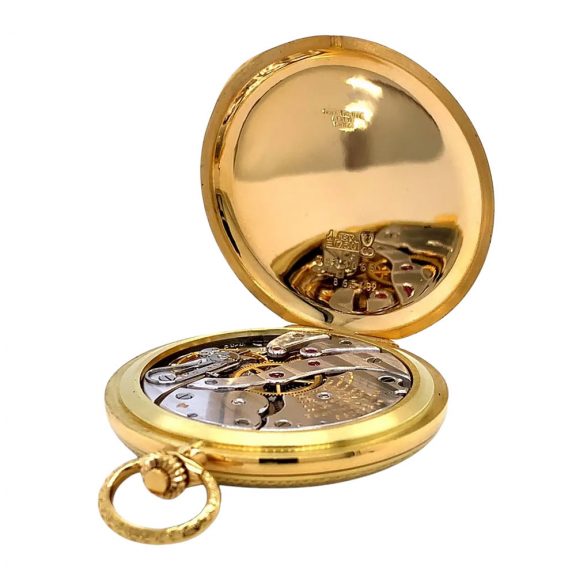
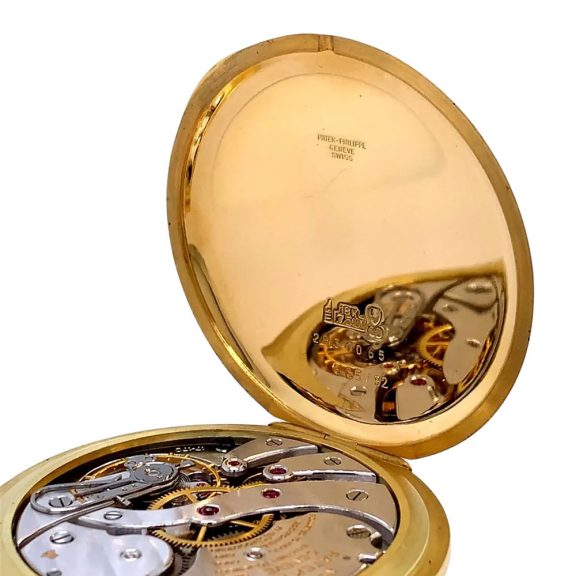
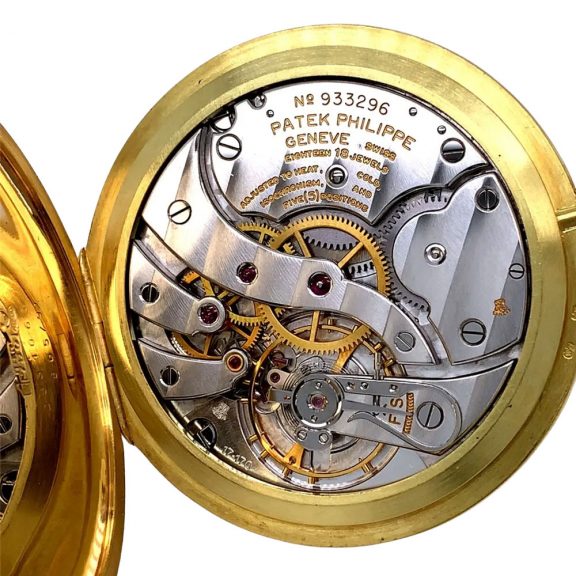
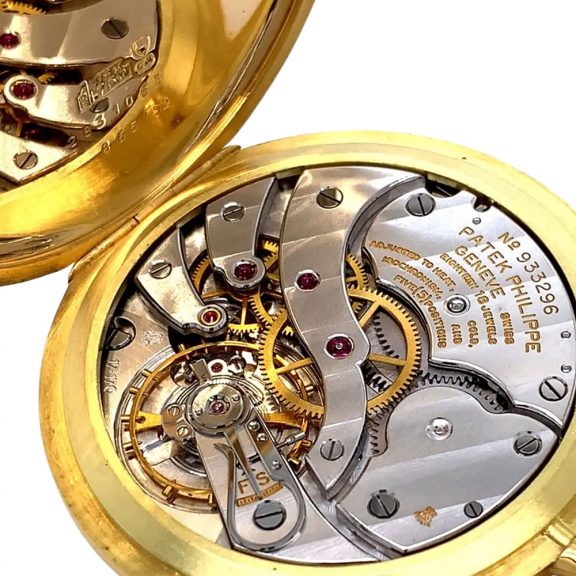
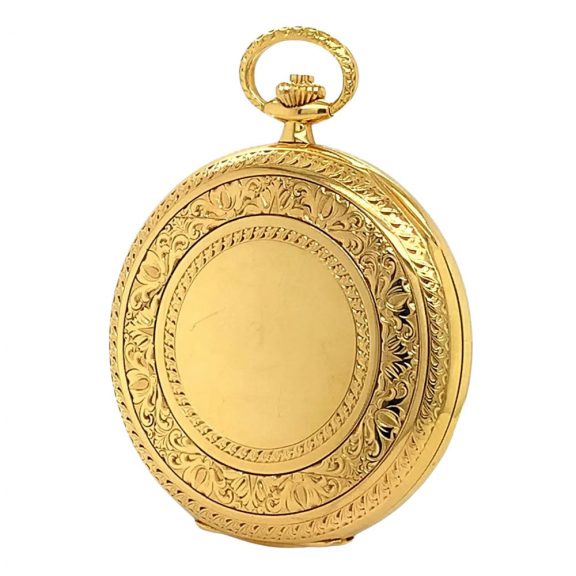
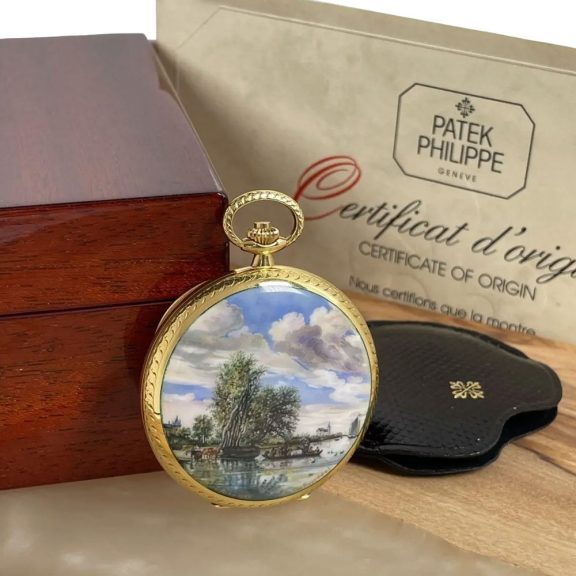
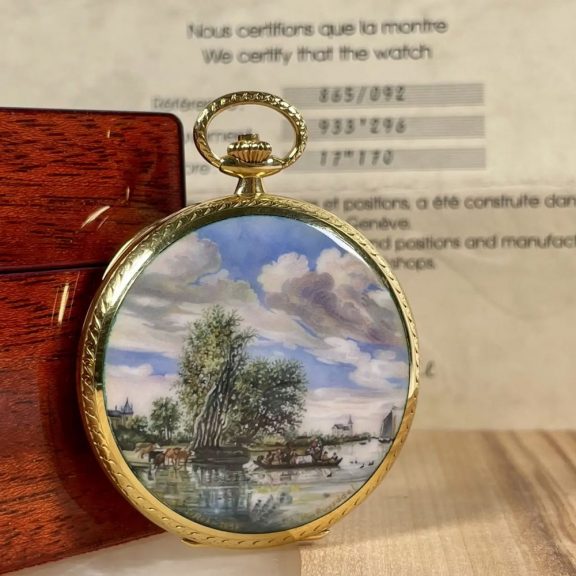
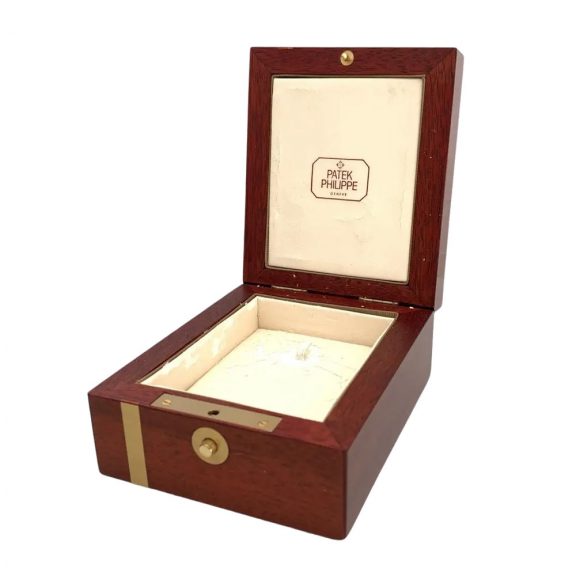
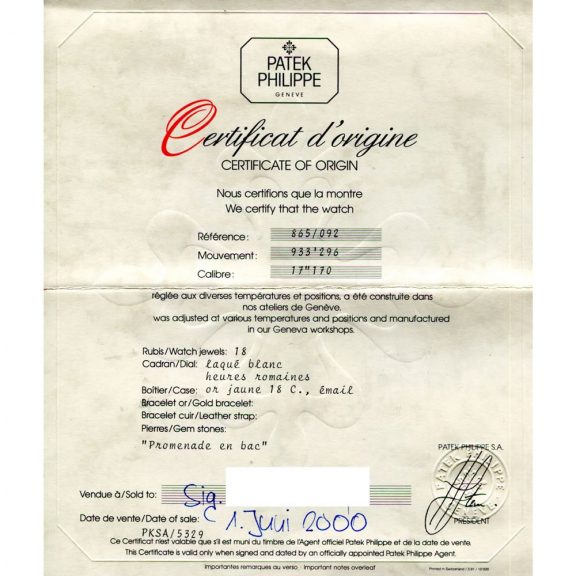
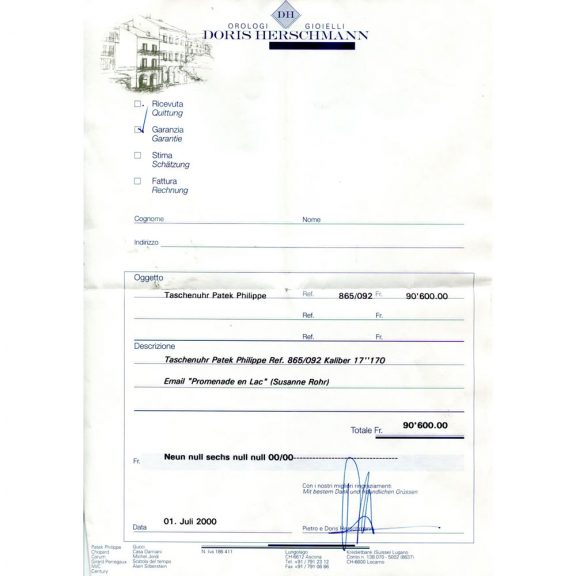
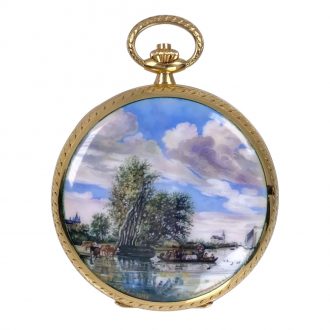
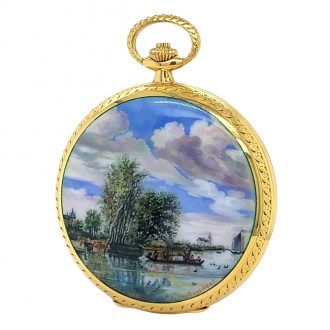
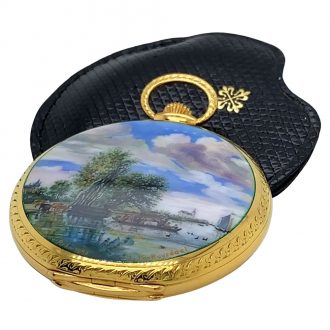
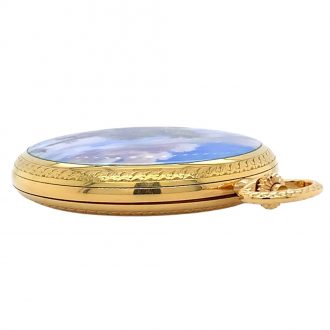
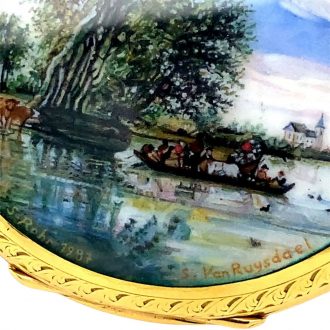
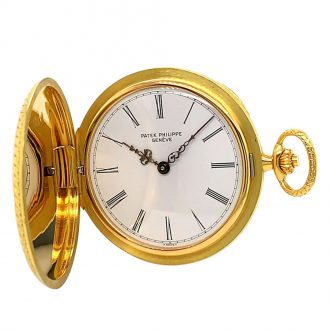
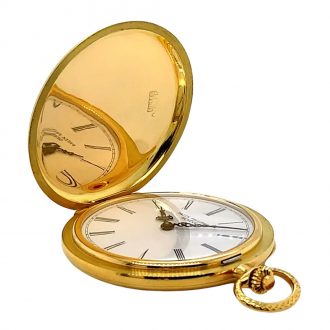
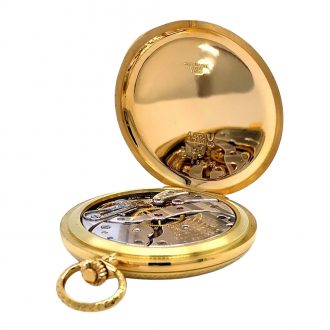
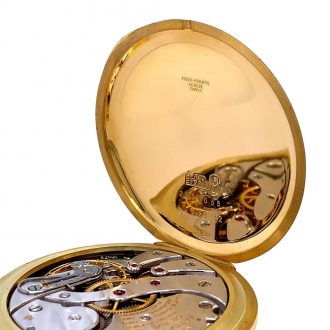
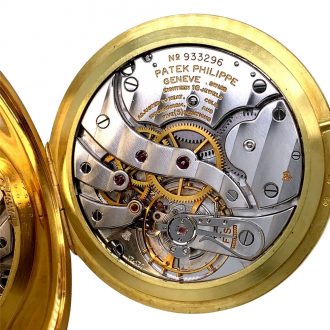
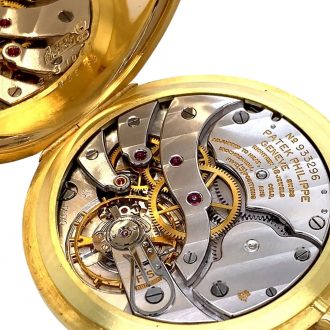
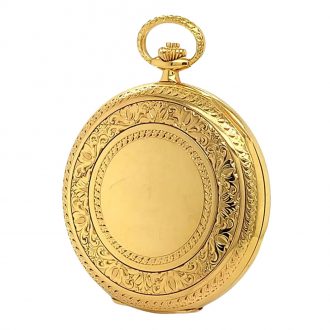
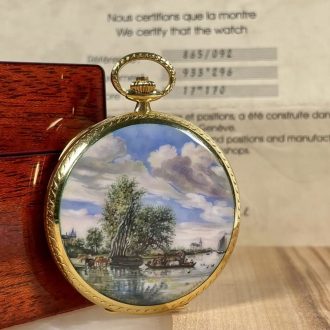
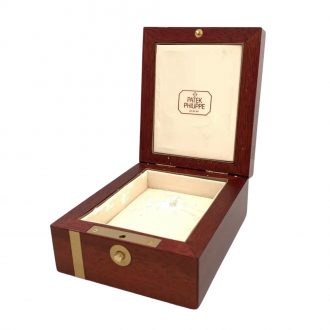
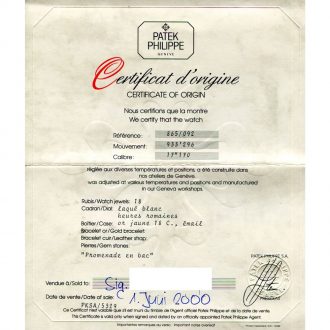
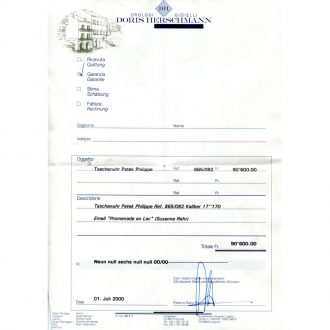
An extremely rare, unique Swiss 18 carat gold and enamel hunting cased lever pocket watch, circa 1987. Sold on July 1, 2000. Bridge movement, a piston tooth lever escapement and a Glucydur screw balance. White enamel dial with Roman hours, an outer minute track and Louis XIV hands. The front of the case with a hand painted polychrome enamel miniature of a river landscape by Suzanne Rohr based on the 1649 painting River Landscape with a Ferry by Salomon van Ruysdael, inscribed S. van Ruysdael, signed and dated S. Rohr 1987, elaborately florally engraved on the back. Dial signed, case and movement signed and numbered. Comes with the original presentation box, a leather folder, leather protective case, Patek Philippe certificate, brochures and a sales receipt.
–
Diameter: 48 mm
–
Weight: 111 g
–
Signed: Patek Philippe Genève Swiss
–
Salomon Jacobzoon van Ruysdael was born in 1602 in Naarden, The Netherlands and died in 1670 in Haarlem. He was a Dutch painter and draftsman from the Golden Age, best known for his river landscapes, often with ferries, such as in his paintings River Landscape with a Ferry (1649) and Ferry (1657). The painting from 1649 shows a river landscape with a large group of trees in the middle, Nyenrode Castle on the left and a ferry on the right. It is now in the Rijksmuseum Amsterdam, The Netherlands.
–
One of the last great enamellers who was able to continue the highly sophisticated art of miniature painting on enamel is Suzanne Rohr, born in 1939, a student of the legendary enamel painter Carlo Poluzzi (1899-1978). Since 1967, Rohr worked closely with Patek Philippe and made her talents available exclusively to the company. She retired in 2016 at the age of 80, after an illustrious 40 year career. In 2017, she was awarded the Special Jury Prize of the Grand Prix d’Horlogerie de Genève and in 2019 she was awarded the Prix de Gaïa in the Artisanat, Création (Art and Creation) category.
–
On May 1st, 1839 the Polish businessman and aristocrat Antoine Norbert Count de Patek and the Polish watchmaker Franciszek Czapek founded a company in Geneva named Patek, Czapek & Cie. Czapek lived in Switzerland since 1832 and changed his name to François Czapek when he became nationalized. The company ran well but each went their own way in 1844 and set up their own company: Czapek & Cie which continued till 1869 and Patek & Cie.
1844 Patek met the French watchmaker Jean-Adrien Philippe at the Paris World’s Fair. Philippe had already enriched the watch’s history with one of its most revolutionary inventions: the crown winding. Since then watches needed no longer to be wound with an additional key, but both the winding and the time adjustment of the hands could now be performed much easier by the crown. On May 15th, 1845 Jean-Adrien Philippe and Vincent Gostkowski entered the company. In the same year, a patent for a watch with a winding stem and hand adjustment mechanism was applied. They produced the first watch with a minute repeater. On January 1st, 1851 the company’s name was changed to Patek, Philippe & Cie. In 1881, a patent for a precision adjustment was applied by Philippe.
On February 1st, 1901 Patek, Philippe & Cie was converted into a stock corporation and renamed Ancienne Manufacture d’Horlogerie Patek, Philippe & Cie S.A. A patent for a double chronograph was applied in 1902. The company continues through significant inventions, which are highly regarded. In 1932, Patek Philippe was taken over by Charles and Jean Stern, after which the company name changed to Patek Philippe S.A. Thierry Stern (fourth generation) took office in 2009 as president. The company has 70 patents and produces the entire clockwork in-house. Their luxurious timepieces are of high quality and therefore often raise record amounts at auctions. A pocket watch produced in 1933 was sold at auction for 11 million euros in 1999. A world record at that time. On November 11th, 2014, it was auctioned again and this time it was sold for 19 million euros. On the occasion of the 150th-anniversary celebration in 1989, the legendary Calibre 89 is presented, which took nine years to develop. With 33 complications and 1728 components, this watch is regarded as a pocket watch of superlatives. Both dials together it has 24 hands and 12 dials, in addition, a minute repeater with a large and small carillion, an alarm function, a tourbillon, a perpetual calendar, a split-second chronograph movement and over 20 other complications. The most complicated pocket watch movement at all.
Patek Philippe, together with Audemars Piguet (1875), Vacheron Constantin (1755) and A. Lange und Söhne (1845) is considered to be ‘the big four’ in the watchmaking world. Today it is one of the few still independent watch companies. The company is also the only Geneva manufacturer, whose entire production of mechanical watch movements is awarded with the Geneva Seal (Poinçon de Genève).
Signed: Patek Philippe Genève Swiss
Share this page: