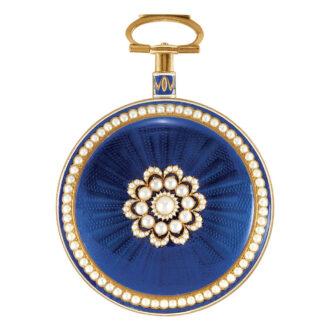
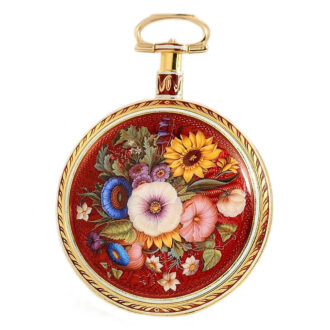
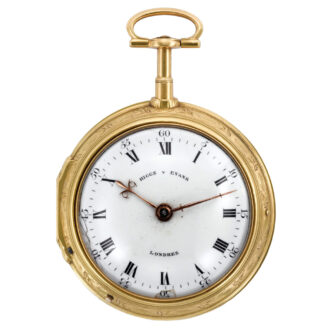
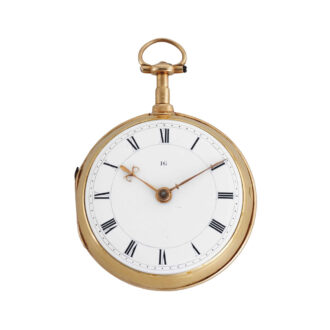
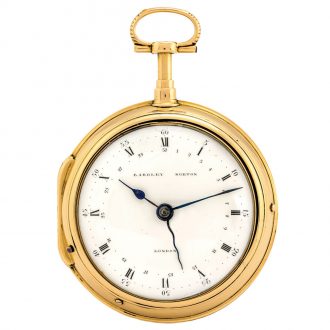
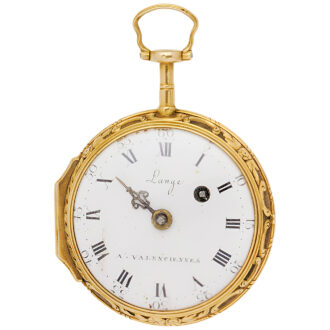
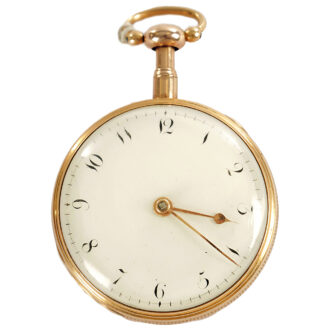
Very fine George III gold and enamel English pocket watch Circa 1795
- Kenmerk
- HA0055
- Diameter
- 52 mm
- Estimate
- € 5.500 - 11.000
- Price sold
- -
George III gold and enamel English pocket watch
–
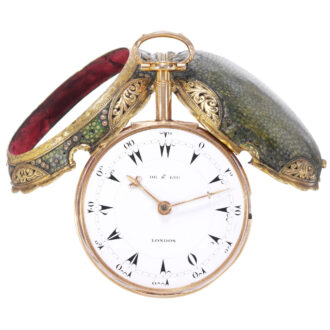
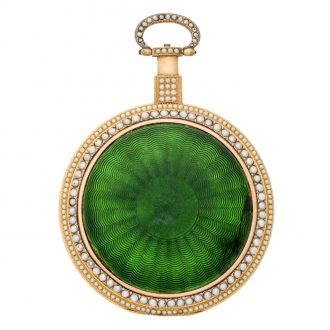
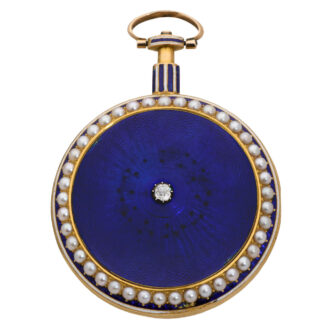
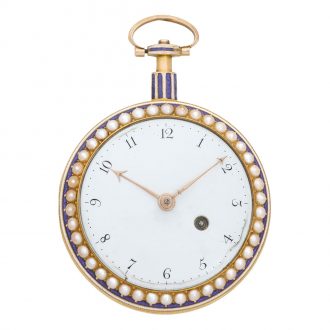
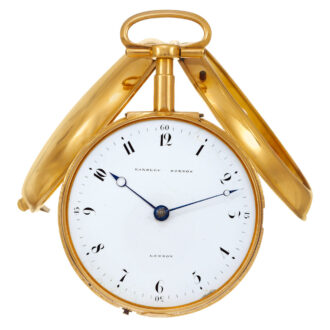
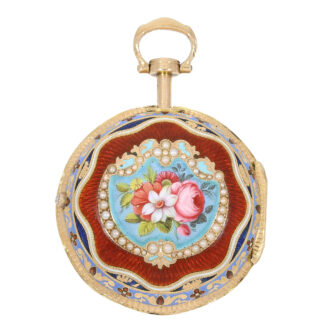
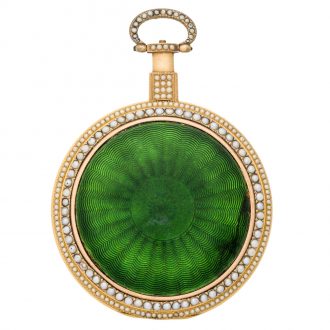
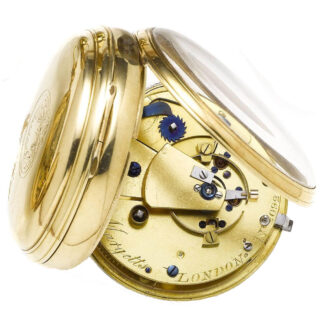
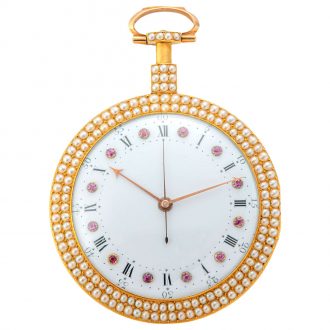
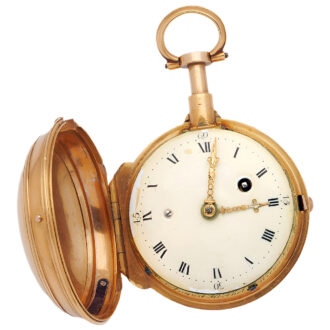
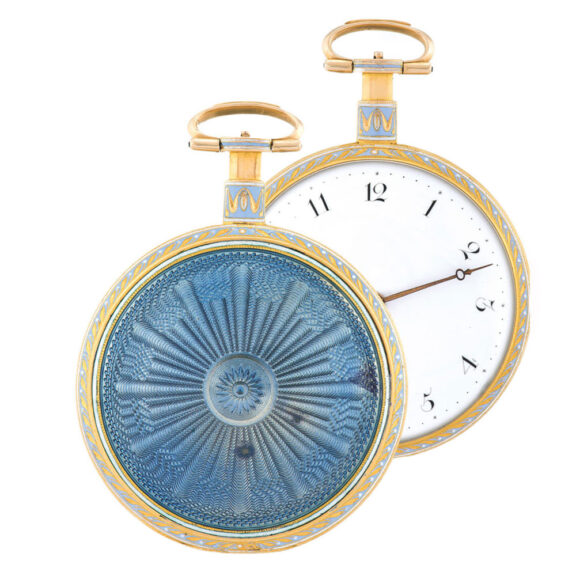
A very fine, George III, 18 Carat gold and enamel pocket watch. Made by Johnson in London, England, circa 1795. The case with London hallmarks for 1795-1796. Double body Directoire case by Jonah Mince (master mark IM), with pale blue and white champlevé enamelled bezels and pendant, the back set with a panel of translucent grey enamel over engine turned decoration in a sunburst pattern and a concealed hinge. Hinged gilt brass cuvette hinged to foliate engraved movement ring.
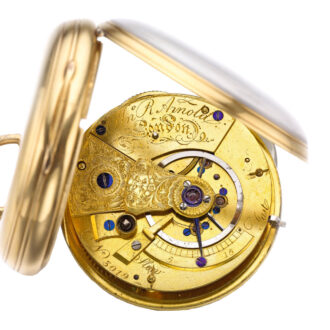
White enamel with radial Arabic numerals, outer dot minute divisions. Gilt hands. Gilt brass full plate with cylindrical pillars movement with fusee with chain, verge escapement, plain polished steel three arm flat rim balance, flat balance spring, gilt brass English cock pierced and engraved with foliage and diamond end stone, rack and a pinion regulator with a silver regulation dial.
Movement signed.
–
Diameter: 51.5 mm
–
Signed: Johnson
–
The Directoire style was a period in the decorative arts, fashion, and especially furniture design in France concurrent with the Directory (November 2, 1795–November 10, 1799), the later part of the French Revolution. The style uses Neoclassical architectural forms, minimal carving, planar expanses of highly grained veneers, and applied decorative painting. It is a style transitional between Louis XVI and Empire.
The Directoire style was primarily established by the architects and designers Charles Percier (1764–1838) and Pier François Léonard Fontaine (1762–1853). In its use of Neoclassical architectural form and decorative motifs, the style anticipates the slightly later and more elaborate Empire style, which was introduced after Napoleon established the First French Empire.
The Directoire style reflected the Revolutionary belief in the values of republican Rome:
“The stoic virtues of Republican Rome were upheld as standards not merely for the arts but also for political behaviour and private morality. Conventionals saw themselves as antique heroes. Children were named after Brutus, Solon and Lycurgus. The festivals of the Revolution were staged by Jacques-Louis David as antique rituals. Even the chairs in which the committee of Salut Publique sat were made on antique models devised by David…. In fact, Neo classicism became fashionable”.
Signed: Johnson, London
Share this page: