Duplex escapements

The duplex escapement was invented in the 18th century and quickly gained popularity due to its accuracy and reliability. This type of escapement is still used in modern high-end watches, but it is also a common feature in antique pocket watches. In this article, we will explore the duplex escapement and its significance in antique pocket watches.

History of the Duplex Escapement

The duplex watch escapement was invented by Robert Hooke around 1700. Over time, the design was improved by Jean Baptiste Dutertre and Pierre Le Roy. However, it was Thomas Tyrer who finalized the design and patented it in 1782. Initially, the duplex escapement utilized two escape wheels. Despite being challenging to manufacture, it offered far greater precision than the cylinder escapement and could match the accuracy of early lever escapements. With careful construction, it could even approach the performance of detent escapements. From approximately 1790 to 1860, this escapement was commonly featured in high-end English pocket watches. Additionally, it was also used in the Waterbury, a low-cost American watch that was popular from 1880 to 1898.

The Duplex Escapement
Robert Hooke: the inventer of the duplex escapement

Mechanics of the Duplex Escapement

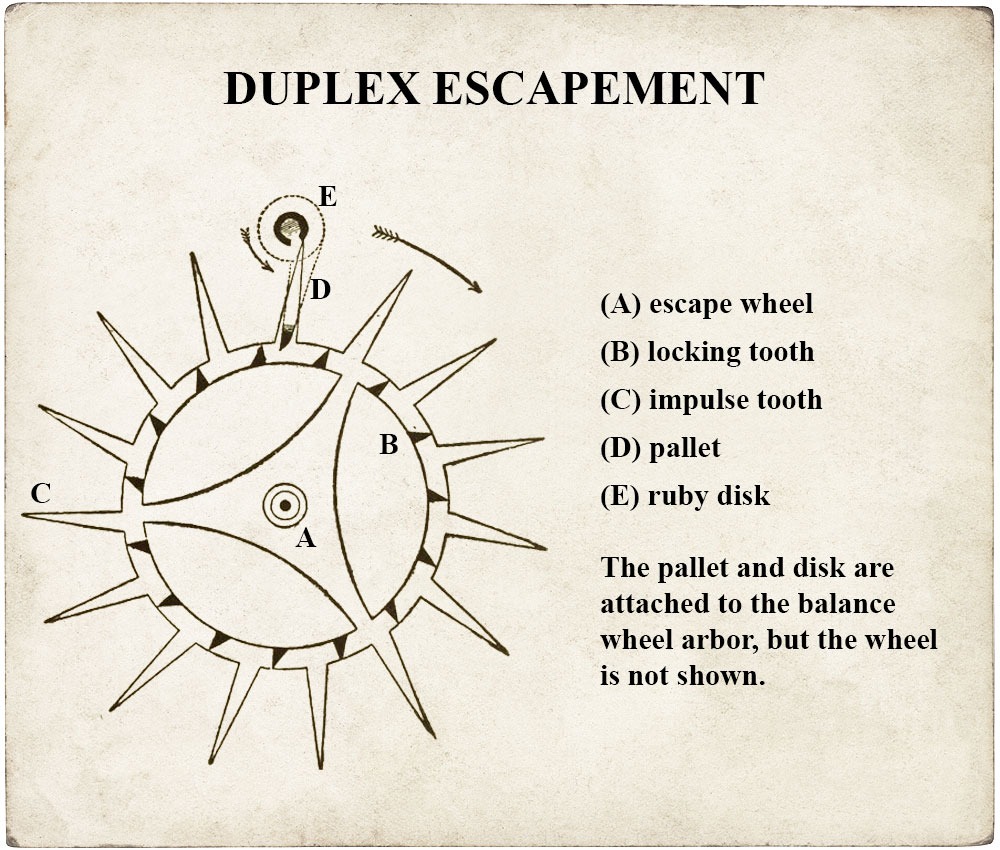
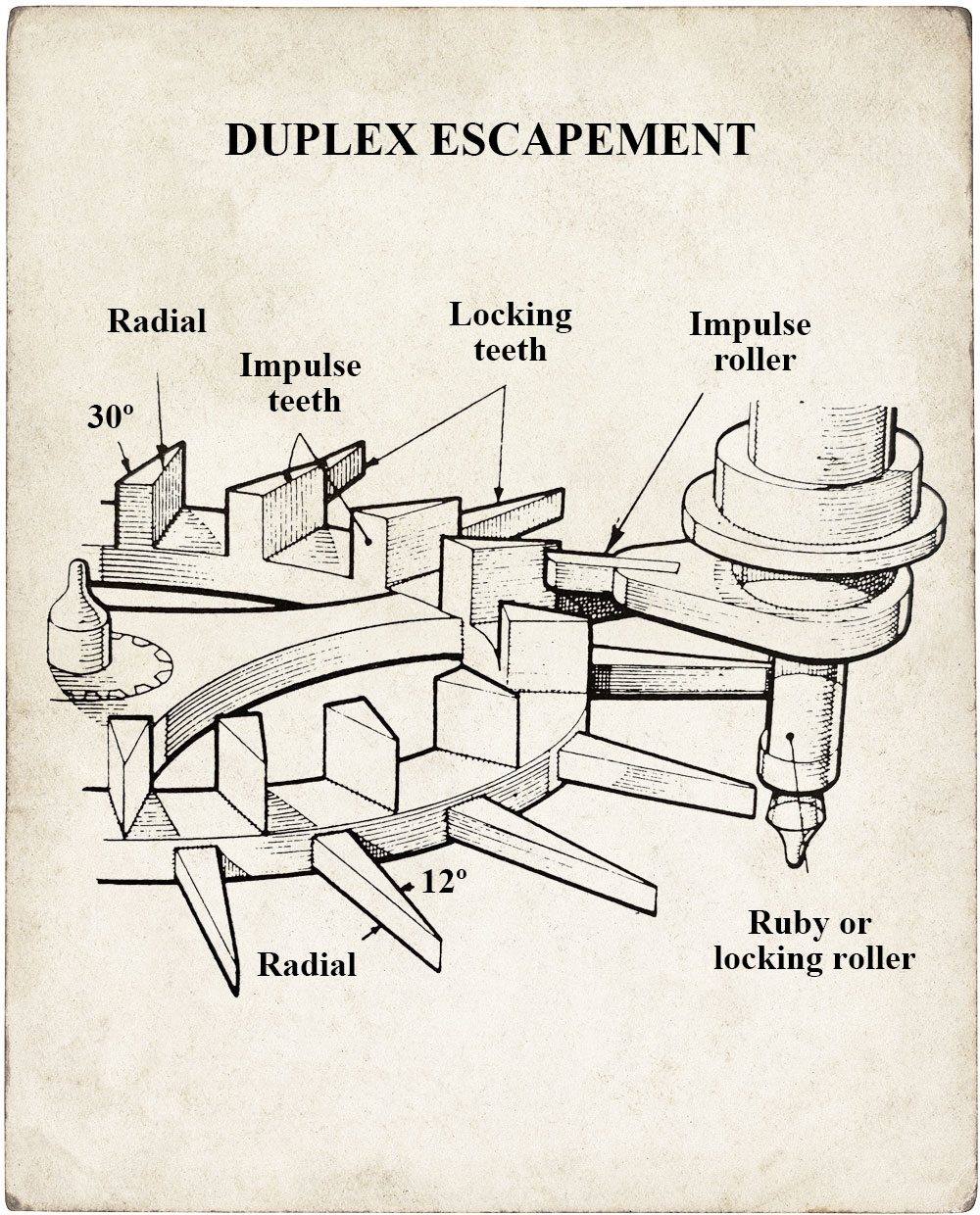
In a duplex escapement the balance wheel only receives an impulse during one of the two swings in its cycle. It has two sets of teeth on the escape wheel, which is why it is named ‘duplex’. The long locking teeth project from the side of the wheel, while the short impulse teeth stick up axially from the top. The cycle begins with a locking tooth resting against the ruby disk. As the balance wheel swings counterclockwise through its central position, the notch in the ruby disk frees the tooth. The pallet is positioned precisely to receive a push from an impulse tooth as the escape wheel rotates. The next locking tooth then drops onto the ruby roller and remains there while the balance wheel completes its cycle by swinging back clockwise (CW). This process is repeated. During the CW swing, the impulse tooth falls briefly into the ruby roller notch again but does not release.

Important features of the Duplex Escapement

One of the key features of the duplex escapement is its double roller. The double roller is a small wheel with two arms that are connected to the pallet fork. The double roller allows the pallet fork to engage with the escape wheels more smoothly, reducing friction and wear.

Another important feature of the duplex escapemen is the impulse jewel. The impulse jewel is a small, highly polished ruby that is mounted on the pallet fork. It provides a smooth surface for the escape wheel to push against, reducing friction and wear. The impulse jewel is an essential component of the duplex escapement, and it plays a significant role in maintaining the accuracy of antique pocket watches.

The duplex escapement is also notable for its “free” or “dead” beat. In a free beat escapement, the balance wheel moves back and forth at a steady pace, with the pallet fork releasing the escape wheel at each beat. This results in a more accurate timekeeping than a verge escapement, which oscillates rapidly and can be easily disturbed by external factors.

In summary, the duplex escapement is a significant improvement over the earlier verge escapement. It provides greater stability and accuracy, and it is still used in high-end watches today. The double roller and impulse jewel are key features that help to reduce friction and wear, while the free beat escapement ensures accurate timekeeping. Robert Hooke’s invention has stood the test of time and remains a cornerstone of modern watchmaking.

To top