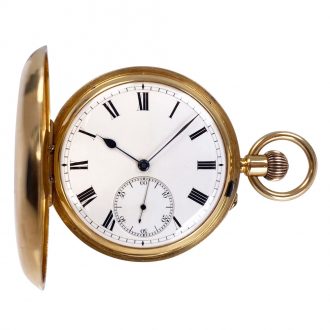
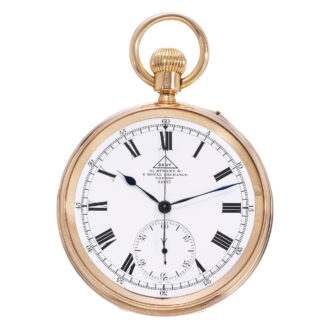
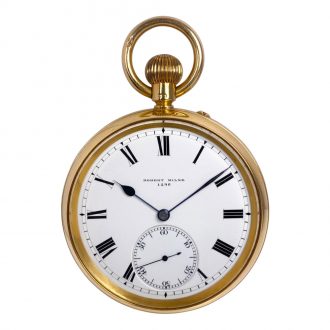
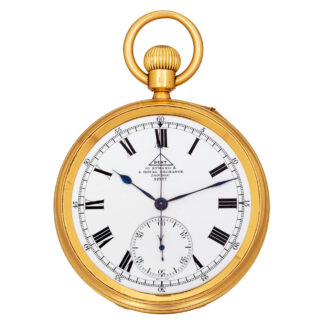
Historically important English flying tourbillon chronograph Circa 1901
- Kenmerk
- DB0274
- Diameter
- 62 mm
- Estimate
- € 50.000 - 90.000
- Price sold
- € 68.800
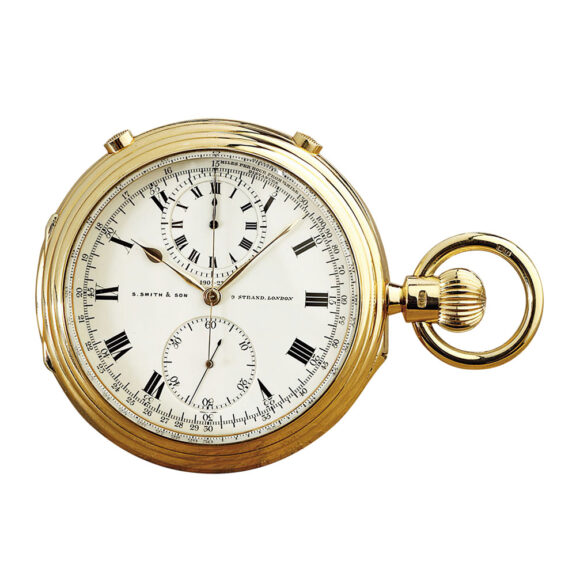
Gold open faced chronograph by Samuel Smith & Son
–
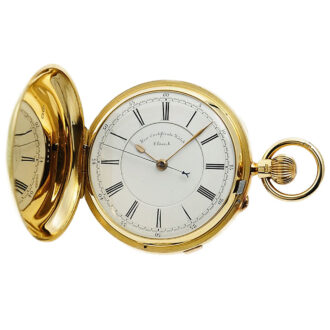
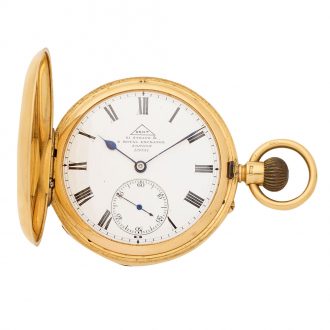
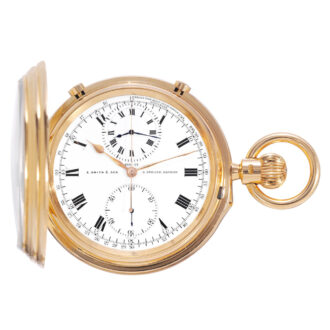
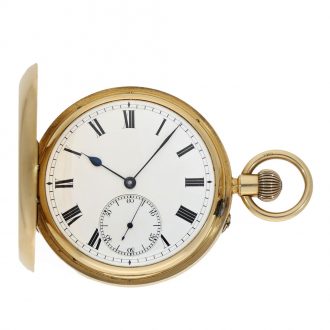
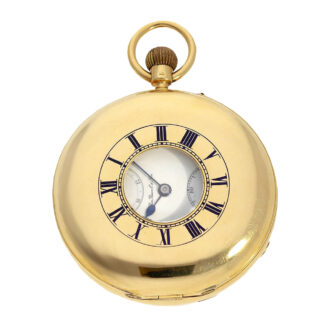
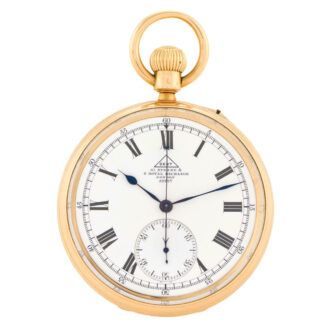
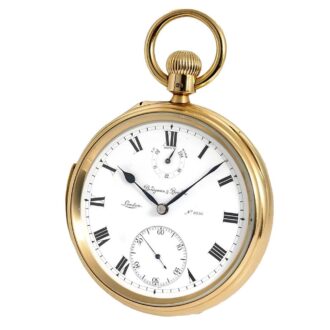
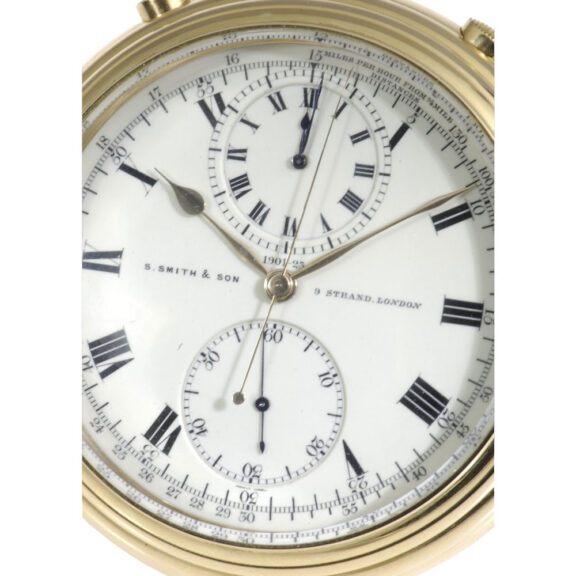
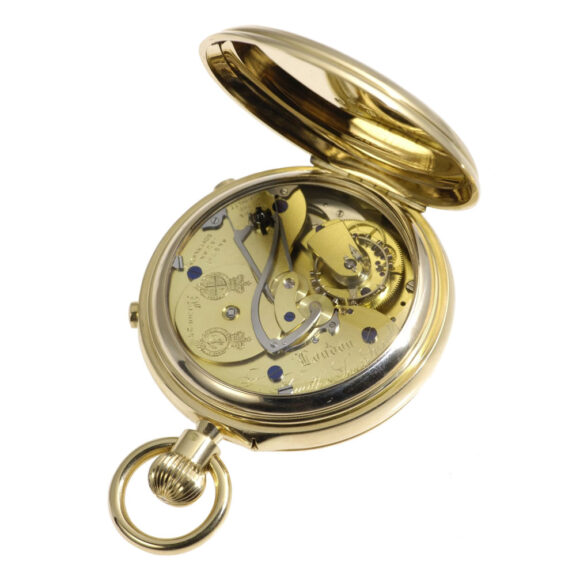
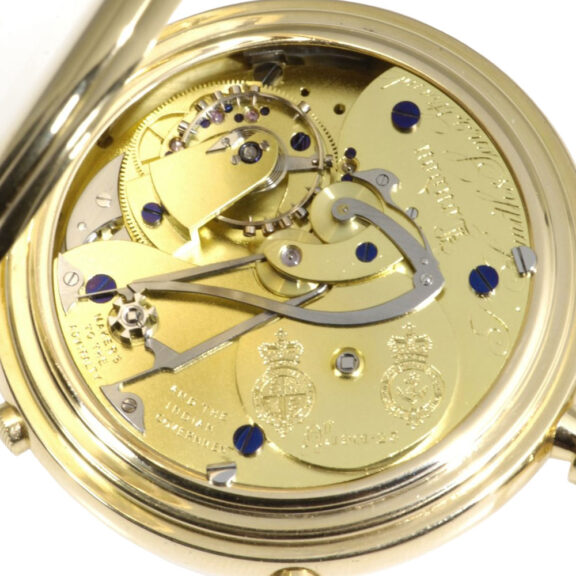
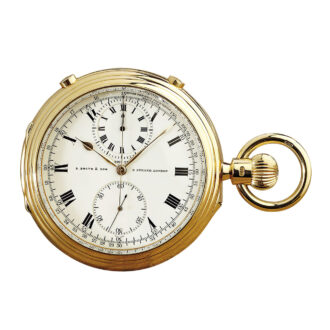
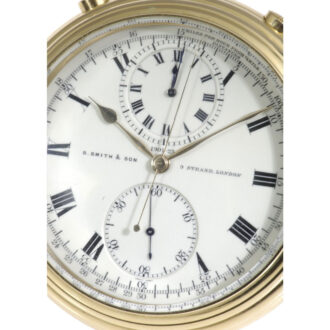
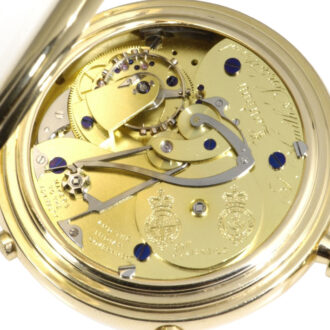
A historically important, large and heavy English 18 carat gold open faced chronograph pocket watch with a flying 12-minute tourbillon according to Robert Benson North, 60-minute and 12-hour counter, circa 1901. Glazed 2/3 plate movement, compensation balance with gold and platinum screws. Off-white enamel dial made by Willis with Roman hours, Arabic five-minute numerals, an Arabic tachy scale, subsidiary seconds at 6 o’clock and a co-axial 12-hour register at 12. Plain case, maker’s mark SS for Samuel Smith, London, the pendant is chased GJ. Dial and movement signed and numbered, case numbered, case and movement with matching numbers. Comes with the original presentation box.
–
Diameter: 62 mm
–
Weight: 228 g
–
Signed: S. Smith & Son 9 Strand London Makers to the British and Indian Governments
–
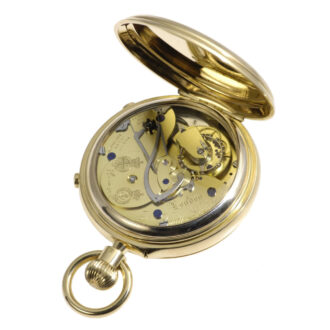
The present watch is No. 1901-23 of a very exclusive series of timepieces which Samuel Smith finished for the observatory trials at Kew. It is an impressive piece with subsidiary 60 minutes and co-axial 12-hour register and also the very first two-button, four-function chronograph known to exist. The construction was first patented by Universal Watch Co in Switzerland in 1929 but the two-button, four-function chronograph system featured in this watch is almost 30 years older. This watch is perfectly finished and fitted with a double overcoiled Phillip’s balance spring, a type that was only ever used in watches of supreme quality to ensure perfect isochronism. The spring is made of a palladium/copper alloy to reduce acceleration and is rustproof and antimagnetic. The revolving escapement is made of gold.
–
S. Smith & Son was a leading firm in London for high-quality and complicated watches at the turn of the century, it was founded in 1851 by the jeweller and watchmaker Samuel Smith. In addition to the wide range of watches and clocks for private customers, Smith’s also built reliable chronometers which made the firm a supplier to the Admiralty. Under the management of Herbert S.A. Smith the firm developed into a large manufacturing company that had its own research laboratories. In the next generation Sir Alan Herbert Smith extended the company product range further and began with the production of automobile and aircraft instruments. Around this time a period of general decline for British horology began, even so, a few British watchmakers created magnificent, ultra-complicated watches, as if to prove to the world that they were still the best. Some of these watches were made in collaboration with the most renowned Swiss watch companies. Charles Frodsham, Edward John Dent and Samuel Smith were the London watchmakers best known for this, as well as J. W. Player in Coventry.
–
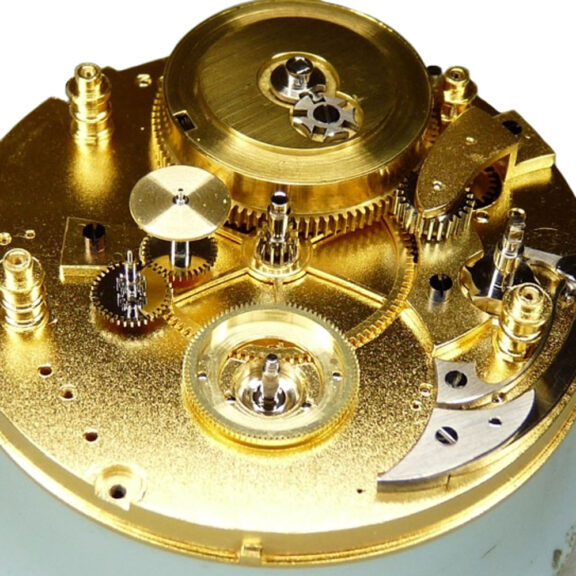
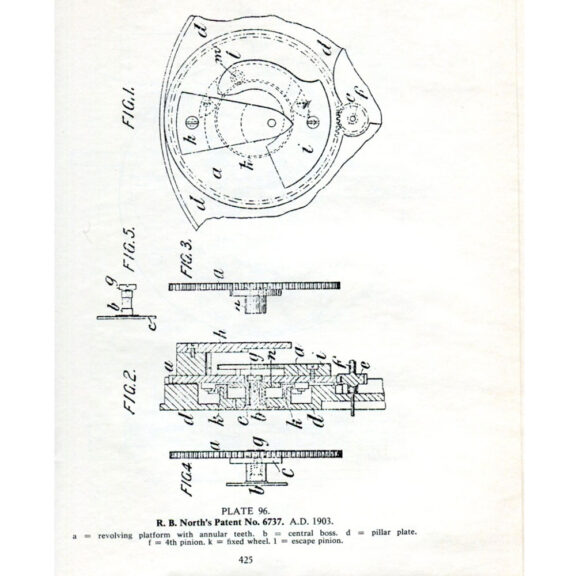
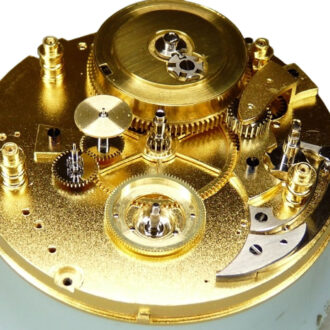
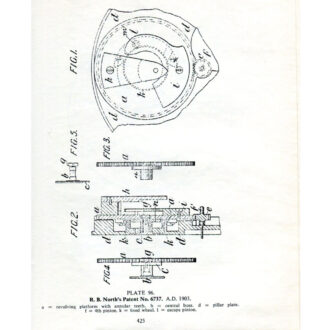
Robert Benson North received patent No. 6737 for this type of revolving escapement without a bridge in 1903. This means that this timepiece is very likely the working prototype for North’s patent. The fact that the English tended to describe both carousel regulators and tourbillons as ‘revolving escapements’ during the late 19th and early 20th century is probably the reason why North’s patent has been more or less ignored. Specifically, the patent was granted for ‘improvements to revolving escapements for watches and other portable timekeepers’. Even though the construction strongly resembles a carrousel, it is in fact technically a tourbillon. Designed without an upper bridge, this must be one of the earliest if not the first flying tourbillons ever made – decades before the Glashütte tourbillons created by Alfred Helwig (although these would gain much more prominence). The decision to do without the finely polished tourbillon cage may have resulted from a focus purely on technology and the unique new design.
Signed: S. Smith & Son 9 Strand London Makers to the British and Indian Governments
Share this page: