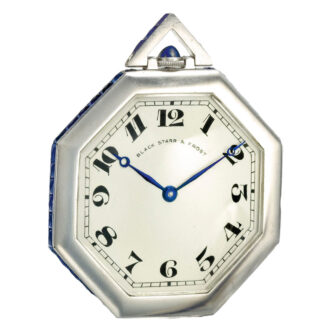
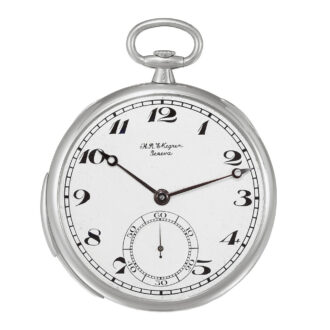
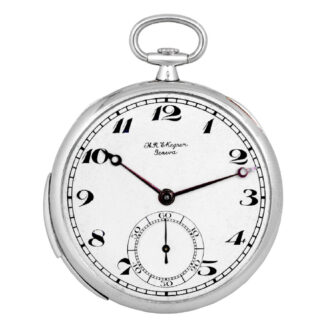
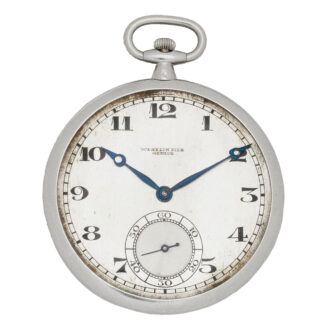
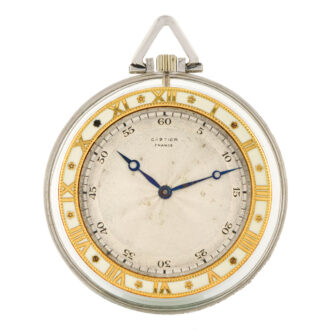
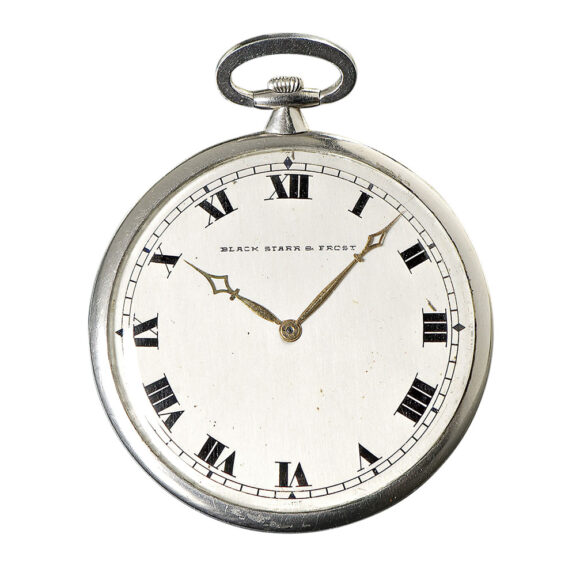
Swiss platinum lever made for the American market Circa 1915
- Kenmerk
- DB0385
- Diameter
- 44 mm
- Estimate
- € 3.500 - 6.000
- Price sold
- € 4.400
Platinum open faced lever by Audemars Piguet
–
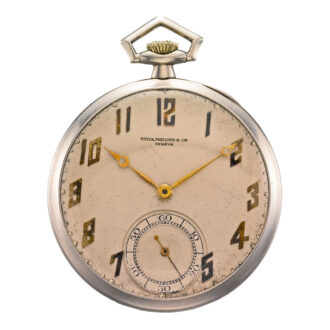
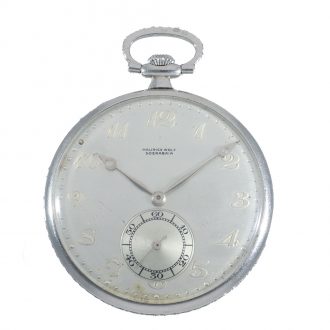
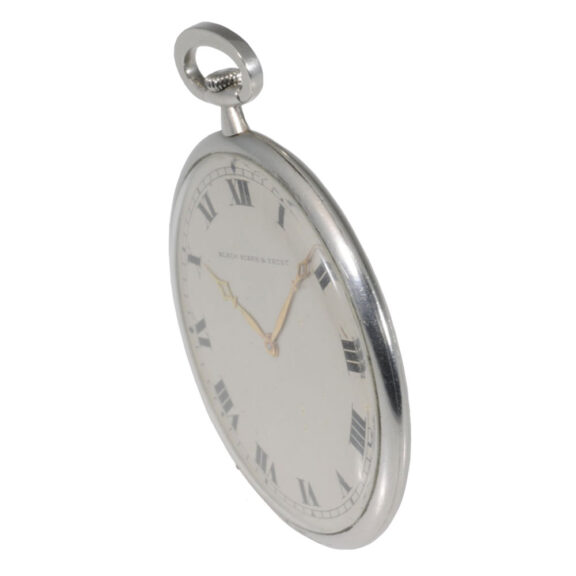
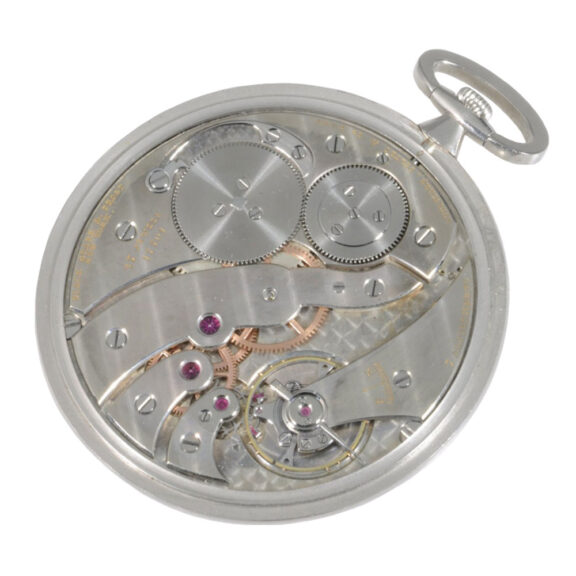
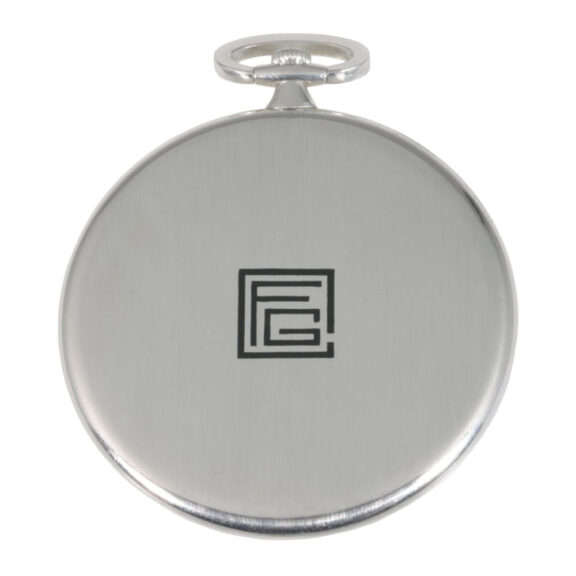
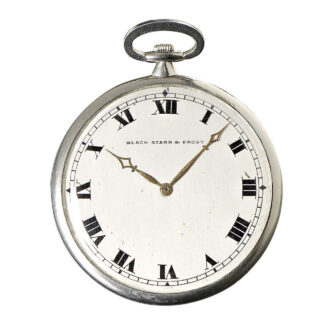
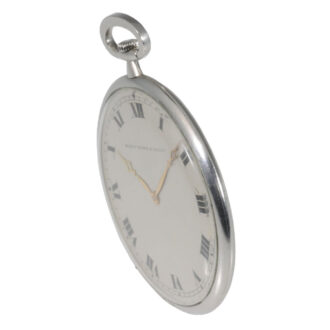
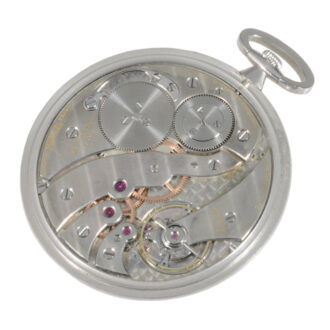
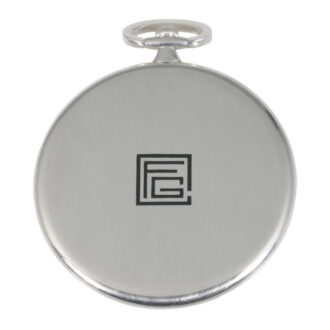
An elegant Swiss platinum open faced lever pocket watch made for the American market, circa 1915. Retailed by Black, Starr & Frost, New York. Ultra thin bridge movement, screw compensation balance. Silvered dial with Roman hours and outer minute divisions. Plain, monogrammed case.
Dial signed by the retailer, movement numbered and signed by the retailer, case numbered.
–
Diameter: 44 mm
–
Weight: 43 g
–
Signed: Audemars Piguet & Co Swiss – Black, Starr & Frost, New York
–
This timepiece is fitted with the flattest movement of its time.
–
Audemars Piguet & Cie. Jules Louis Audemars, born on March 28th, 1851 and died on October 15th, 1918 and Edward Auguste Piguet born in 1853 and died in 1919 were two young and ambitious watchmakers who established their workshop in 1875 in their home village Le Brassus, Vallée de Joux, Switzerland. Audemars was in charge of production and technical aspects while Piguet focused on sales and management. Believing in the power of the Vallée de Joux’s network of artisanship and following their firm convictions, they set on crafting unique complicated mechanisms by hand at a time when serial production was looming with the rise of industrialisation. While the two entrepreneurs first produced complicated movements that were sold to Geneva-based firms, they soon orchestrated the production of complete watches in the region by coordinating the activities of a variety of craftsmen, buying in blanks, cases, dials, bracelets and sending out pieces for gem-setting and decorating. The miniaturisation, design, assembly and setting of movements were then done at Audemars Piguet’s workbenches. The company ledgers demonstrate that nearly 80% of the 1600 watches produced by Audemars Piguet between 1882 and 1892 included at least one, if not several complications. Refined chiming, chronograph and astronomical watches, assembled and finished by hand, have remained the beating heart of Audemars Piguet ever since.
–
Black, Starr & Frost trace their origins back to a company that was founded by Erastus Barton in 1810. His successor was Frederick Marquand, who named it Marquand & Barton and later Marquand & Brothers before the business finally became Marquand & Company. Marquand & Company took part in the Crystal Palace Exhibition in London in 1851, one of only a very small number of American jewellers who did. In 1839 the company came under new management and from then on traded as Ball, Tompkins & Black. The company had several branches on Broadway in New York. In 1874 it changed its name once again to Black, Starr & Frost, at the same time when new premises on Fifth Avenue opened their doors. The shop on Fifth Avenue was certainly one of the great landmarks of the city, on par with Tiffany’s and Cartier. They counted the most important members of New York’s society amongst their patrons, for example, the Vanderbilts and the Carnegies. Their reputation was such that they were sometimes called “the Fifth Avenue Jewellers of New York City”. When describing themselves in a publication on the occasion of their hundredth anniversary in 1910, the company stated that they marketed the most reliable movements produced by national and international manufacturers and also created their own watches. For the movements a variety of cases was chosen, watches came in enamelled, engraved or bejewelled cases to satisfy the customers’ demands. By the 1920s Black, Starr & Frost operated branches in Paris, Palm Beach and Southampton, Long Island. The company merged with Gorham Manufacturing Co – another Fifth Avenue store – in 1929 and became Black, Starr, Frost-Gorham Inc. The new shop opened its doors only a few weeks after Black Thursday and the stock market crash. During this and the next decade Black, Starr & Frost produced a great number of marvellous clocks and other fine works of art matching those sold by the most famous French jewellery houses, no other American house produced the highly sought-after Art Deco mystery clocks. Consequently Black, Starr & Frost were one of five jewellers to exhibit in the “House of Jewels” at the New York World’s Fair 1939, the others were Tiffany, Cartier, Marcus & Co, and Udall & Ballou.
Signed: Audemars Piguet & Co Swiss – Black, Starr & Frost, New York
Share this page: