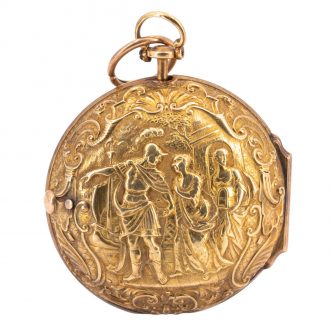
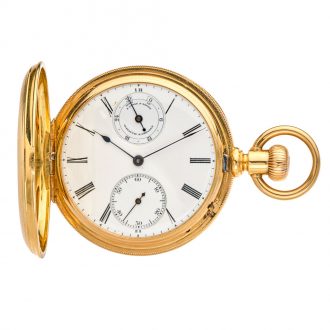
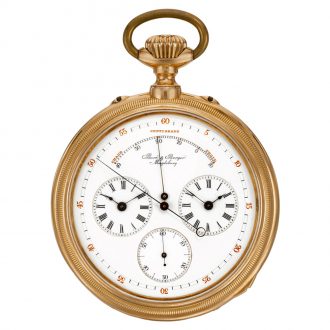
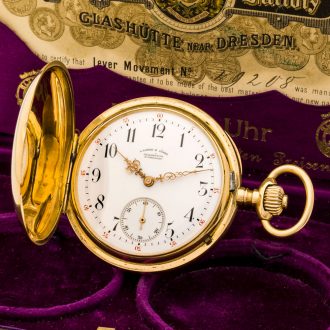
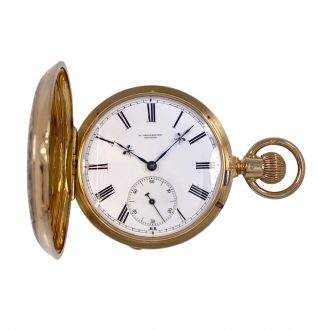
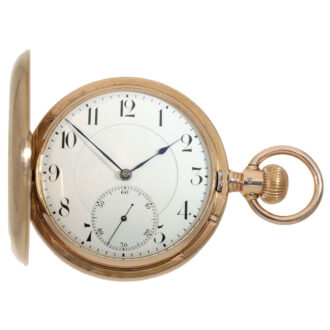
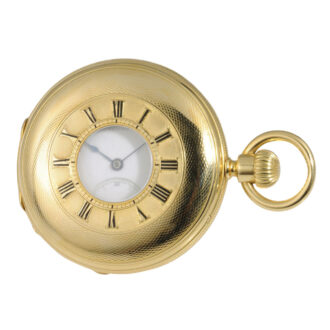
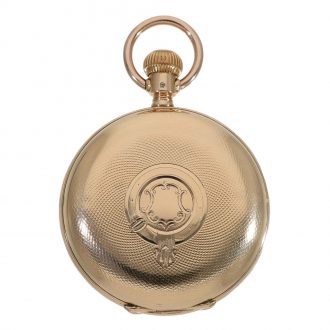
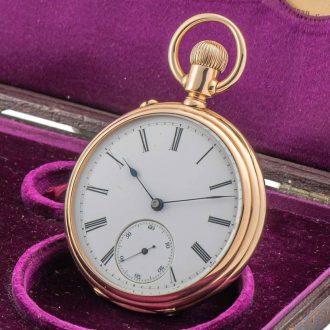
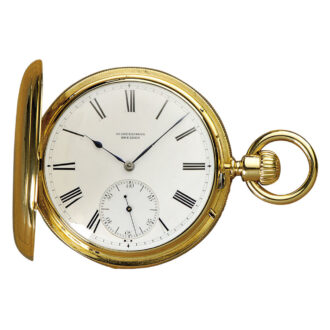
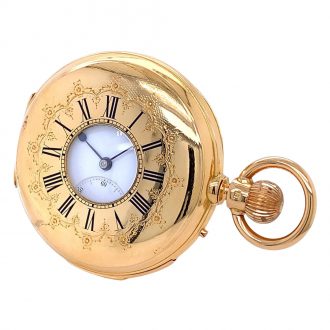
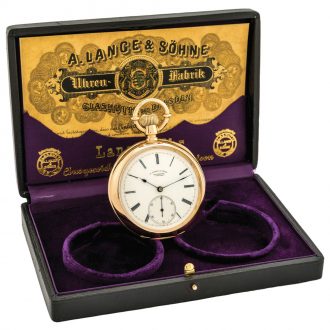
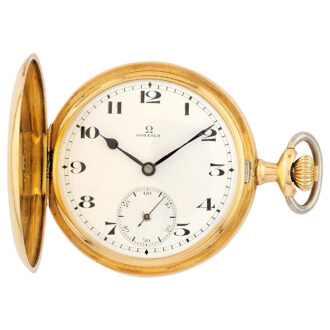
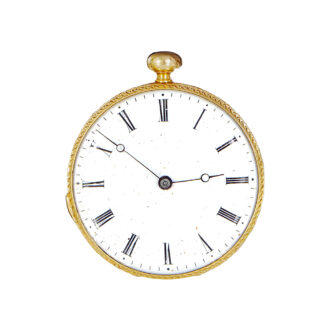
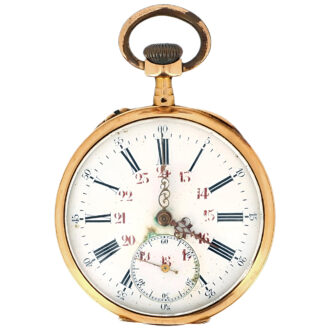
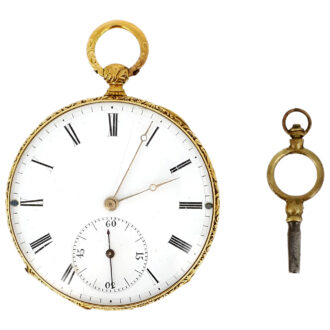
German 18 carat gold hunting cased precision watch Circa 1880
- Kenmerk
- DB0417
- Diameter
- 52 mm
- Estimate
- € 6.000 - 12.000
- Price sold
- € 7.900
Gold full hunter by Moritz Grossmann
–
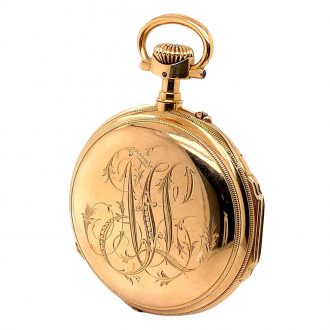
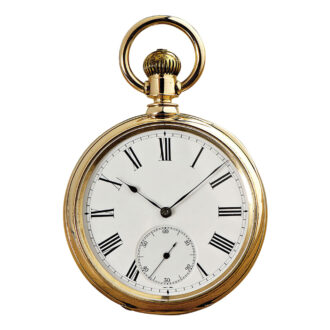
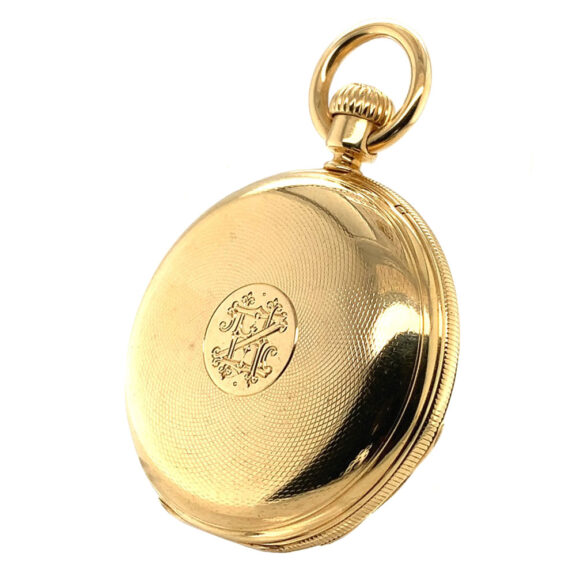
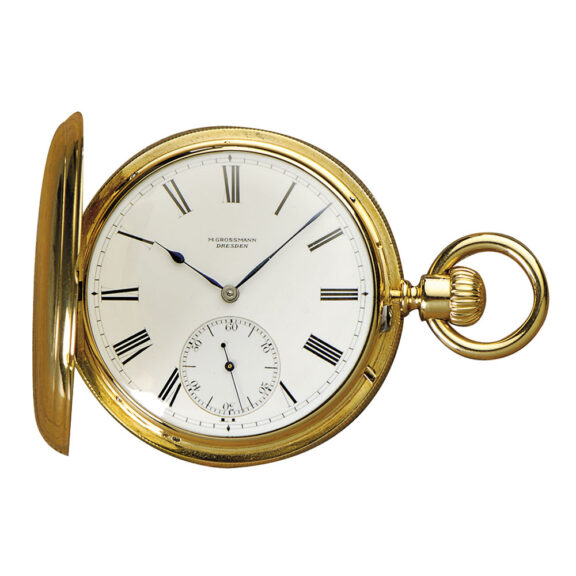
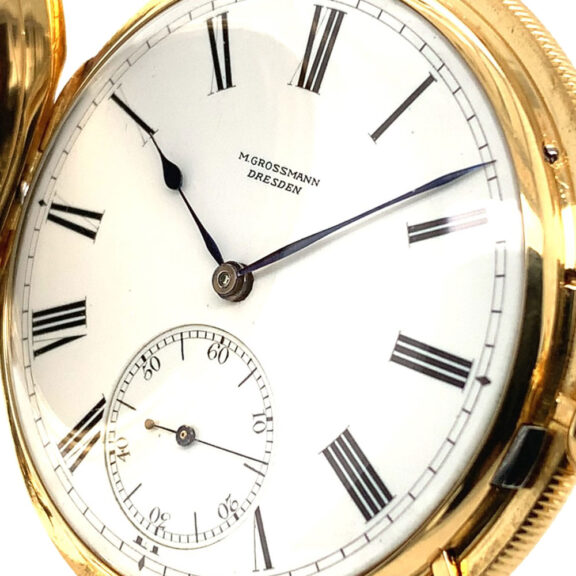
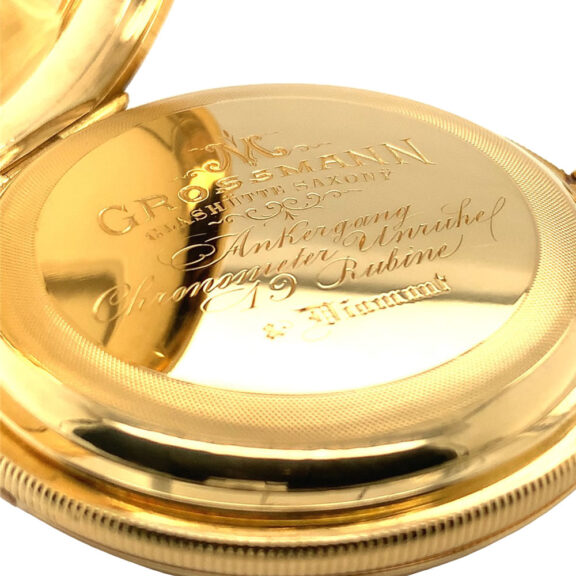
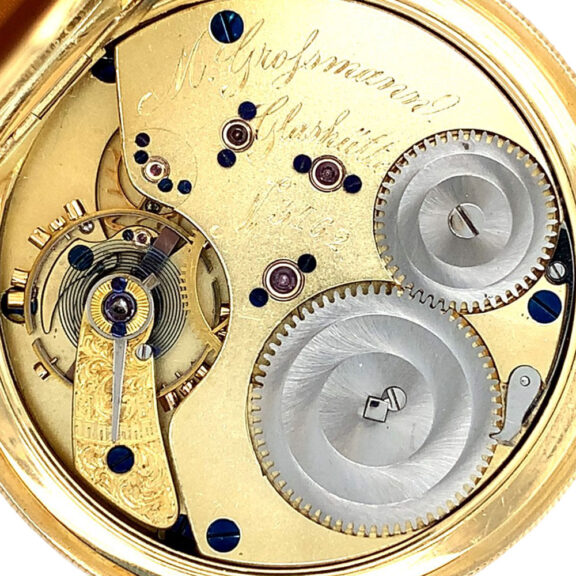
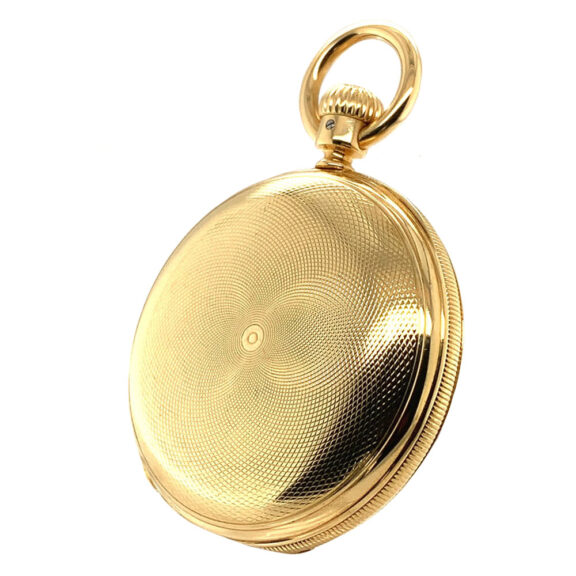
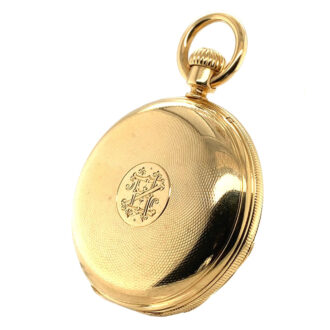
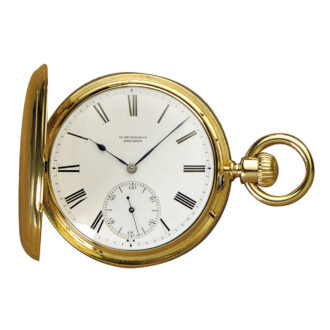
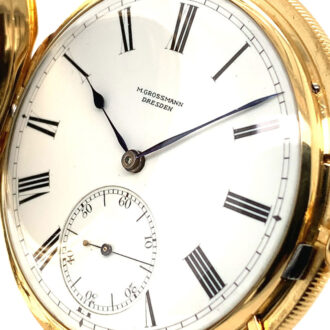
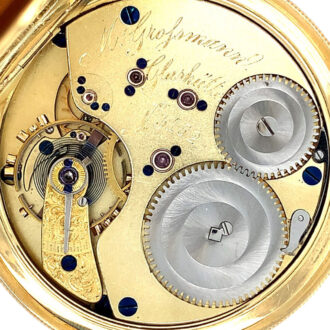
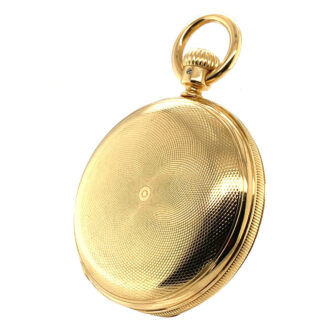
A rare 18 carat gold hunting cased quality 1A Glashütte precision pocket watch, circa 1880. ¾ Plate movement, gold screw compensation balance. White enamel dial with Roman hours, outer minute divisions and sunk subsidiary seconds. An engine turned case made by Perron Frères, the front with central monogram HZ.
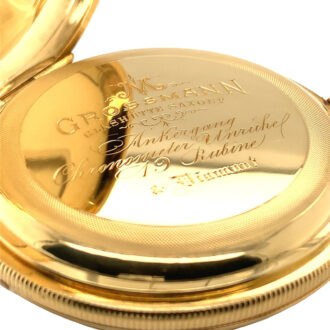
Dial signed, cuvette signed M. Grossmann Glashütte Saxony, movement signed and numbered.
–
Diameter: 52 mm
–
Weight: 126 g
–
Signed: M. Grossmann Dresden
–
Carl Moritz Grossmann was born in Dresden on March 27th, 1826. His father was a sorter at the Royal Court Post Office. Moritz grew up in modest circumstances, but his teachers at school soon realised that he was an exceptionally gifted pupil and he received a free place at the “Technische Bildungsanstalt” (which was later to become Dresden’s Technical University). This enabled him to study for two years, just like Ferdinand Adolph Lange some years before him. In 1842 Grossmann began his apprenticeship with the watchmaker Gottfried Friedrich Kumme (sen) in Dresden and was allowed to end his apprenticeship early because of his unusual talent. He also learnt English, French and Italian. At the same time, Grossmann became friends with the watchmaker Lange who was 11 years older. Both men were ambitious and meticulous workers, keen to learn and build watches. His travels took Moritz Grossmann to Altona in 1847 where he worked with chronometer maker Moritz Krille, afterwards he went to stay with watchmaker to the Munich court Josef Bierganz. He went on to La Chaux-de-Fonds, the Swiss stronghold of the watchmaking industry. From there he travelled to England, France, Denmark and Sweden, always on the lookout for opportunities to learn and further his knowledge and abilities in watchmaking. He only returned to Dresden for a short while in 1854 before moving to Glashütte, about 30 km from Dresden. In Glashütte Grossmann invented the “Glashütter Drehstuhl”, a small watchmaker’s lathe. He began devoting himself to the construction of lever escapements and tried to perfect the pivoted detent escapement. He also built precision tools, movement models, fine pocket watches and marine chronometers. Grossmann mastered this multitude of tasks with a team of highly qualified colleagues. He was able to win the two expert watchmakers Ludwig Strasser and Carl Maucksch for his workshop. This allowed Grossmann not only to build his own watches but also to pass his knowledge on to others. Grossmann gave lectures, wrote articles for national and international horological magazines and translated technical books such as Claudius Saunier‘s textbook on watchmaking “Lehrbuch der Uhrmacherei”, which consisted of several volumes. In 1866 Grossmann was the first German to win a competition at the British Horological Institute in London with his paper “On the detached lever”. Moritz Grossmann was also very socially and politically active. He founded the volunteer fire brigade of the sports club in Glashütte, the military club and supported the building of the railway link to the Müglitz valley. After his wife died in 1871, he remarried and the couple had three children. In 1876 Grossmann became a member of the state parliament of Saxony. He initiated and created the concept for the German Watchmaking School in Glashütte. He founded the school in 1878 and served as its first chairman of the board and taught maths and languages at the school. Moritz Grossmann died after a stroke on January 23rd, 1885 in Leipzig, shortly after holding a lecture on the introduction of Universal Time. Just like his friend Lange, he was only 60 years old when he died. After Grossmann’s sudden death, his factory in Glashütte was dissolved.
Signed: M. Grossmann Dresden
Share this page: