Early Swiss 18K gold and enamel keyless lever watch Circa 1854
- Kenmerk
- BA3542
- Diameter
- 50 mm
- Estimate
- € 7.500 - 12.500
- Price sold
- € 9.150
Gold enamelled full hunter
–
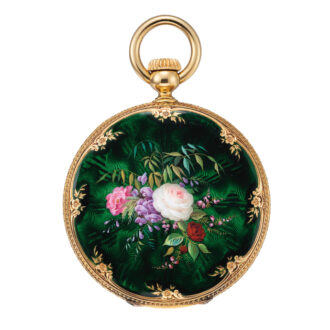
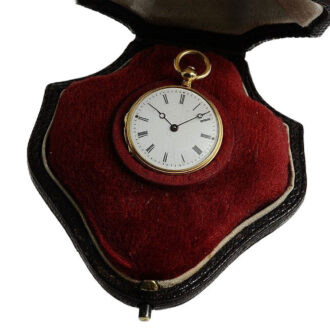
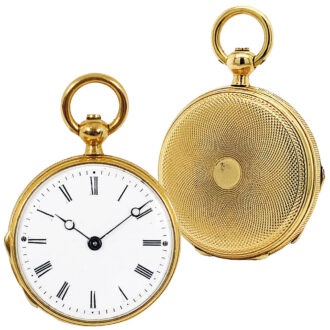
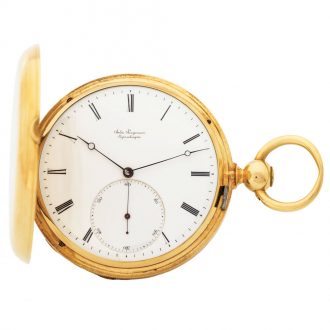
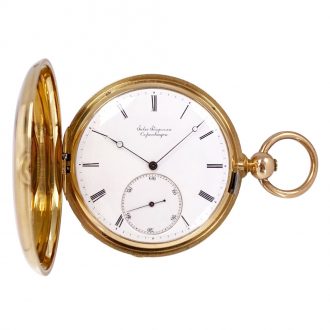
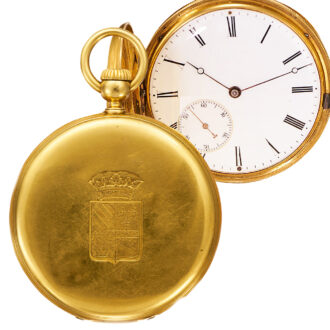
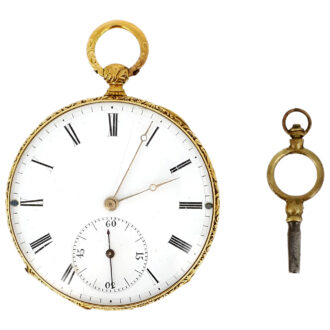
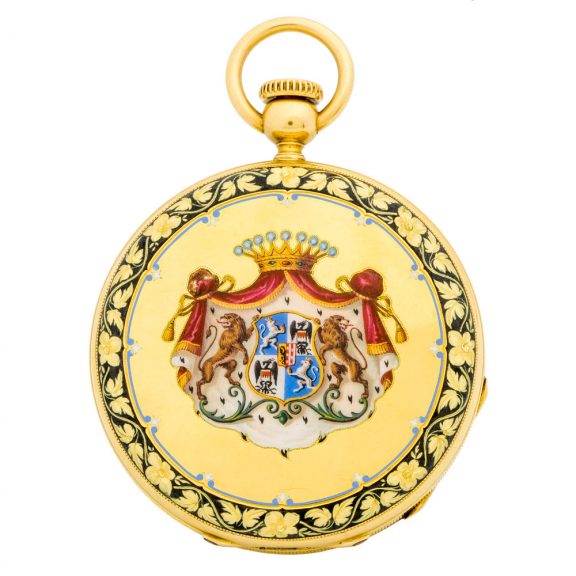
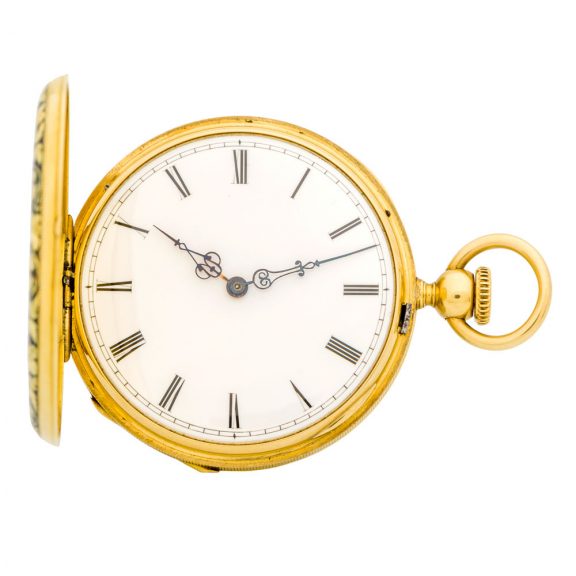
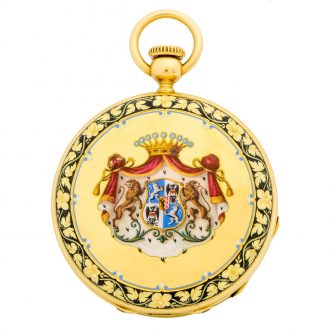
An extremely fine and equally rare, early Swiss 18 carat gold and enamel hunting cased keyless wind and set presentation pocket watch, made for the Central-Eastern European market (the Austro-Hungarian Empire at the time) by Constant Girard, circa 1852-1856. Retailed by Charles Suchy & Fils in Prague, Czech Republic. The frosted gilt brass bridge movement, probably made by LeCoultre in Le Sentier, Vallée de Joux, with an equilibrated straight line lever escapement, a barrel, 19 rubies, a compensated balance with gold poising screws and blued steel Breguet hairspring, polished steel endplate and an index regulator. A hinged, finely engraved, gold cuvette signed by the retailer, Chs Suchy & Fils Prague.
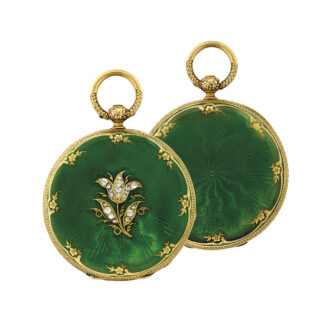
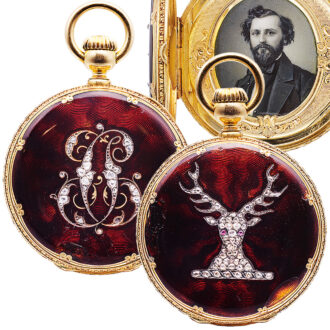
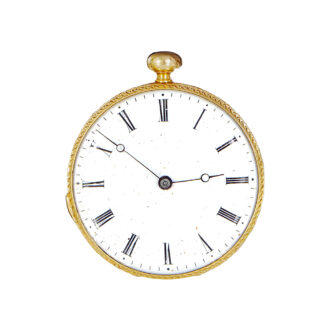
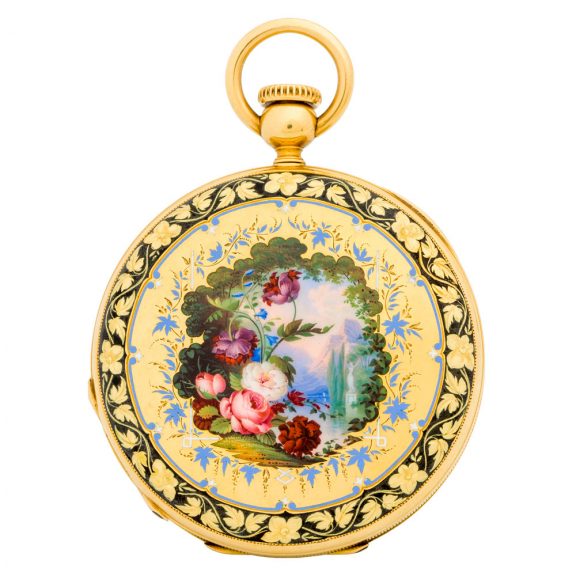
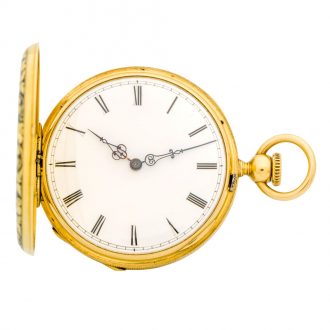
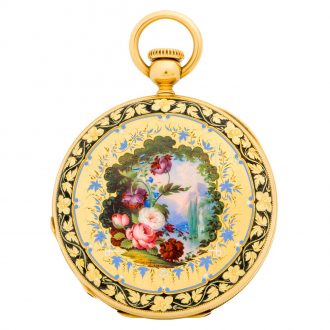
White enamel dial with Roman hour numerals, an outer minute track and decorative blued steel hands. The polished case with a reeded band, the front featuring a multicoloured enamel coat of arms of a Central-Eastern European family on an ermine mantling showing a family crest held by two lions, topped by a Count’s crown and green scrolls underneath, surrounded by gold floral and foliage decoration on a black enamelled ground, on the back, polychrome enamelled flowers with a lake landscape in the background, framed by white and light blue champlevé enamel and engraved decoration also surrounded by gold floral and foliage decoration on a black enamelled ground.
Cuvette signed, numbered on the plate under the dial.
–
Diameter: 50 mm
–
Signed: Girard
–
This watch, signed ‘Girard’, is most likely made by Constant Girard (1825-1903), the ultimate founder of Girard-Perregaux.
The ébauche of the movement with its early keyless winding and setting system is probably made by Antoine LeCoultre (1803-1881) from Le Sentier in the Vallé de Joux, who invented his first system ‘à bascule’ in 1847. Four years later, in 1851, he received a gold medal for his work on precision and mechanisation in watchmaking at the first Universal Exhibition in London, Crystal Palace. The system used in the present watch is presumably an improved version of the initial invention by LeCoultre.
As early as the end of the 18th century, watchmakers sought to make keys unnecessary by the invention of winding, and sometimes setting, mechanisms integrated into the watch itself. In Switzerland at the end of the 1830s and during the 1840s, such mechanisms were devised by Louis Audemars (1782-1833), Antoine LeCoultre (1803-1881) and Adolphe Nicole (1812-1876), from the Vallée de Joux. During the same period, Adrien Philippe (1815-1877) was experimenting with this type of mechanism in Paris. It is to Philippe, who settled in Geneva in 1845 and became co-founder of Patek Philippe, that we can attribute the form of pendant winding still in use today.
–
The polychrome enamel scene can be attributed to the Genevan workshop of Gaspard Lamunière (1810-1865), the greatest enamel painter of his time.
–
Constant Girard (1825-1903). After a happy childhood, Constant Girard, born Othenin-Girard, the last name of his father and his mother combined (at the time is was traditional in the Neuchâtel Mountains to associate a man’s name with that of his wife when married) learned the watchmaker’s trade, slowly and patiently absorbing its secrets as they were passed on by demanding master craftsmen. After training by and working for others, he associated with watchmaker C. Robert from La Chaux-de-Fonds in 1845. Around 1852, Constant and his elder brother Numa founded a watch manufacturing company in La Chaux-de-Fonds, which they named Girard & Compagnie. Barely two years later, at the age of 29, Constant married Marie Perregaux (1831-1912), the daughter of a marchand horloger from Le Locle, Henri-François Perregaux (1797-1847).
In 1856, the name of the company was changed to Girard-Perregaux. He was very technically minded, devising fine time measurement instruments for his customers. Constant Girard-Perregaux marks his era as a perfectionist, he was constantly trying to design increasingly sophisticated, meticulously fashioned movements. His years of experimenting and experience culminated eventually in the three parallel bridge construction. Performance took on greater importance, spurring the development of progressively more complex and accurate watches, with an increasing variety of indications. This was the heyday of chronometry and observatory contests between the great watchmakers of the period. Constant was a talented contestant, winning no less than 13 gold medals and several other distinctions at industrial exhibitions in Switzerland, Europe and America. His business was growing rapidly, expending as far as America and Japan.
–
Gaspard Lamunière, born in Genève on May 15th, 1810 and died in Nice on April 6th, 1865, was a painter and enameller, practicing oil and enamel painting, and the portraitist and master of an enamel workshop. He apprenticed with Joseph Hornung (1792-1870) and Jean-Léonard Lugardon (1801-1884). Lamunière opened a workshop where he worked with his wife Louise Franel (1819-after 1865) and later, his niece. From age 18, June 1828, he exhibited in Geneva in the Société des Arts with two enamel portraits and then with regularly series of portraits painted on enamel or in oil. He had many pupils, both in the field of enamel and oil painting: Françoise (or Fanny) Chatel (1832-1874), Philippe Prochietto (or Prochet) 1825-1890), Jean-Marc Baud (1828-1907), Jules Crosnier (1843-1917) and Edouard Ravel (1847-1920).
Signed: Girard
Share this page: