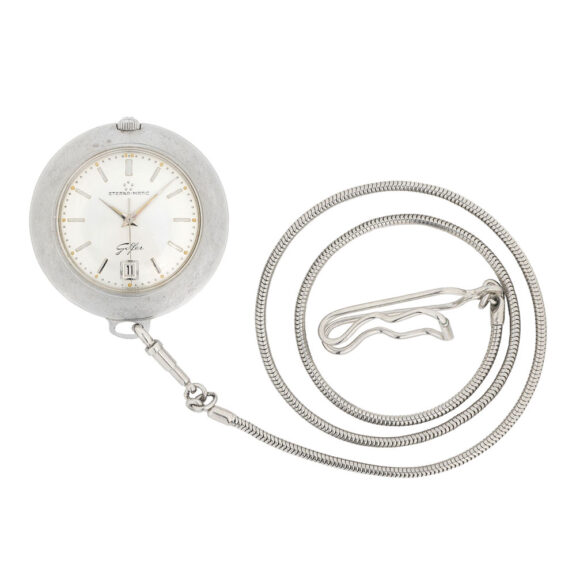
Thin Swiss stainless steel automatic watch with date Circa 1957
- Kenmerk
- BB1179
- Diameter
- 40 mm
- Estimate
- € 400 - 800
- Price sold
- € 750
Stainless steel Eterna-Matic Golfer
–
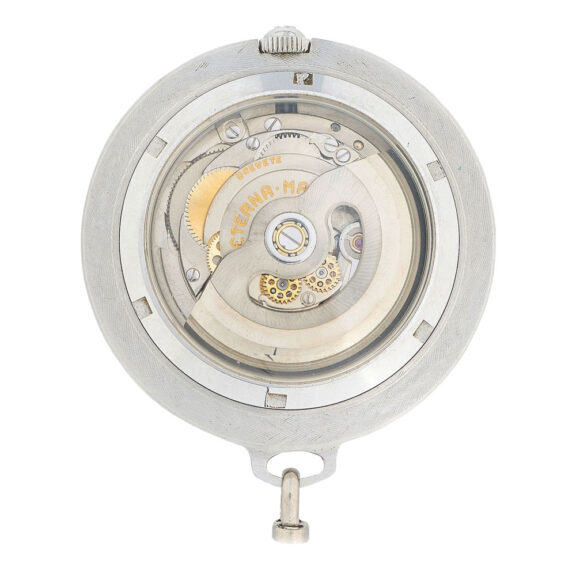
An unusual, thin and chic Swiss stainless steel open faced automatic pocket watch with date made by Eterna in Grenchen, circa 1957. The jewelled fine precision movement is shock protected and water resistant, and fitted with a patented ballbearing winder. Sunburst silvered dial with baton hour indexes, outer dot minute divisions, an aperture at 6 o’clock for indication of the date and dauphine hands. The brushed case with a transparent back. Dial and case signed, movement signed and numbered. Comes with a stainless steel chain and clip.
–
An unusual, thin and chic Swiss stainless steel open faced automatic pocket watch with date made by Eterna in Grenchen, circa 1957. The jewelled fine precision movement is shock protected and water resistant, and fitted with a patented ballbearing winder. Sunburst silvered dial with baton hour indexes, outer dot minute divisions, an aperture at 6 o’clock for indication of the date and dauphine hands. The brushed case with a transparent back. Dial and case signed, movement signed and numbered. Comes with a stainless steel chain and clip.
–
Diameter: 40 mm
–
Signed: Eterna-Matic Golfer Swiss
–
Model: Golfer.
–
Eterna has a very important place in the history of watchmaking.
–
In 1856, Dr Joseph Girard and Urs Schild, a 28-year-old school teacher, established the watch movement factory ‘Dr Girard & Schild’ in Grenchen, Switzerland and began producing both semi finished and fully finished watch movements.
–
In 1866, Dr Girard left the company. Left the sole owner, Urs Schild, innovated the production process by introducing the first automatic manufacturing machines, which could be powered not only by water but also by a modern steam engine.
–
When the production of ebauches became less profitable due to supply increases and prices going down, Schild also started producing fully assembled watches. In 1876, the first pocket watch, entirely manufactured in Grenchen, was presented with great success. Meanwhile, his brother Adolph had joined the company and the name was changed to Präzisionsuhren-Fabrik Gebrüder Schild, it was generally known as Schild Fréres & Co.
–
Just 58 years old and a year after being elected to the National Council of the Swiss Confederation, Urs Schild died in 1888. His sons, Max and Theodore, took over the company.
–
In 1890, the company employed about 300 workers and produced 180 timepieces a day. The Eterna logo appeared on the dials of some watches as the name of a collection.
–
In 1906, the company name was changed to Eterna-Werke, Gebrüder Schild & Co.
–
Eterna kept expanding worldwide, opening several branches while greatly increasing productivity thanks to advanced manufacturing methodologies and innovative electric machinery.
–
In 1904, Eterna filed a patent for a special wrist watch casing with moving safety band lugs intended for military forces. Four years later, a wrist watch featuring an alarm function was patented. Launched at the Swiss National Exhibition in Berne in 1914, it was the world’s first series production wristwatch with an alarm. Further developed, in 1929, a new model with an eight day power reserve was brought on the market. A year later, Eterna presented the smallest production wristwatch with a Baguette movement. Other watchmakers had smaller models, but those were handmade and much more expensive.
–
In 1932, Theodor Schild, who had led the company since 1899, died. The son of his brother Max, Rudolf Schild-Comtesse, succeeded him. That same year, the company was divided into two legal entities: ETA SA for the production of movements and Eterna for the production of watches. Over the years, ETA would become one of the largest ebauche movement manufacturers in the world. Today, it is a wholly owned subsidiary of the Swatch Group.
–
1948 was the year of a fundamental invention not only for Eterna but for the entire watchmaking industry: the Eterna-Matic movement.
–
The history of automatic watches began in the 1770s with designs of Swiss watchmaker Abraham-Louis Perrelet and French inventor Hubert Sarton, further improved by Abraham-Louis Breguet a few years later. However, those designs were not sufficiently reliable and did not take off until the 20th century with the initial production of wristwatches. In fact, the motions of the hands could finally provide enough energy to power a mechanical watch movement.
–
In 1920, John Harwood, a watch repairer from Bolton, England, came up with the idea to use a pivoting weight, which swung as the wearer moved, to wind the mainspring of a wristwatch. The weight did not rotate a full 360° as spring bumpers limited the swing to about 270°. For this reason, this early type of self winding mechanism is often referred to as a ‘bumper’. He obtained a patent for his invention in Switzerland, where he started making automatic wristwatches with the capacity of working 12 hours after being fully charged. However, the accuracy and reliability of these movements were still affected by the friction between components. Eterna found a solution that proved to be ideal by introducing a ball-bearing-mounted rotor. Five miniature ball bearings provided the necessary support and balance to the rotor, significantly reducing bearing friction and making the watch operate smoothly and reliably even under extreme conditions, for example, when the watch was dropped on the ground.
–
From then on, all the automatic watches made by Eterna were marketed under the name Eterna-Matic and the five tiny balls, which brought worldwide fame and success to the brand, were chosen as the new logo. This Eterna technology took watchmaking to new levels, soon becoming the new standard for all automatic (wrist)watches in the world. It remains in use today.
Diameter: 40 mm
–
Signed: Eterna-Matic Golfer Swiss
–
Model: Golfer.
–
Eterna has a very important place in the history of watchmaking.
–
In 1856, Dr Joseph Girard and Urs Schild, a 28-year-old school teacher, established the watch movement factory ‘Dr Girard & Schild’ in Grenchen, Switzerland and began producing both semi finished and fully finished watch movements.
–
In 1866, Dr Girard left the company. Left the sole owner, Urs Schild, innovated the production process by introducing the first automatic manufacturing machines, which could be powered not only by water but also by a modern steam engine.
–
When the production of ebauches became less profitable due to supply increases and prices going down, Schild also started producing fully assembled watches. In 1876, the first pocket watch, entirely manufactured in Grenchen, was presented with great success. Meanwhile, his brother Adolph had joined the company and the name was changed to Präzisionsuhren-Fabrik Gebrüder Schild, it was generally known as Schild Fréres & Co.
–
Just 58 years old and a year after being elected to the National Council of the Swiss Confederation, Urs Schild died in 1888. His sons, Max and Theodore, took over the company.
–
In 1890, the company employed about 300 workers and produced 180 timepieces a day. The Eterna logo appeared on the dials of some watches as the name of a collection.
–
In 1906, the company name was changed to Eterna-Werke, Gebrüder Schild & Co.
–
Eterna kept expanding worldwide, opening several branches while greatly increasing productivity thanks to advanced manufacturing methodologies and innovative electric machinery.
–
In 1904, Eterna filed a patent for a special wrist watch casing with moving safety band lugs intended for military forces. Four years later, a wrist watch featuring an alarm function was patented. Launched at the Swiss National Exhibition in Berne in 1914, it was the world’s first series production wristwatch with an alarm. Further developed, in 1929, a new model with an eight day power reserve was brought on the market. A year later, Eterna presented the smallest production wristwatch with a Baguette movement. Other watchmakers had smaller models, but those were handmade and much more expensive.
–
In 1932, Theodor Schild, who had led the company since 1899, died. The son of his brother Max, Rudolf Schild-Comtesse, succeeded him. That same year, the company was divided into two legal entities: ETA SA for the production of movements and Eterna for the production of watches. Over the years, ETA would become one of the largest ebauche movement manufacturers in the world. Today, it is a wholly owned subsidiary of the Swatch Group.
–
1948 was the year of a fundamental invention not only for Eterna but for the entire watchmaking industry: the Eterna-Matic movement.
–
The history of automatic watches began in the 1770s with designs of Swiss watchmaker Abraham-Louis Perrelet and French inventor Hubert Sarton, further improved by Abraham-Louis Breguet a few years later. However, those designs were not sufficiently reliable and did not take off until the 20th century with the initial production of wristwatches. In fact, the motions of the hands could finally provide enough energy to power a mechanical watch movement.
–
In 1920, John Harwood, a watch repairer from Bolton, England, came up with the idea to use a pivoting weight, which swung as the wearer moved, to wind the mainspring of a wristwatch. The weight did not rotate a full 360° as spring bumpers limited the swing to about 270°. For this reason, this early type of self winding mechanism is often referred to as a ‘bumper’. He obtained a patent for his invention in Switzerland, where he started making automatic wristwatches with the capacity of working 12 hours after being fully charged. However, the accuracy and reliability of these movements were still affected by the friction between components. Eterna found a solution that proved to be ideal by introducing a ball-bearing-mounted rotor. Five miniature ball bearings provided the necessary support and balance to the rotor, significantly reducing bearing friction and making the watch operate smoothly and reliably even under extreme conditions, for example, when the watch was dropped on the ground.
–
From then on, all the automatic watches made by Eterna were marketed under the name Eterna-Matic and the five tiny balls, which brought worldwide fame and success to the brand, were chosen as the new logo. This Eterna technology took watchmaking to new levels, soon becoming the new standard for all automatic (wrist)watches in the world. It remains in use today.
Signed: Eterna-Matic Golfer Swiss
Share this page: